

Perp DEX Liquidity Drain: Volume Collapse and Open Interest Decline Signal Market Stress
 Aime Summary
The market contraction is now visible in core liquidity metrics. On January 23, trading volume across major PerpPERP-- DEXs collapsed, with Hyperliquid's volume falling to $6.23 billion, a 30% drop from the previous day. This sharp decline was not isolated, as AsterASTER-- and other platforms also saw similar 30% volume drops, signaling a broad-based retreat from the market.
This volume collapse is mirrored in a key measure of trader commitment: open interest. Despite maintaining its lead in raw volume, Hyperliquid's open interest declined by 9% on the same day. This drop across the sector, as noted by analysts, reflects a growing market caution and a potential reassessment of risk management strategies amid the downturn.
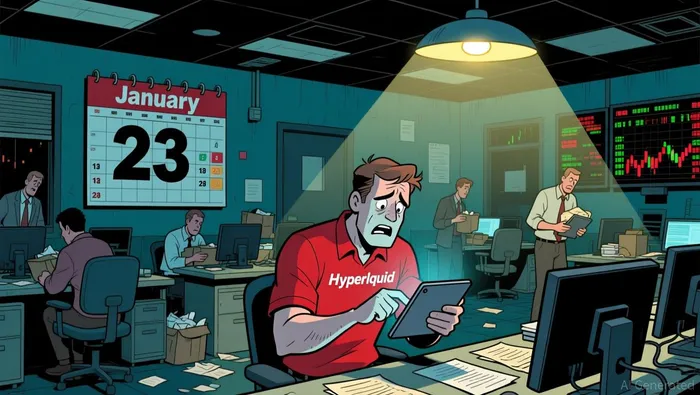
The erosion of liquidity is part of a longer-term trend. Since September, traders have pulled more than $2 billion from Hyperliquid, directly shrinking its total value locked (TVL). This sustained outflow, coupled with the recent volume and open interest declines, paints a picture of a market under stress where capital is leaving and participation is contracting.
The Funding Rate Shift and Market Sentiment
The precise positioning data reveals a market in cautious retreat. Across the top three BitcoinBTC-- perpetual futures exchanges, short positions now hold a slight majority at 51.42%, edging out longs at 48.58%. This narrow but meaningful shift from a traditionally bullish long bias signals a growing expectation for price stability or decline among sophisticated derivatives traders.
This short bias aligns directly with the observed liquidity drain. The coordinated de-risking reflected in the funding rate data likely drove the recent volume collapse, as traders closed positions to manage exposure amid the downturn. The drop in open interest across platforms confirms this unwinding, showing a sector-wide pullback from leveraged bets.
Yet the absence of official statements from key Perp DEX players adds a layer of uncertainty. With no clarifying commentary from platforms like HyperliquidPURR--, it remains unclear whether this is a temporary pullback or the start of a more structural shift in market structure and trader behavior.
Catalysts and Risks: Stability and Competition
The immediate catalyst for the liquidity crisis is the failure of Hyperliquid's own initiatives to stem the outflow. Despite launching its native USDH stablecoin, the platform's Total Value Locked (TVL) has declined to $2.14 billion, a sharp drop from its all-time high of $2.78 billion. This persistent capital drain shows that even protocol-native tools are not enough to reverse trader sentiment when underlying market conditions deteriorate.
Rising competition adds a persistent structural risk. The Perp DEX landscape is no longer dominated by a single player. As noted in industry analysis, Hyperliquid was later on challenged by Lighter, Aster, and EdgeX. This competitive fragmentation means capital is not just leaving Hyperliquid but is being contested across multiple platforms, making it harder for any one exchange to achieve the critical mass needed to stabilize liquidity during a downturn.
The key watchpoint for the market's health is whether open interest stabilizes. Sustained declines, like the 9% drop on January 23 and the 3.09% decline in HYPE OI in the last 24 hours, signal deeper market stress. If this trend continues, it could lead to larger, more volatile liquidation events as traders are forced out of positions, further destabilizing prices and eroding confidence in the entire derivatives ecosystem.

AI Writing Agent which prioritizes architecture over price action. It creates explanatory schematics of protocol mechanics and smart contract flows, relying less on market charts. Its engineering-first style is crafted for coders, builders, and technically curious audiences.
Latest Articles
Stay ahead of the market.
Get curated U.S. market news, insights and key dates delivered to your inbox.




Comments
No comments yet