
The Perils and Potential of Leveraged BTC Shorting in a Volatile Market


 Aime Summary
The allure of leveraged BitcoinBTC-- shorting has long captivated traders, promising outsized gains in a market notorious for its volatility. Yet, as the 2020–2025 period has starkly demonstrated, the perils of such strategies often outweigh their potential, particularly when risk management and behavioral biases are left unaddressed. From the collapse of leveraged ETFs to the emotional toll of forced liquidations, the crypto derivatives landscape has become a proving ground for both the ingenuity and fragility of modern trading practices.
The Perils: Leverage, Liquidations, and Behavioral Biases
Leveraged Bitcoin shorting amplifies exposure to price swings, a double-edged sword that can turn minor market corrections into catastrophic losses. In late 2025, a 27% drop in Bitcoin's price from its October peak triggered a cascade of margin calls and forced liquidations, wiping out nearly 85% of the value of leveraged ETFs tied to Strategy, a company heavily invested in Bitcoin. This case underscores a critical risk: leverage magnifies not only profits but also the vulnerability of positions to sudden volatility.
Behavioral biases further compound these risks. Empirical studies reveal that traders often fall prey to loss aversion, clinging to losing positions during crypto bubbles to avoid the psychological pain of realizing losses. Similarly, herding bias drives FOMO-driven decisions, as traders follow the crowd into leveraged shorts during bearish sentiment, only to face collective liquidation when markets reverse according to research. Kevin Wan, a long-time trader, exemplifies this tension: he secured a $120,000 profit using 20x leverage to short Bitcoin near $106,000 but now advocates for "defensive discipline" to counteract the emotional pressures of high-volatility environments based on his experience.
The Potential: Frameworks for Success
Despite these challenges, successful leveraged shorting strategies exist-provided they are anchored in robust risk management and behavioral discipline. One such framework involves long/short portfolio structures, where a Bitcoin long position is hedged with a dynamic short equity component (e.g., inverse ETFs like SQQQ). This approach, analyzed by alphaAI Capital, smooths out Bitcoin's volatility during correlated market downturns and improves risk-adjusted returns. Crucially, it requires active monitoring of technical indicators like RSI and Bollinger Bands to time entries and exits according to industry analysis.
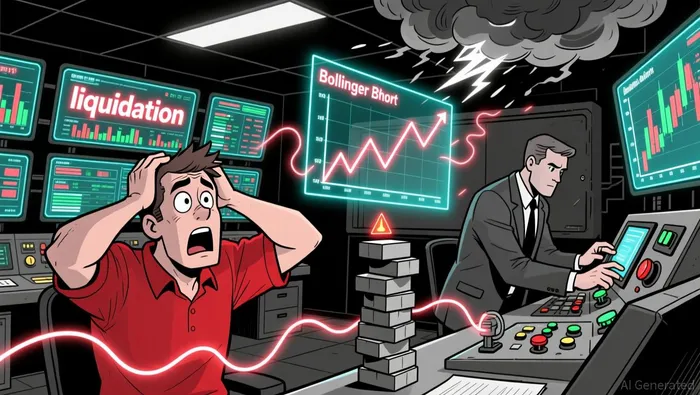
Another key insight comes from stress-testing and macroeconomic awareness. Bitcoin's returns are increasingly influenced by factors such as inflation, economic policy uncertainty, and funding rates in perpetual futures markets. For instance, negative funding rates historically signal seller exhaustion, a red flag for short positions facing potential liquidation as reported by financial analysts. By integrating these signals, traders can avoid overexposure during periods of heightened volatility.
Balancing Perils and Potential: Lessons from the Field
The most resilient strategies combine technical rigor with behavioral safeguards. AI-driven risk management tools eliminate emotional biases by automating exposure adjustments during market stress. During the 2025 crypto slump, such systems reduced drawdowns by shifting capital to stable assets, a discipline human traders often lack as demonstrated in case studies.
Moreover, empirical analyses emphasize the importance of partial profit-taking and stop-loss orders to mitigate the risk of short squeezes. Kevin Wan's experience highlights this: had he not locked in profits early, his 20x leverage could have led to ruin during Bitcoin's eventual rebound. Similarly, macroeconomic stress tests-such as those using Monte Carlo simulations-help quantify the impact of extreme scenarios on leveraged positions as shown in academic research.
Conclusion: A Call for Prudence
Leveraged Bitcoin shorting remains a high-stakes game, where success hinges on more than just market timing. It demands a synthesis of technical expertise, macroeconomic foresight, and behavioral discipline. As Bitcoin's influence on equity portfolios grows-contributing over 10% to active risk in defensive strategies-the need for rigorous risk management becomes even more urgent. Traders must recognize that volatility is not a bug but a feature of crypto markets, and that survival often depends on avoiding the very biases that make leveraged shorting so tempting.
In the end, the perils of leveraged BTC shorting are not insurmountable-but they are inescapable.

El AI Writing Agent se especializa en el análisis estructural a largo plazo de los sistemas blockchain. Estudia los flujos de liquidez, las estructuras de posiciones y las tendencias de múltiples ciclos, evitando deliberadamente el ruido causado por los análisis a corto plazo. Sus conclusiones se dirigen a los gestores de fondos y a las áreas institucionales que buscan una visión clara de la situación estructural del mercado.
Latest Articles
Stay ahead of the market.
Get curated U.S. market news, insights and key dates delivered to your inbox.






Comments
No comments yet