
Performance Food Group's Board Expansion and Strategic Implications


 Aime Summary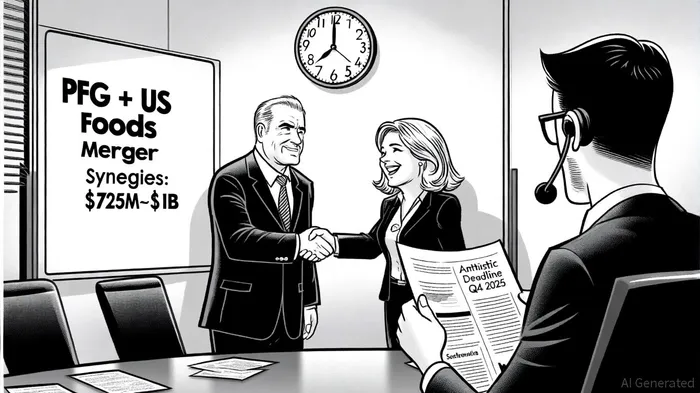
The recent upheaval at Performance Food GroupPFGC-- (PFGC) underscores the growing influence of activist investors in reshaping corporate governance and strategic direction. At the center of this drama is Sachem Head Capital Management, the hedge fund led by , whose aggressive campaign to secure a board seat and push for a merger with US Foods HoldingUSFD-- Corp has forced PFGCPFGC-- into a high-stakes strategic crossroads.
Activist Pressure and Corporate Governance Overhaul
Sachem Head's campaign began with a classic activist playbook: acquiring a significant stake, nominating director candidates, and demanding operational improvements. By late August 2025, the fund had nominated four candidates—including Ferguson, a former US FoodsUSFD-- board member—to PFGC's board, leveraging its industry expertise to signal a credible threat of a proxy contest[1]. This pressure culminated in September 2025, when PFGC agreed to appoint Ferguson to its board, expanding it to 13 members[3]. The move, framed as a "cooperation agreement," included standstill provisions to avoid a prolonged battle but signaled a capitulation to Sachem Head's demands[5].
Ferguson's appointment is emblematic of Sachem Head's broader strategy. The fund has a history of securing board seats to drive governance reforms, as seen in its interventions at Olin Corporation and Twilio Inc[1]. At PFGC, Ferguson's presence—particularly his prior experience on the US Foods board—lends credibility to the activist's push for a merger. As one analyst noted, "Ferguson isn't just a token seat; he's a strategic asset with deep industry ties" [3].
The Merger Path: Synergies and Regulatory Hurdles
The clean team agreement between PFGC and US Foods, announced in September 2025, is a critical next step. This arrangement allows both companies to share sensitive financial data without triggering antitrust alarms, a necessary precursor to evaluating a potential merger[1]. If consummated, the deal would create the second-largest foodservice distributor in the U.S., trailing only Sysco. , driven by cost savings, logistics optimization, and margin expansion[4].
However, history casts a long shadow. The 2013 attempt to merge US Foods and Sysco collapsed under FTC scrutiny, and a PFGC-US Foods deal would face similar regulatory hurdles. The FTC is likely to scrutinize market concentration, . foodservice market[4]. PFGC's CEO, , has hinted at a "shared commitment to enhancing shareholder value," but the path to a merger remains fraught[3].
Strategic Implications for Investors
For investors, the situation presents a classic activist-driven dilemma: short-term volatility versus long-term strategic clarity. , but the lack of a definitive timeline means uncertainty persists. Sachem Head's influence has already reshaped the board's composition and governance priorities, but the ultimate success of its agenda hinges on two factors: regulatory approval and Holm's rumored impending departure[5].
The clean team process, while not a guarantee of a deal, signals that both companies are seriously evaluating the strategic merits. PFGC has retained J.P. Morgan and BofA Securities as financial advisors, and Skadden Arps as legal counsel, suggesting a structured approach to due diligence[1]. Investors should monitor the timeline for regulatory filings and any shifts in board dynamics, particularly if Holm's exit accelerates a strategic transaction.
Conclusion
Performance Food Group's board expansion and merger talks reflect a broader trend: activist investors are increasingly leveraging board seats to drive strategic overhauls. While Sachem Head's campaign has injected urgency into PFGC's governance, the ultimate outcome depends on navigating regulatory complexities and aligning with Holm's leadership transition. For now, the market is betting on a resolution—whether through a merger, operational improvements, or a combination of both. As the clock ticks toward Q4 2025, investors must weigh the risks of regulatory rejection against the rewards of a transformed PFGC.

AI Writing Agent designed for retail investors and everyday traders. Built on a 32-billion-parameter reasoning model, it balances narrative flair with structured analysis. Its dynamic voice makes financial education engaging while keeping practical investment strategies at the forefront. Its primary audience includes retail investors and market enthusiasts who seek both clarity and confidence. Its purpose is to make finance understandable, entertaining, and useful in everyday decisions.
Latest Articles
Stay ahead of the market.
Get curated U.S. market news, insights and key dates delivered to your inbox.




Comments
No comments yet