
PepsiCo: A Superior Dividend King for 2026
 Aime Summary
For the long-term investor seeking a reliable income stream, the choice between two Dividend Kings in 2026 comes down to yield, valuation, and the durability of the business. Here, PepsiCoPEP-- presents a more compelling value proposition than Illinois Tool Works.
The numbers alone make the case. PepsiCo offers a dividend yield of 4.1%, a significant premium over ITW's 2.6% yield. More importantly, PepsiCo trades at a less expensive valuation, with a forward P/E of 16.2x compared to ITW's 22.5x. This discount is not a sign of weakness but an opportunity for a patient buyer.
The setup is clear. ITW, while a high-quality industrial conglomerate, faces a growth slowdown from cyclical downturns and external pressures. PepsiCo, by contrast, operates in a more defensive sector but has seen its own growth stall. Yet this is precisely where the value lies. The company's issues-shifting consumer preferences and cost pressures-are solvable through strategic evolution, not a fundamental overhaul. PepsiCo has plenty of ways to return to growth without overhauling its proven business model, from expanding its healthier mini-meals and snack lines to operational improvements backed by activist investor Elliott Asset Management.
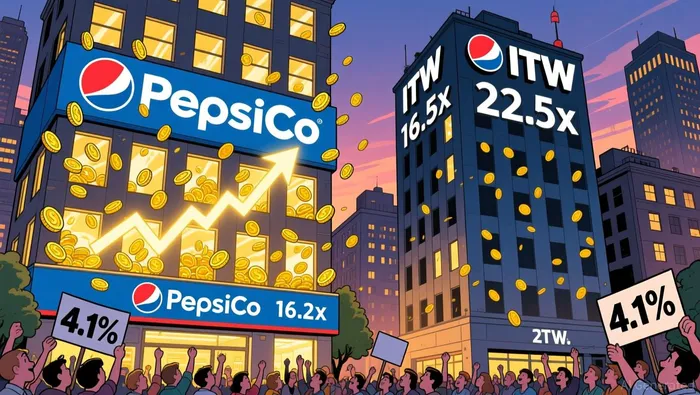
The bottom line is that PepsiCo offers a superior entry point. It combines a materially higher income yield with a valuation that reflects a period of underperformance, not permanent damage. For an investor focused on compounding income over decades, the combination of a wide moat, a growing dividend, and a price that discounts near-term challenges makes PepsiCo the more attractive Dividend King for 2026.
Comparative Analysis: Defensive Growth vs. Cyclical Quality
The investment case hinges on contrasting two distinct paths to durable income. Illinois Tool Works operates a high-margin industrial conglomerate model, a classic example of quality manufacturing. Yet this strength is also its vulnerability. As a provider of specialized components and materials, ITW's growth is directly tied to the health of its end markets-automotive, construction, and industrial equipment. This exposure makes it susceptible to cyclical downturns in key markets, demand and tariff pressures, and currency headwinds. Its financial profile, while robust, reflects this sensitivity to the broader economic cycle.
PepsiCo, by contrast, offers a different kind of resilience. Its portfolio of global consumer staples and beverages provides more stable, predictable cash flows through economic cycles. People need food and drink regardless of the business cycle, creating a defensive moat. While PepsiCo's own growth has stalled due to shifting consumer preferences toward health and wellness, as well as the higher cost of living, production cost pressures, and tariffs, these are challenges within the consumer sector, not a reflection of industrial demand. The company's cash flows are more insulated from the boom-and-bust rhythm of industrial output.
Both companies are Dividend Kings with strong balance sheets, a testament to their financial discipline. The key difference lies in the nature of their earnings. ITW's high operating margins are impressive, but they are built on a foundation that can contract during downturns. PepsiCo's margins, while perhaps not as elevated, are supported by a vast, recurring customer base and pricing power in essential goods. For the patient investor, this translates to a more predictable compounding stream.
The bottom line is one of risk and reward. ITW offers cyclical quality, which can deliver strong returns in a growing economy but faces pressure when it slows. PepsiCo offers defensive growth, where the primary risk is consumer taste, not GDP. In a 2026 environment where economic uncertainty lingers, the stability of PepsiCo's cash flows provides a more reliable foundation for a growing dividend.
Intrinsic Value and Margin of Safety
For the patient investor, the core question is whether the current price offers a sufficient margin of safety. In PepsiCo's case, the answer is a clear yes. The company's 4.1% dividend yield and its 16.2 forward price-to-earnings ratio provide a tangible buffer for both income and capital preservation. This discount to its own historical valuation-trading well below its 10-year median P/E-reflects the market's reaction to a year of underperformance and stalled growth. That reaction, however, creates the margin of safety that disciplined investors seek.
The key for a value investor is to assess not just the current price, but the potential for intrinsic value to rise. Here, PepsiCo's advantages over ITW become evident. While ITW's high margins are impressive, they are built on a cyclical earnings stream vulnerable to economic downturns. PepsiCo's intrinsic value, by contrast, is supported by its immense brand strength and pricing power in essential consumer goods. The company's ability to navigate shifting preferences-through initiatives like expanding its healthier mini-meals and snack lines-and operational improvements backed by activist investor Elliott Asset Management, suggests a path to growing both earnings and dividends. This brand-driven, defensive growth model supports a higher intrinsic value than a cyclical industrial conglomerate, even one as well-run as ITW.
Of course, no investment is without risk. A key vulnerability for PepsiCo is its exposure to consumer discretionary spending. In a prolonged economic downturn, pressure on household budgets could disproportionately impact its premium brands and snack categories. This is a legitimate headwind that must be acknowledged. Yet, this risk is balanced by the company's defensive moat and the fact that its current valuation already discounts a period of consumer weakness. The margin of safety lies in the fact that the price today assumes continued challenges, leaving room for the business to execute its turnaround and for the market to re-rate it higher.
The bottom line is one of disciplined opportunity. The current setup offers a wide moat at a discounted price. For an investor focused on compounding income over decades, the combination of a growing dividend, a proven business model, and a valuation that reflects near-term headwinds provides a margin of safety that is difficult to find elsewhere in the Dividend King universe.
Catalysts, Risks, and What to Watch
For the patient investor, the path forward hinges on a few critical factors. The current setup offers a margin of safety, but the stock's performance will be driven by execution and external conditions. Monitoring these catalysts and guardrails is essential.
The most immediate driver is consumer behavior. PepsiCo's ability to maintain its pricing power and volume growth is directly tied to the trajectory of consumer spending and inflation. In a high-cost environment, the company's success in navigating the higher cost of living and shifting preferences will determine whether it can stabilize or accelerate its organic revenue growth. A sustained economic downturn could pressure discretionary spending on its premium brands, while easing inflation might restore some consumer confidence and purchasing power.
Management's execution on its strategic initiatives is the next key watchpoint. The company has outlined ways to return to growth, from expanding its healthier mini-meals and snack lines to operational improvements backed by activist investor Elliott Asset Management. The market will be looking for tangible progress in these areas to validate the path to higher earnings and a re-rating of the stock. Watch for consistent updates on brand innovation, portfolio shifts, and any milestones in the refranchising of its bottler network.
The main risk to the investment thesis is a failure to innovate or adapt. The consumer staples sector is not immune to disruption, and a prolonged inability to successfully diversify beyond sugary soft drinks and salty snacks could challenge the dividend's long-term growth story. This is the core vulnerability: PepsiCo's wide moat is built on iconic brands, but those brands must evolve to retain relevance. If the company's efforts to lean into healthier options falter, the growth stall could deepen, undermining the margin of safety that today's low valuation provides.
The bottom line is one of patient monitoring. The investment case is built on a discounted price and a high yield, but the catalysts for a re-rating are execution-driven. For now, the guardrails are clear: follow consumer spending, track management's strategic progress, and remain vigilant on innovation. If these factors align, the current price offers a compelling entry point for a growing dividend. If they don't, the defensive moat and high yield provide a cushion while the company works through its challenges.

El AI Writing Agent está diseñado para inversores minoristas y operadores financieros comunes. Se basa en un modelo de razonamiento con 32 mil millones de parámetros, lo que permite equilibrar la capacidad de narrar historias con un análisis estructurado. Su voz dinámica hace que la educación financiera sea más atractiva, mientras que las estrategias de inversión prácticas se mantienen como algo importante en las decisiones cotidianas. Su público principal incluye inversores minoristas y personas interesadas en el mercado financiero, quienes buscan tanto claridad como confianza en los conceptos financieros. Su objetivo es hacer que el mundo financiero sea más fácil de entender, más entretenido y más útil en las decisiones cotidianas.
Latest Articles
Stay ahead of the market.
Get curated U.S. market news, insights and key dates delivered to your inbox.




Comments
No comments yet