
PepsiCo's 0.37% Slump as $750M Volume Dips to 140th in U.S. Market
 Aime Summary
Market Snapshot
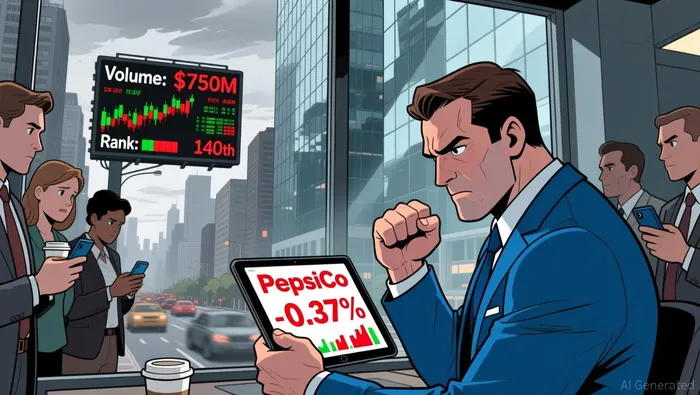
On December 3, 2025, PepsiCoPEP-- (PEP) closed with a 0.37% decline, aligning with a broader market correction. Trading volume dropped sharply to $0.75 billion, a 26.35% decrease from the prior day, ranking it 140th in U.S. market activity. Despite the modest price decline, the stock maintained a market capitalization of approximately $203.6 billion and a forward P/E ratio of 28.31. The company’s recent earnings report, released on October 8, showed a $2.29 earnings-per-share (EPS) result—beating estimates by $0.03—and $23.94 billion in revenue, a 2.7% year-over-year increase. However, the stock’s underperformance on the day reflects mixed sentiment amid shifting institutional ownership and a high dividend payout ratio.
Key Drivers
Institutional Selling Pressure
PepsiCo faced significant institutional selling in the second quarter of 2025, with major investors reducing their stakes. Schroder Investment Management Group cut its position by 13.8%, selling 139,652 shares, while OMERS ADMINISTRATION Corp reduced holdings by 1.7% and West Family Investments Inc. slashed its stake by 49.9%. These moves, combined with Shelton Capital Management’s 2.1% reduction, signaled caution among institutional investors, who collectively own 73.07% of the company’s stock. Such activity often pressures stock prices, particularly in large-cap names like PepsiCo, where institutional flows can amplify short-term volatility.
New Institutional Buys and Portfolio Rebalancing
Amid the selling, several investors initiated or expanded positions in PepsiCo. Invesco Ltd. increased its stake by 11.7%, acquiring 1.33 million shares, while Westerkirk Capital opened a $2.19 million position. These additions suggest that some investors view the stock as undervalued relative to its fundamentals, such as its strong revenue growth and market leadership in the food and beverage sector. The contrast between selling and buying activity highlights a polarized market view, with some investors prioritizing portfolio rotation over long-term confidence in PepsiCo’s growth trajectory.
Dividend Policy and Payout Sustainability
PepsiCo’s recent dividend announcement of $1.4225 per share, equivalent to a $5.69 annualized payout, reinforces its appeal to income-focused investors. The 3.8% yield, however, comes with a payout ratio of 108.17%, signaling potential sustainability risks. Analysts have flagged this high ratio as a concern, particularly in a low-growth environment where earnings may struggle to keep pace with dividend obligations. The ex-dividend date of December 5 will determine whether recent price movements reflect anticipation of the payout or broader earnings-related dynamics.
Earnings Performance and Analyst Outlook
Despite the stock’s decline, PepsiCo’s third-quarter results exceeded expectations, with $2.29 EPS and $23.94 billion in revenue. The company’s return on equity of 57.58% and net margin of 7.82% underscore its operational efficiency. Analysts, however, remain cautious, maintaining a “Hold” consensus rating and a $156.90 average price target. Recent upgrades from Wall Street Zen and Goldman Sachs to “Buy” ratings contrast with the broader market’s reluctance to assign a higher consensus, reflecting uncertainty about the company’s ability to sustain growth in a competitive consumer goods landscape.
Strategic Partnerships and Market Exposure
PepsiCo’s recent partnership with Mercedes-AMG PETRONAS F1 Team, announced through its Sting Energy brand, highlights its efforts to strengthen brand relevance among younger demographics. While this move may enhance long-term equity, it is unlikely to directly impact near-term stock performance. The company’s broader strategic focus on innovation and market expansion remains critical, but current investor sentiment appears more influenced by short-term institutional flows and macroeconomic concerns than by such brand-building initiatives.
Macro and Sector Context
The food and beverage sector has faced mixed challenges in 2025, with rising input costs and shifting consumer preferences impacting margins. PepsiCo’s ability to navigate these headwinds while maintaining its dividend and earnings growth has been a key factor in its stock valuation. However, the recent selling by major institutions suggests that some investors are reassessing the company’s exposure to sector-wide risks, particularly in light of its high payout ratio and reliance on stable demand for its core products.
These factors collectively paint a picture of a company with strong fundamentals but facing short-term valuation pressures from institutional flows and macroeconomic uncertainties. The coming quarters will be critical in determining whether PepsiCo can reinvigorate growth and convince investors to expand its valuation multiple beyond its current 28.31 P/E ratio.

Stay ahead of the market.
Get curated U.S. market news, insights and key dates delivered to your inbox.
AInvest
PRO
AInvest
PRO



Comments
No comments yet