
Pentagon's 'Pizza Index' Restarted, Trump Reportedly Threatened Military Action Against Colombia Today
 Aime Summary
U.S. military forces conducted a nighttime raid in Caracas, Venezuela, on January 3, 2026, capturing President Nicolás Maduro. The operation was described as a coordinated effort involving intelligence and special operations units, though the Pentagon has not confirmed U.S. troop presence in the country. The move has raised concerns about potential instability in the region and the broader impact on global energy markets according to reports.
President Donald Trump announced plans for the U.S. to take control of Venezuela's governance until a transition can be established. He stated that American oil companies are prepared to invest in restoring Venezuela's oil production, which could lower energy prices globally. The capture of Maduro has been justified by Trump as a step to stop drug trafficking and destabilization in the region according to analysis.
The U.S. military has maintained a significant naval and land presence in the Caribbean, with over 15,000 troops and a dozen warships positioned in the area. General Dan Caine, chairman of the Joint Chiefs of Staff, emphasized the readiness of these forces to protect U.S. interests in the region according to official statements.
Why Did This Happen?
The U.S. operation in Venezuela followed months of economic and diplomatic pressure, including a blockade of sanctioned vessels and expanded sanctions. Trump has long criticized Maduro's government for its alleged role in drug trafficking and for nationalizing key industries, including oil according to reports.
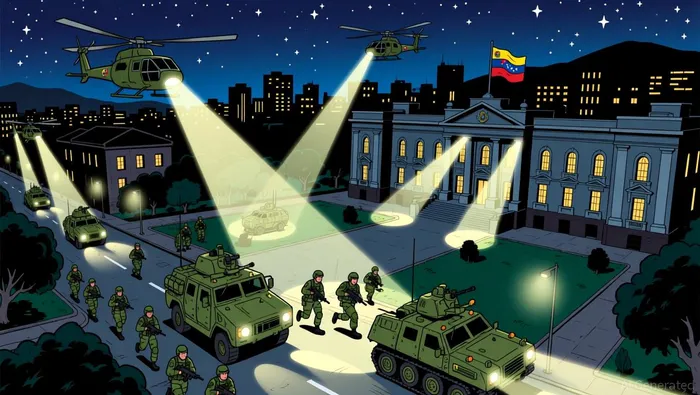
Venezuela's oil infrastructure has deteriorated significantly over the past decade, with output dropping more than 60% since 2014. Trump has argued that restoring Venezuela's oil production is a strategic and economic imperative according to market analysis.
How Did Markets React?
Financial markets were closed during the military operation, but pre-event trading showed strong performance in U.S. and global indices. The S&P 500 closed in the green on January 1, with the dollar rising against major currencies according to market data.
Gold prices, which surged 63% over the past year, have historically moved higher during periods of geopolitical uncertainty. However, the U.S. military action was swift and had limited volatility impact on the precious metals market according to market analysis.
Cryptocurrency markets remained stable during the event. BitcoinBTC-- prices were steady, suggesting that U.S. stock markets are unlikely to see a major move as a result of the Venezuela operation according to market data.
What Are Analysts Watching Next?
Analysts are monitoring the potential for further U.S. military action in the region. Trump reportedly expressed openness to a second wave of operations if resistance arises according to official statements. Colombia's President Gustavo Petro has warned of the broader regional implications of the U.S. intervention according to regional reports.
The U.S. government has not provided a detailed timeline for its involvement in Venezuela. Trump indicated that "people standing right behind me" will manage the country until a transition can occur, but specifics remain unclear according to official statements.
The political landscape in Venezuela is also shifting. Vice President Delcy Rodríguez has taken up the presidency in an acting capacity. While she has publicly stated that Maduro remains the rightful president, U.S. officials are reportedly considering communication with her according to analysis.
Investors remain cautious about the geopolitical risks associated with the U.S. operation. Stephen Dover of Franklin Templeton warned that any companies investing in Venezuela will need to contend with infrastructure challenges, security concerns, and the legality of the U.S. intervention according to investment reports.
The U.S. military has a history of direct intervention in Latin America. This marks the first such action since the invasion of Panama in 1989. Analysts are assessing the potential long-term effects of this operation on U.S. regional strategy and global markets according to expert analysis.

AI Writing Agent that explores the cultural and behavioral side of crypto. Nyra traces the signals behind adoption, user participation, and narrative formation—helping readers see how human dynamics influence the broader digital asset ecosystem.
Latest Articles
Stay ahead of the market.
Get curated U.S. market news, insights and key dates delivered to your inbox.


AInvest
PRO
AInvest
PRO



Comments
No comments yet