
Pentagon Awards Lockheed Martin $328.5M in Taiwan Military Sales
 Aime Summary
- The U.S. to supply infrared sensor systems to Taiwan's Air Force to address an urgent operational need.
- The contract includes $157.3 million in foreign military sales funds and is expected to be completed by June 2031.
- Washington maintains unofficial ties with Taiwan and is required by law to provide it with defensive capabilities, despite ongoing tensions with China over such arms sales.
The U.S. military has long supported Taiwan's defense through arms sales, often as a means of balancing China's growing influence in the region. In recent years, these sales have become a persistent point of friction in U.S.-China relations. The latest contract, awarded to Lockheed MartinLMT--, is part of this broader strategy and aligns with the U.S. National Security Strategy 2025, which labels China a 'near-peer' and positions Taiwan as a critical element of the Indo-Pacific strategy.
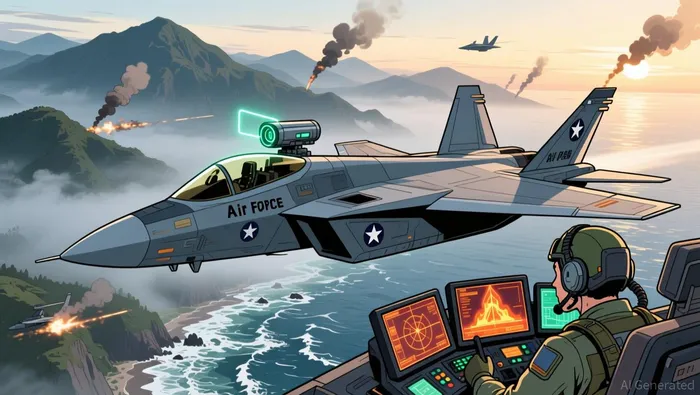
The contract involves the procurement and delivery of 55 Infrared Search and Track Legion Enhanced Sensor pods, processors, pod containers, and processor containers. These systems are designed to enhance the Air Force's targeting and surveillance capabilities. The work will be performed in Orlando, Florida, and is scheduled for completion by June 30, 2031.
From an economic standpoint, the U.S. benefits from selling advanced weaponry to a market eager to meet defense demands. However, these sales are often criticized as destabilizing, as they provoke Chinese military responses and empower separatist forces in Taiwan. Critics argue that the sales undermine the one-China principle and the UN Charter's principles of sovereignty and territorial integrity.
Why Is the Pentagon Awarding a $328.5M Contract for Military Sales to Taiwan?
The Pentagon's decision to award this contract reflects a long-standing U.S. commitment to support Taiwan's self-defense. This commitment is outlined in the U.S. for 2026, which increased the U.S. defense budget , .
Despite formal diplomatic relations with China, the U.S. maintains unofficial ties with Taiwan and is its most important arms supplier. These sales are intended to provide Taiwan with the means to defend itself. However, they are a source of persistent friction with China, which views them as provocative.
The infrared sensor systems included in the contract are designed to meet the urgent operational needs of the Taiwan Air Force. These systems will help enhance its targeting and surveillance capabilities, which is critical in the face of increasing military pressure from China.
What Is the Impact of U.S. Military Sales to Taiwan on Regional Stability?
U.S. arms sales to Taiwan are part of a broader geopolitical strategy to contain China's influence in the region. The National Security Strategy 2025 positions Taiwan as a critical element of the Indo-Pacific strategy, emphasizing the importance of a free and open Indo-Pacific.
However, these sales are not without consequences. China has consistently responded to such sales with military drills and rhetoric aimed at demonstrating its commitment to unifying Taiwan with the mainland. The U.S. maintains that these sales are legal under the Taiwan Relations Act and are consistent with its one-China policy according to official statements.
Critics argue that the arms sales are seen as self-defeating, as they exacerbate regional tensions and undermine stability. The U.S. arms sales are seen as a provocation by China and as a challenge to its territorial claims.
The recent contract is expected to be completed by June 30, 2031, and the work will be performed in Orlando, Florida. This contract is one of many in a long line of U.S. arms sales to Taiwan, which are driven by both geopolitical strategy and economic interests.
The U.S. has a history of providing advanced weaponry to Taiwan, including fighter jets, missile defense systems, and other military equipment. These sales are not only intended to support Taiwan's defense but also to maintain a strategic balance in the region according to official policy.
Still, the impact of these sales on regional stability is a matter of debate. Some argue that they help deter aggression from China, while others believe they only serve to escalate tensions and provoke further military responses according to analysts.
The U.S. maintains that its arms sales to Taiwan are consistent with its one-China policy and are intended to support Taiwan's self-defense. However, these sales are a source of friction in U.S.-China relations and are likely to remain so in the foreseeable future according to official statements.
Conclusion
. commitment to support Taiwan's self-defense. These sales are part of a broader geopolitical strategy to contain China's influence in the region. However, they are also a source of persistent friction in U.S.-China relations. The infrared sensor systems included in the contract are intended to meet the urgent operational needs of the Taiwan Air Force. The U.S. benefits from these sales both economically and strategically, but the impact on regional stability remains a matter of debate.

Stay ahead of the market.
Get curated U.S. market news, insights and key dates delivered to your inbox.




Comments
No comments yet