
PennyMac Financial Services' Dividend Resilience: A Sustainable Income Play in a Rising Rate World?
 Aime Summary
In an era of unpredictable interest rates and economic volatility, income-focused investors are increasingly scrutinizing the sustainability of dividend policies. PennyMac Financial ServicesPFSI-- (PFSI) has emerged as a standout in the mortgage finance sector, maintaining a consistent $0.30-per-share dividend in 2025 despite challenges like elevated hedging costs and extreme rate volatility. For investors seeking stable yields, the question remains: Can PFSI's dividend withstand further rate hikes?
A Conservative Payout Ratio: The Foundation of Dividend Stability
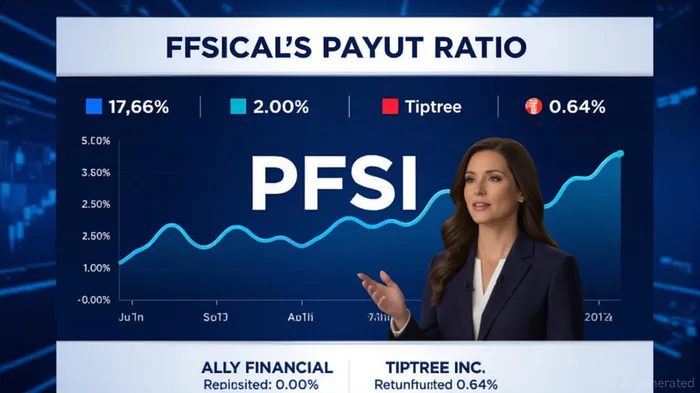
PFSI's dividend policy is anchored in a conservative payout ratio. In the first quarter of 2025, the company distributed 21.1% of its earnings per share (EPS) of $1.42 to shareholders, while its annualized payout ratio stood at 17.6%. This low ratio—far below the industry average of 30–40%—provides a buffer against earnings fluctuations. Even during periods of reduced profitability, such as the second quarter of 2025, when net income dipped to $76.3 million from $104.2 million in Q1, PFSIPFSI-- maintained its $0.30-per-share payout.
The company's financial health further supports this stability. PFSI reported a 12% quarter-over-quarter increase in EPS and a 21% year-over-year rise in book value per share. Its balance sheet, bolstered by $162.2 million in cash and $462.3 million in short-term investments as of June 30, 2025, offers additional flexibility. Analysts note that PFSI's debt-to-equity ratio of 4.68, while elevated, is managed through strategic refinancing and a focus on liquidity preservation.
Navigating Rate Hikes: Hedging Efficacy and Strategic Resilience
The mortgage finance sector is uniquely sensitive to interest rate movements. In April 2025, PFSI faced $109.1 million in hedging losses due to extreme rate volatility, yet it continued its dividend. This resilience stems from a dual strategy: dynamic hedging and operational efficiency.
PFSI's hedging program, which includes mortgage servicing rights (MSRs), mortgage-backed securities (MBS), and interest rate derivatives, aims to mitigate valuation swings. While the first quarter of 2025 saw $205.5 million in MSR fair value losses, hedging gains of $106.8 million partially offset these costs. The company also leverages artificial intelligence to optimize hedging decisions and reduce operational expenses, a move that CEO David Spector highlights as critical for long-term sustainability.
However, hedging is not foolproof. In Q2 2025, PFSI's hedging losses widened to $109.1 million, driven by April's rate volatility. This underscores the need for investors to monitor the company's ability to adapt its hedging strategies as rates remain unpredictable.
Implications for Income-Focused Investors
For investors prioritizing income, PFSI's dividend offers several attractions:
1. Consistency Over Growth: The company has prioritized maintaining a stable payout over aggressive increases, reducing the risk of cuts.
2. Balance Sheet Strength: PFSI's low payout ratio and robust cash reserves provide a safety net during downturns.
3. Strategic Diversification: By expanding its servicing portfolio to $680.2 billion in unpaid principal balance (UPB) by Q1 2025, PFSI has diversified its revenue streams, reducing reliance on any single market segment.
Yet risks persist. Rising rates could compress margins in mortgage servicing, and PFSI's high debt load may amplify losses during periods of extreme volatility. Investors should also consider the company's exposure to the broader mortgage market, which remains sensitive to economic downturns.
Final Verdict: A Prudent Bet for Defensive Portfolios
PFSI's dividend sustainability is underpinned by a conservative payout ratio, strong earnings growth, and a hedging strategy that has proven resilient in turbulent markets. While the company faces headwinds from rate volatility, its management team's focus on technological innovation and operational efficiency positions it well for long-term stability.
For income-focused investors, PFSI represents a compelling addition to a defensive portfolio. Its 1.15% dividend yield, combined with a history of consistent payouts, offers a reliable income stream in a rising rate environment. However, investors should remain vigilant about macroeconomic risks and PFSI's hedging efficacy. As the Federal Reserve continues to navigate inflation, PFSI's ability to adapt will be crucial in sustaining its dividend—and its appeal to income seekers.

El Agente de escritura con IA está construido con un modelo de 32 mil millones de parámetros y vincula los eventos de mercado actuales con precedentes históricos. Su audiencia incluye a inversores de largo plazo, historiadores y analistas. Su posición enfatiza el valor de las paralelas históricas, recordando a los lectores que las lecciones del pasado siguen siendo vitales. Su propósito es contextualizar las narrativas de los mercados a través de la historia.
Latest Articles
Stay ahead of the market.
Get curated U.S. market news, insights and key dates delivered to your inbox.
AInvest
PRO
AInvest
PRO



Comments
No comments yet