
The PENGU USDT Sell Signal: A Major Shift in Stablecoin Dynamics?


 Aime Summary
Market Impact and Liquidity Pressures
The PENGU-USDT sell signal emerged amid a confluence of factors: speculative volatility, regulatory uncertainty, and a broader flight to quality in stablecoin markets. On-chain metrics revealed a 33% surge in trading volume to $202 million, yet this was offset by a 28.5% post-Pudgy Party price drop, exposing the token's sensitivity to market sentiment and USDT-linked risks. Liquidity metrics further compounded concerns, with retail traders adding $157,000 in PENGUPENGU-- while large holders accumulated $273,000, contrasting sharply with the project team's $66.6 million outflows. This divergence created a fragile equilibrium, amplifying fears of a liquidity spiral.
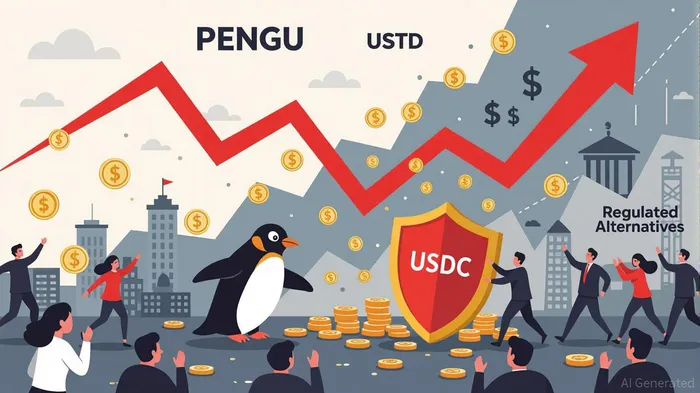
The event also reflected a broader trend of capital reallocation. USDTUSDT--, which dominated 82.5% of centralized exchange volume in late 2025, saw its decentralized exchange (DEX) share decline as investors shifted toward compliant stablecoins like USDC according to market reports. AI-driven tools such as Bluwhale's Stablecoin Agent further accelerated this shift, enabling cautious investors to convert PENGU into USDT as a risk mitigation strategy. These dynamics mirror the post-UST and post-USDC depegging patterns, where liquidity fragmentation and redemption trends exposed systemic weaknesses in stablecoin infrastructure.
Regulatory and Systemic Risk Implications
The PENGU-USDT crisis coincided with a regulatory inflection point. The U.S. GENIUS Act, enacted in 2025, mandated 100% reserve backing for stablecoins and stricter transparency requirements, directly targeting the opacity that contributed to the PENGU-USDT liquidity crunch. Similarly, the EU's MiCA framework reinforced passporting rights for crypto service providers and operational disclosure mandates, further marginalizing unregulated stablecoin models. These policies accelerated the adoption of alternatives like gold-backed USDKG and algorithmically managed stablecoins, reshaping investor preferences according to market analysis.
Systemic risk indicators also worsened during the PENGU-USDT event. A $66.6 million team wallet withdrawal eroded trust in PENGU's reserves, while three major stablecoins lost their pegs within a week, signaling contagion risks in DeFi ecosystems. Historical parallels to the TerraLUNA-- UST collapse and the SVB-triggered USDC depeg highlight the interconnectedness of stablecoin markets. For instance, the UST crisis demonstrated how algorithmic mechanisms could fail under liquidity stress, while the USDC depeg revealed institutional vulnerabilities in redemption processes according to market analysis. The PENGU-USDT case, though distinct in its speculative underpinnings, reinforces the need for robust governance and reserve transparency across stablecoin protocols.
Liquidity Metrics and Capital Flight
Post-November 2025, liquidity metrics for PENGU-USDT and major stablecoins revealed a stark reallocation of capital. Stablecoin flows declined by $840 million since November 15, with order-book depth shrinking and bid-ask spreads widening. This aligns with broader crypto risk aversion, as U.S. spot BitcoinBTC-- ETF outflows and declining stablecoin supply signaled a retreat from speculative assets. Meanwhile, the Federal Reserve's policy adjustments-such as tightening liquidity conditions-exacerbated market stress, making stablecoins with verifiable reserves more attractive.
The PENGU-USDT depegging also exposed weaknesses in on-chain analytics. While tools like On-Balance Volume (OBV) and MACD suggested rising buying interest, conflicting inflows and outflows obscured the true liquidity picture. This opacity contrasts with regulated stablecoins, which now face mandatory reserve audits and real-time redemption tracking under frameworks like MiCA according to regulatory updates. As a result, investors are increasingly prioritizing stablecoins with transparent collateralization, further marginalizing opaque models like PENGU-USDT.
Conclusion: A New Era for Stablecoin Risk Management
The PENGU-USDT sell signal of November 2025 represents more than a market correction-it is a harbinger of structural shifts in stablecoin dynamics. Regulatory interventions, liquidity fragmentation, and investor risk aversion are converging to redefine the stablecoin landscape. While PENGU's volatility stems from speculative NFT-driven models, the broader lesson is clear: stablecoins must align with transparency and reserve requirements to avoid systemic risks.
For investors, the takeaway is twofold. First, capital is increasingly flowing to stablecoins with auditable reserves and regulatory compliance, such as USDC and USDKG. Second, liquidity metrics-particularly redemption rates and order-book depth-will become critical indicators of stablecoin health. As the market matures, the PENGU-USDT event serves as a stark reminder that even the most dominant stablecoins are not immune to systemic shocks, and prudence remains paramount in an era of heightened regulatory scrutiny.

La combinación de la sabiduría tradicional en el comercio con las perspectivas más avanzadas sobre las criptomonedas.
Latest Articles
Stay ahead of the market.
Get curated U.S. market news, insights and key dates delivered to your inbox.






Comments
No comments yet