
The PENGU USDT Sell Signal: A Critical Inflection Point in Stablecoin Dynamics?


 Aime Summary
The Anatomy of the PENGU USDT Sell Signal
The PENGU/USDT sell signal, first flagged in late 2025, exposed glaring flaws in the collateral oversight and smart contract security of algorithmic stablecoins. Unlike fiat-backed stablecoins such as USDCUSDC--, PENGU's reliance on opaque redemption mechanisms and algorithmic price stabilization created a feedback loop of reflexivity. 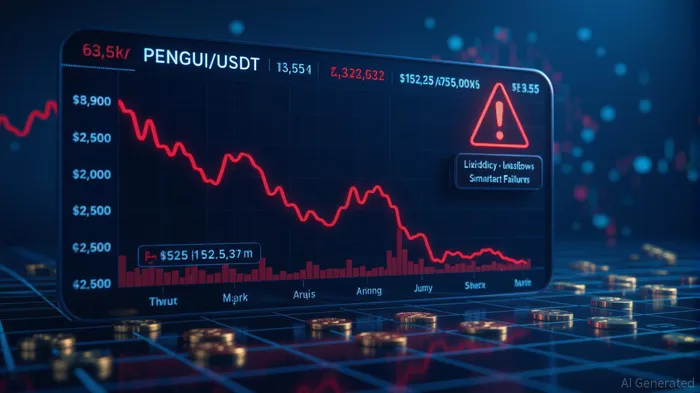 As traders began redeeming PENGU for USDT, the protocol's ability to maintain parity collapsed, triggering a cascade of liquidations. This mirrors the 2023 UST-USTC crisis, where algorithmic models proved ill-equipped to handle sudden shifts in market sentiment.
Technical indicators further amplified the crisis. While short-term bullish momentum on the 4-hour chart suggested resilience, bearish trends on the daily chart painted a grim picture of structural instability. The volatility metric of 14.46%-a stark deviation from traditional stablecoin benchmarks-highlighted the disconnect between speculative momentum and fundamental value. For investors, this duality created a paradox: optimism about DeFi innovation clashed with the harsh reality of untested risk models.
Market Psychology and the Flight to Transparency
The sell signal catalyzed a psychological shift in investor behavior. As trust in algorithmic stablecoins eroded, capital flowed toward more transparent alternatives. USDC, for instance, gained market share due to its alignment with the U.S. GENIUS Act and EU's MiCA rules, which mandate reserve transparency. Conversely, USDT's exclusion from MiCA-compliant status led to its delisting on European exchanges, accelerating its marginalization.
This flight to transparency reflects a broader trend: investors are increasingly prioritizing regulatory compliance over speculative potential. The IMF has warned that stablecoins with weak governance could undermine monetary sovereignty, particularly in high-inflation economies where dollarization risks are acute. Meanwhile, innovations like Bluwhale's AI Stablecoin Agent and government-backed stablecoins (e.g., Kyrgyzstan's USDKG) are redefining liquidity patterns, offering alternatives that blend algorithmic efficiency with institutional safeguards.
Strategic Risk Assessment: Lessons from Financial Crises
The PENGU USDT crisis echoes historical patterns in financial instability. As noted by Hélène Rey of the London Business School, stablecoins often perform well in stable environments but falter under stress. The 2025 sell signal exemplifies this: algorithmic models, designed to self-correct, instead exacerbated the crisis by triggering liquidity spirals. This aligns with the IMF's critique that stablecoins lack the resilience of traditional financial systems, particularly during periods of panic.
Strategic risk mitigation now hinges on three pillars:
1. Investors are spreading exposure across fiat-backed, CBDC-linked, and AI-driven stablecoins to hedge against algorithmic failures.
2. On-chain analytics tools are being deployed to track redemption rates, collateral ratios, and oracle vulnerabilities.
3. The U.S. GENIUS Act's exclusion of algorithmic stablecoins from its framework has pushed innovators to adopt MiCA-compliant structures.
The Road Ahead: Inflection Point or Correction?
The PENGU USDT sell signal is not an isolated event but a symptom of deeper structural issues. For the stablecoin ecosystem to mature, it must address three critical questions:
- Collateral Transparency: Can algorithmic models coexist with reserve-backed structures without compromising decentralization?
- Regulatory Clarity: Will frameworks like MiCA and the GENIUS Act foster innovation while preventing systemic risks?
- Market Psychology: How will investor behavior evolve in response to repeated crises?
The answer lies in a hybrid approach. As the IMF and BIS have emphasized, stablecoins must balance innovation with prudence. The rise of AI-driven agents and CBDCs suggests a future where stability is engineered through technology and governance, not speculation. For now, the PENGU USDT sell signal serves as a cautionary tale-a reminder that in the world of stablecoins, the line between stability and collapse is thinner than it appears.

Blending traditional trading wisdom with cutting-edge cryptocurrency insights.
Latest Articles
Stay ahead of the market.
Get curated U.S. market news, insights and key dates delivered to your inbox.






Comments
No comments yet