
PENGU Token's Transformational Rise: A New Era of Community-Driven DeFi


 Aime Summary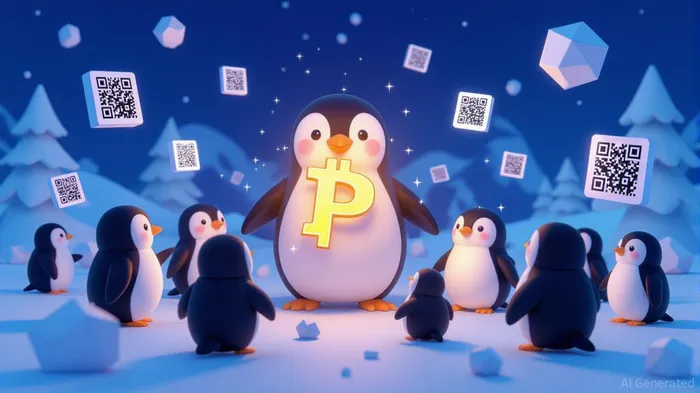
In the rapidly evolving DeFi landscape of 2025, PENGU Token has emerged as a standout contender, blending meme coin virality with strategic innovation. While traditional altcoins like SolanaSOL-- (SOL) and CardanoADA-- (ADA) dominate headlines with institutional partnerships and infrastructure upgrades, PENGU's unique value proposition lies in its community-centric tokenomics and creative ecosystem expansion. This article evaluates how PENGU's approach could position it to outperform peers by leveraging cultural resonance, cross-chain utility, and a governance model that prioritizes user engagement.
Tokenomics: Balancing Scarcity and Community Incentives
PENGU's tokenomics structure is a masterclass in balancing supply dynamics with community rewards. With a total supply of 88.88 billion tokens, the allocation prioritizes decentralization: 25.9% for Pudgy Penguins NFT holders, 24.12% for broader Web3 communities, and 17.8% for the team. This contrasts with traditional altcoins like DOGEDOGE--, which lack structured community incentives. The token's deflationary mechanisms—such as burning unclaimed tokens during the 2025 airdrop—create scarcity, while staking rewards and governance rights incentivize long-term holding.
Critics may point to the absence of a formal whitepaper as a transparency risk, but PENGU's cultural appeal and active community engagement have offset this. The token's circulating supply of 62.86 billion (as of early 2025) reflects strong liquidity, supported by listings on Binance, OKX, and Solana DEXs. shows a peak of $0.06989, stabilizing at $0.03745, driven by retail and institutional interest.
Strategic Partnerships: Bridging Digital and Physical Worlds
PENGU's partnerships with WalmartWMT-- and TargetTGT-- to launch Pudgy Toys exemplify its innovative approach. These QR-coded physical toys grant access to Pudgy World, a 3D virtual platform where users interact with their penguins. This “phygital” model not only expands the brand's reach to non-crypto audiences but also reinforces PENGU's utility beyond speculative trading.
The integration with ZED RUN, a blockchain-based horse racing game, further diversifies the ecosystem. Unlike traditional altcoins focused on financial infrastructure, PENGU's partnerships emphasize cultural and entertainment value. This strategy aligns with the growing trend of Web3 projects targeting mainstream adoption through tangible experiences.
Cross-Chain Expansion and Play-to-Earn Mechanics
While Solana and Cardano dominate institutional narratives, PENGU is preparing to expand to EthereumETH--, enhancing its cross-chain utility. This move addresses scalability concerns and taps into Ethereum's vast user base. Additionally, the upcoming Pudgy Party game, which will incorporate play-to-earn (P2E) mechanics, could drive demand for PENGU tokens as in-game currency.
Traditional altcoins like MAGACOIN FINANCE rely on deflationary tokenomics and exchange listings, but PENGU's P2E model introduces a recurring revenue stream. By tying token utility to gaming and virtual experiences, PENGU creates a flywheel effect: increased user activity boosts token demand, which in turn funds further ecosystem development.
Risks and Opportunities
PENGU's reliance on community-driven momentum carries risks. The absence of a whitepaper may deter institutional investors seeking regulatory clarity, and meme coins are inherently volatile. However, the project's cultural capital—bolstered by initiatives like Pengu Kindness, a public good campaign—mitigates some of these concerns.
For investors, PENGU represents a hybrid opportunity: a speculative asset with structured tokenomics and real-world utility. Its cross-chain expansion and P2E integrations could attract both retail and institutional capital, particularly as DeFi evolves beyond pure financial tools.
Investment Thesis
PENGU's success hinges on its ability to maintain community engagement while scaling its ecosystem. Key catalysts include:
1. Cross-Chain Adoption: Listing on Ethereum could unlock new liquidity pools and partnerships.
2. P2E Growth: Pudgy Party's launch may drive token demand through gaming rewards.
3. Institutional Listings: Expanding to major exchanges like CoinbaseCOIN-- could enhance price discovery and reduce volatility.
highlights PENGU's outperformance, driven by its unique value proposition. While DOGE relies on community hype and SHIBSHIB-- on passive burns, PENGU combines virality with actionable utility.
Conclusion
PENGU Token's transformational rise is a testament to the power of community-driven innovation in DeFi. By blending meme coin appeal with strategic partnerships, cross-chain expansion, and P2E mechanics, PENGU is redefining what it means to be a utility token. For investors seeking exposure to a project that balances cultural resonance with technical execution, PENGU offers a compelling case—though caution is warranted given its speculative nature. As the DeFi ecosystem matures, tokens like PENGU may prove that the future of crypto lies not just in infrastructure, but in the communities that build around it.

Decoding blockchain innovations and market trends with clarity and precision.
Latest Articles
Stay ahead of the market.
Get curated U.S. market news, insights and key dates delivered to your inbox.






Comments
No comments yet