
PENGU Token Price Surge: A Technical and On-Chain Analysis of Market Dynamics


 Aime Summary
Technical Analysis: A Tale of Contradictions
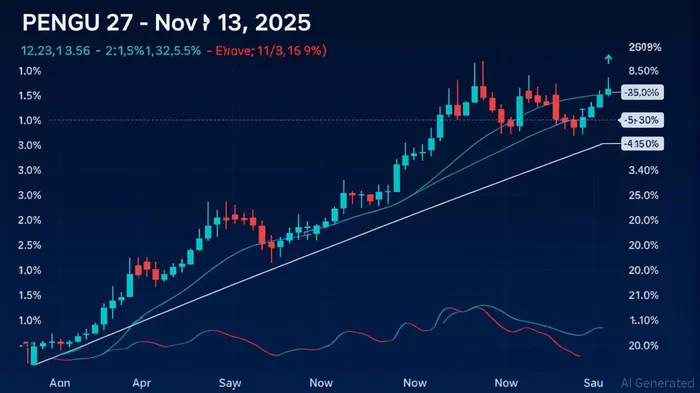
The PENGU token's 24-hour surge, which pushed its price to $0.016, was fueled by a $35.3 billion increase in altcoin market capitalization and a 33% spike in trading volume to $202 million. However, this bullish momentum clashes with broader technical indicators. On higher timeframes, PENGU remains in a bearish trend, having fallen 28.5% since October 27 and breaching the critical 78.6% Fibonacci retracement level near $0.016. The On-Balance Volume (OBV) has shown sustained selling pressure for over a month, while the Moving Average Convergence Divergence (MACD) lines remain closely converged, signaling weak momentum.
Short-term optimism, however, is emerging. Rising OBV and MACD on lower timeframes suggest buyer interest in the $0.016 to $0.017 range. This divergence between short-term and long-term indicators highlights a key risk: the rally may lack the structural strength to sustain a reversal.
On-Chain Metrics: Whale Activity and Network Dynamics
On-chain data reveals a complex narrative. Whale activity has been a double-edged sword. In the past week, smart money inflows reached $157,000, with $103,000 attributed to profit-and-loss traders, suggesting coordinated buying by major investors. A token burn of 13.69% of the total supply further reduced circulating supply, pushing the number of holders above 868,000.
Yet, large holder movements have raised alarms. Over 206.9 million PENGU tokens-worth $8.91 million-were transferred to centralized exchanges within a single 24-hour period, while 2 billion tokens (approximately $66.6 million) were moved from team-controlled wallets to trading platforms over the past month. Such outflows, coupled with 7.68 million in leveraged short positions at $0.01579, underscore persistent bearish sentiment in the derivatives market.
Market Context and External Factors
The broader crypto ecosystem also influences PENGU's trajectory. The launch of CMC20, a DeFi-native index token on BNBBNB-- Chain, has introduced new liquidity and trading strategies, potentially drawing attention away from niche tokens like PENGU. Meanwhile, Pudgy Penguins NFT sales-a key driver of PENGU's utility-dropped 36.87% to $2.79 million in the week prior to November 17, 2025, exacerbating downward pressure on the token. This decline aligns with a 5.4% drop in global NFT volume, reflecting broader market fatigue.
Investment Implications
The PENGU token's price surge is a product of both external tailwinds and internal contradictions. While Bitcoin's rebound and whale inflows have temporarily buoyed sentiment, structural weaknesses-such as bearish OBV trends, weak MACD momentum, and large holder outflows-suggest caution. Short-term traders may find opportunities in the $0.016 to $0.017 range, where technical indicators hint at potential support. However, long-term investors should remain wary of the token's susceptibility to macroeconomic shifts and NFT market volatility.
Conclusion
The PENGU token's recent rally is a reminder of the crypto market's inherent volatility. While technical and on-chain metrics offer conflicting signals, the broader context-ranging from NFT sales trends to DeFi innovation-underscores the need for a balanced approach. Investors must weigh the token's speculative appeal against its structural vulnerabilities, recognizing that the current surge may be a fleeting reprieve rather than a sustainable turnaround.

Blending traditional trading wisdom with cutting-edge cryptocurrency insights.
Latest Articles
Stay ahead of the market.
Get curated U.S. market news, insights and key dates delivered to your inbox.






Comments
No comments yet