
PENGU Token Maintains $417.8M Market Cap Amid Brand Expansion and Structural Revenue Disconnect
 Aime Summary
Pudgy Penguins' native token (PENGU) currently holds a market capitalization of $417.8 million, supported by robust daily trading volume exceeding $97.6 million. This volume-to-market cap ratio of approximately 23.4% signals active speculative trading and distinguishes the asset from typical cryptocurrencies with lower turnover rates. Despite a modest decline in USD terms, the token has demonstrated resilience against BitcoinBTC-- and outperformed several legacy blockchain protocols.
The asset's unique market dynamics are driven by its mainstream brand integration, including appearances in ETF commercials and partnerships with major corporations. However, a critical structural disconnect exists between the parent company's commercial success and the token's financial utility.
The project has launched real-world tools such as the PenguPENGU-- Card and hybrid physical-digital collectibles to bridge Web3 with traditional commerce. These initiatives aim to stabilize demand by broadening utility beyond simple trading, yet official documentation explicitly states the token is for entertainment only.
What Drives High Liquidity Without Revenue Claims?
The PENGU token's high liquidity is fueled by its positioning as a social currency rather than a traditional financial instrument. Investors are attracted to the brand's reported 100 billion views and its crossover between NFT culture and corporate branding. This narrative allows the token to function as a social signaling mechanism, decoupling its price from stagnant NFT floor prices.
The token's performance shows selective strength, gaining 3.79% against Bitcoin while declining against major fiat currencies like the USD and EUR. This divergent performance suggests price movements are influenced by factors beyond broad market sentiment, potentially tied to specific regional dynamics or community-driven flows.
Despite the absence of revenue-sharing mechanisms, the token's valuation trades at a 3.2x premium to similar NFT tokens. This premium relies heavily on the project's ability to sustain cultural relevance and execute on roadmap promises.
How Does Ecosystem Expansion Impact Token Value?
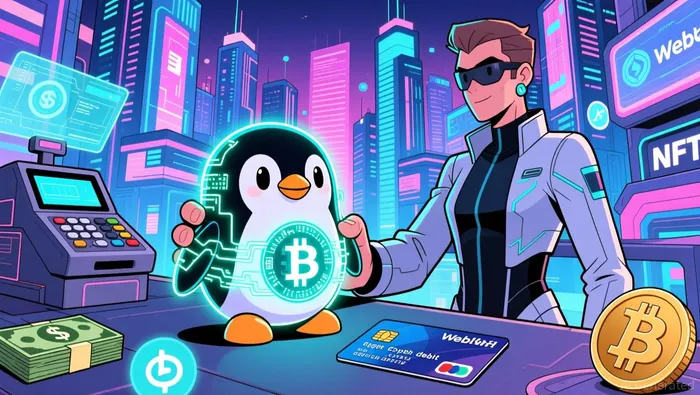
Pudgy Penguins has executed a strategic pivot to merge Web3 assets with traditional finance through the launch of hybrid collectibles and a Visa-backed crypto debit card. The Pengu Card supports over 25 cryptocurrencies and offers up to 12% cashback at 150 million global merchants. Additionally, a partnership with Sizeprop enables traders to access funded accounts up to $100,000 without risking personal capital.
The project has also introduced PenguBot, an AI trading assistant integrated into Telegram that allows users to execute trades via natural language commands. This tool automatically generates self-custodial wallets and supports multi-chain trading across SolanaSOL--, EthereumETH--, and Abstract.
Despite these real-world adoptions, the token lacks formal economic claims on brand revenue. Token holders possess no legal claims to revenue from toy sales, licensing deals, or other streams generated by the parent company, Igloo.
What Are the Key Risks for Investors?
A significant structural risk involves the concentration of supply among insiders, with nearly 29.3% of the total supply controlled by insiders with vesting through 2028. A major unlock scheduled for June 2026 poses a potential overhang risk that could impact market stability.
The token's valuation remains disconnected from the company's commercial performance, requiring sustained execution on brand monetization to sustain value. The project faces the challenge of converting its reported 100 billion views into recurring economic activity.
Investors must monitor whether the team can sustain cultural relevance and develop utility beyond the initial launch hype. The token's unique risk-return profile, combining NFT heritage with social media influence, makes traditional valuation frameworks difficult to apply.
While the parent company secured $11 million in venture funding, the token trades at a premium that requires continued execution on brand monetization to sustain valuation. Regulatory scrutiny and the difficulty of translating cultural success into sustained NFT floor price appreciation remain key risks for investors.

Blending traditional trading wisdom with cutting-edge cryptocurrency insights.
Latest Articles
Stay ahead of the market.
Get curated U.S. market news, insights and key dates delivered to your inbox.


AInvest
PRO
AInvest
PRO



Comments
No comments yet