
The PENGU Price Drop: Implications for Crypto Market Sentiment and Altcoin Exposure


 Aime Summary
The Anatomy of the PENGU Crash
PENGU's decline was fueled by a toxic mix of macroeconomic headwinds and behavioral missteps. Regulatory ambiguity in key markets, coupled with algorithmic trading systems exacerbating sell-offs, created a self-fulfilling prophecy of panic. The token's 36% drop in NFT sales volume further highlighted the fragility of speculative ecosystems tied to token performance according to market reports. Meanwhile, PENGU's underperformance against memecoins like DOGEDOGE-- and BONK-marked by lower highs and lower lows-revealed ongoing distribution by large holders, eroding retail confidence as reported by TradingView.
Technical indicators offered mixed signals: while the RSI and MACD hinted at short-term buying interest, bearish momentum dominated as Bitcoin's movements dictated PENGU's trajectory according to market analysis. Yet, by late November 2025, a 10% rebound emerged, driven by "smart money" inflows and on-chain accumulation, suggesting that institutional activity could temporarily stabilize the token according to market data.
Investor Psychology: The Role of Behavioral Biases
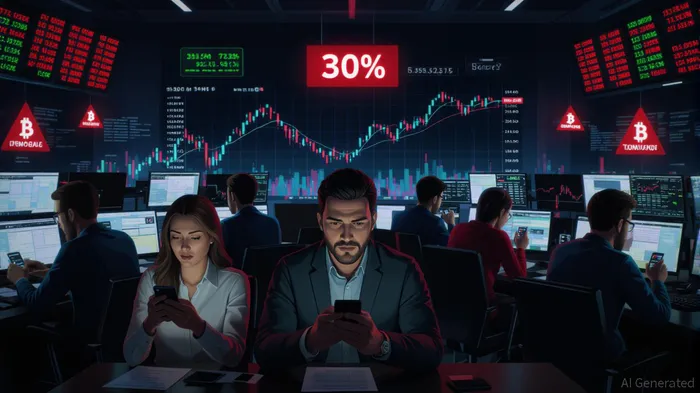 The PENGU crash laid bare the psychological underpinnings of speculative trading. Retail investors, influenced by social media and FOMO, checked PENGU's price an average of 14.5 times daily, amplifying emotional contagion and impulsive decisions. Personality traits like neuroticism and overconfidence further skewed behavior: investors high in neuroticism exhibited the disposition effect, clinging to losing positions, while overconfident traders exacerbated volatility through premature exits according to behavioral research.
The crash also revealed a disconnect between retail and institutional behavior. While PENGU's team wallets saw $66.6 million in outflows, large whales accumulated $273,000 worth of tokens, signaling divergent risk perceptions according to market analysis. This duality reflects broader trends in crypto markets, where retail investors often act on narratives rather than fundamentals, while institutions prioritize liquidity and strategic positioning as observed in market data.
Education as a Mitigating Factor
The role of education in tempering panic selling and improving risk assessment cannot be overstated. Studies show that investors with higher financial literacy are less prone to emotional trading, even in volatile markets according to research findings. For instance, during the PENGU crash, those with economics or psychology training were more likely to employ stop-loss orders and diversification strategies, reducing exposure to single-asset risks according to case studies.
However, education alone is not a panacea. Overconfidence in one's knowledge can paradoxically lead to irrational decisions, as seen in PENGU's July 2025 480% surge driven by social media hype according to market reports. Behavioral interventions, such as nudges based on the IKEA effect, have shown promise in curbing panic selling by fostering emotional attachment to self-constructed portfolios according to experimental data. Yet, these tools remain underutilized in retail investor education programs.
Broader Implications for Altcoin Exposure
The PENGU crash serves as a cautionary tale for altcoin investors. Projects with opaque fundamentals or heavy reliance on speculative sentiment-like Pudgy Penguins' NFT ecosystem-remain vulnerable to systemic shocks according to market analysis. Diversification and liquidity monitoring are now table stakes for risk management, as macroeconomic conditions and institutional activity increasingly dictate market dynamics according to market reports.
Strategic partnerships, such as Pudgy Penguins' collaboration with Schleich and Bitso, offer long-term bullish potential by bridging Web3 and mainstream markets according to market analysis. However, these initiatives must be paired with regulatory clarity and investor education to mitigate the risks of overleveraging and herd behavior.
Conclusion
The PENGU price drop of 2025 is more than a token-specific event-it is a microcosm of crypto's broader challenges. Investor psychology, driven by cognitive biases and social media, remains a double-edged sword, capable of both amplifying volatility and stabilizing markets through informed decision-making. As education in economics, psychology, and research methods gains traction, its role in reshaping speculative behavior will become increasingly critical. For altcoin investors, the lesson is clear: in a market defined by uncertainty, resilience lies in balancing speculative ambition with disciplined risk management.

Blending traditional trading wisdom with cutting-edge cryptocurrency insights.
Latest Articles
Stay ahead of the market.
Get curated U.S. market news, insights and key dates delivered to your inbox.






Comments
No comments yet