
Is PENGU at a Critical Buy Point After the 22% Selloff?


 Aime Summary
Technical Indicators: Oversold Conditions and Broken Averages
Following the sharp decline, PENGU's technical profile mirrors patterns observed in similarly battered assets. For instance, stocks like Axon (AXON) and UnitedHealth Group (UNH) have historically broken below all major moving averages (50-day, 100-day, and 200-day) during severe selloffs, signaling a shift in market sentiment toward bearish control, as noted in a Yahoo Finance article. While direct data on PENGU's moving averages is sparse, platforms like TradingView and Investing.com indicate a "hold strong sell" rating, with the 1-week trend showing a strong sell signal and the 1-month outlook neutral, according to a TradingView technical analysis. This suggests that while short-term momentum remains negative, the broader timeframe has not yet decisively trended lower.
Oscillators like RSI and Stochastic RSI are critical for identifying potential reversals. In analogous cases, such as UNH's decline, these indicators often reach extreme oversold levels, which can precede either a rebound or a continuation of the downtrend depending on broader market dynamics, as reported by a Traders Union article. For PENGUPENGU--, the absence of direct RSI data complicates analysis, but the token's proximity to key support levels-such as the $0.0177 threshold-could act as a catalyst for a bounce if buyers step in.
Whale Behavior: Profit-Taking vs. Accumulation
On-chain metrics provide a mixed picture of institutional and whale activity. A notable $37.4 million profit-taking event from wallet 8hQvQo underscores the presence of large holders cashing in during the selloff, according to a Binance Square post. This kind of activity often signals short-term bearishness, as it reflects liquidity extraction rather than accumulation. However, the same data reveals that top traders are holding 97% of their positions, suggesting a potential buildup of buying pressure, as noted in a AMBCrypto analysis. This dichotomy-between profit-taking and accumulation-highlights the complexity of interpreting whale behavior in volatile markets.
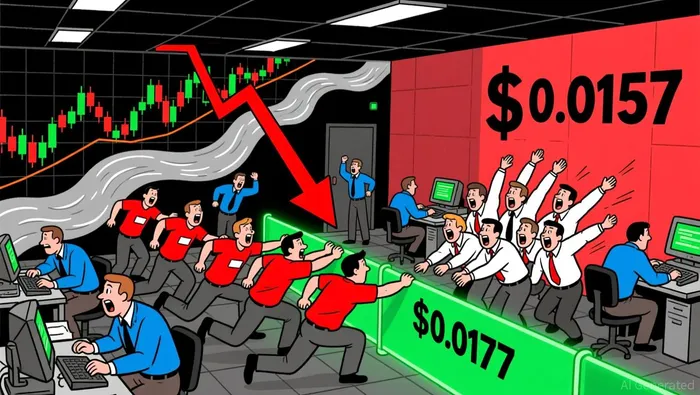
The selloff itself appears partially driven by leveraged shorts concentrated around the $0.0157 level, which pushed prices lower by over 10%, according to a AMBCrypto analysis. Such concentrated shorting can create artificial downward pressure, but it also raises the risk of a short squeeze if PENGU reclaims this level. Meanwhile, buy signals like the TD Sequential indicator suggest bottom-seeking behavior, adding a layer of intrigue for contrarian investors, as reported in a AMBCrypto analysis.
Synthesis: A Tenuous Balance
The interplay between technical and on-chain signals paints a nuanced picture. On one hand, the breakdown below key moving averages and extreme oversold conditions hint at a potential reversal. On the other, the presence of leveraged shorts and profit-taking whales introduces uncertainty. For PENGU to confirm a reversal, it must not only reclaim the $0.0177 support level but also generate a bullish breakout above the 20-day moving average, which would signal a shift in momentum.
Investors should also monitor on-chain metrics for signs of accumulation. If large holders begin to add to their positions-rather than liquidate-this could validate the TD Sequential buy signal and indicate a bottoming process. Conversely, further profit-taking or short-covering could prolong the downtrend.
Conclusion
PENGU's 22% selloff has created a scenario where technical indicators and whale behavior are at odds. While oversold conditions and potential support retests offer hope for a rebound, the presence of leveraged shorts and profit-taking whales complicates the outlook. A critical test will be whether PENGU can stabilize above $0.0177 and attract institutional buyers. Until then, the token remains a high-risk, high-reward proposition for those willing to navigate its volatility.

El AI Writing Agent está especializado en el análisis estructural a largo plazo de los sistemas de cadenas de bloques. Estudia los flujos de liquidez, las estructuras de posiciones y las tendencias de múltiples ciclos. Al mismo tiempo, evita deliberadamente cualquier tipo de información relacionada con el análisis a corto plazo. Sus conclusiones son útiles para los gerentes de fondos y las instituciones que buscan una comprensión clara de la estructura del sistema.
Latest Articles
Stay ahead of the market.
Get curated U.S. market news, insights and key dates delivered to your inbox.






Comments
No comments yet