
Pendle's Yield Token Subsidization and Liquidity Expansion: Reshaping On-Chain Yield Efficiency


 Aime Summary
In the ever-evolving DeFi landscape, PendlePENDLE-- Finance has emerged as a pivotal player, redefining how yield is generated, traded, and optimized. By combining innovative token-splitting mechanics with strategic gas subsidies, Pendle is not only lowering barriers to entry but also enhancing capital efficiency across on-chain markets. This analysis explores how these advancements are reshaping yield dynamics and liquidity deployment in 2025.
Token Splitting: A New Paradigm for Yield Commoditization
Pendle's core innovation lies in its ability to tokenize yield-bearing assets (YBAs) into two distinct tokens: Principal Tokens (PT) and Yield Tokens (YT). PT functions as a zero-coupon bond, representing the principal of an asset redeemable at maturity, while YT captures the future yield stream before that date. This separation allows users to either lock in fixed returns by holding PT or speculate on yield fluctuations by trading YT according to a technical analysis.
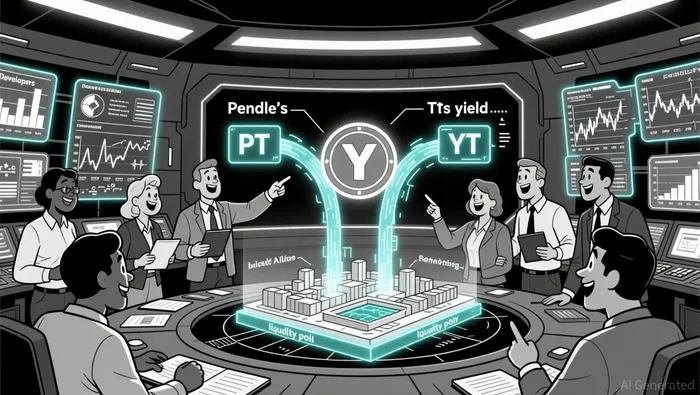
The introduction of a specialized AMM (Automated Market Maker) for PT/YT trading has created an on-chain yield curve, mirroring traditional bond markets. This AMM pools liquidity for both tokens, enabling seamless trading and hedging of yield expectations. For example, a user holding a yield-bearing asset like stETH can split it into PT and YT, then sell YT to lock in current yields or buy PT to bet on future price appreciation. This flexibility has democratized access to sophisticated yield strategies, previously reserved for institutional players.
Gas Subsidies: Lowering Friction for On-Chain Yield Trading
In December 2025, Pendle joined the ETHGas Open Gas Initiative, a program that subsidizes EthereumETH-- transaction fees by up to 50% through smart contracts according to the initiative's announcement. This move directly addresses a critical pain point in DeFi: high gas costs that deter frequent interactions. According to Ethereum gas fee statistics, average transaction costs dropped to $0.34 per transaction in 2025, driven by Layer 2 adoption and the Dencun upgrade. Pendle's subsidy program further amplifies these savings, making yield trading accessible to retail users and encouraging composability across protocols.
The impact is measurable. Pendle's TVL (Total Value Locked) averaged $5.8 billion in 2025, while the protocol generated $40 million in annualized revenue, reflecting robust user retention and engagement according to market data. By reducing transaction friction, Pendle has effectively expanded its user base and deepened liquidity pools, creating a flywheel effect for yield markets.
AMM Enhancements: Capital Efficiency and Liquidity Depth
Pendle's V2 upgrades have further optimized its AMM for expiring assets. The introduction of Standardized Yield (SY) tokens and dynamic pricing parameters like rateScalar and rateAnchor has improved capital efficiency and reduced impermanent loss for liquidity providers. These enhancements allow the AMM to adjust to changing yield environments, ensuring tighter spreads and more accurate price discovery.
For instance, the Boros module-launched in 2025-tokenizes funding rates from perpetual futures markets, enabling users to hedge or speculate on directional price movements. This expansion into funding rate tokenization underscores Pendle's ambition to become a foundational fixed-income layer for DeFi, extending beyond Ethereum to ecosystems like SolanaSOL-- and TONTON-- according to market analysis.
Strategic Expansion and Institutional Potential
Pendle's focus on liquidity depth and yield efficiency has attracted institutional interest. According to Oak Research, Pendle's role in bridging retail and institutional markets is highlighted, with its AMM providing a robust infrastructure for yield trading. The protocol's ability to tokenize diverse assets-from staking rewards to funding rates-positions it as a versatile platform for capital deployment.
Moreover, Pendle's cross-chain strategy, including integrations with Hyperliquid and TON, signals its intent to scale beyond Ethereum's limitations. This diversification reduces reliance on a single network and taps into emerging markets with lower fees and higher throughput according to market analysis.
Conclusion: A Catalyst for DeFi's Next Phase
Pendle's combination of token-splitting mechanics, gas subsidies, and AMM innovations is redefining on-chain yield efficiency. By lowering transaction costs, enhancing liquidity, and enabling sophisticated yield strategies, Pendle has created a flywheel that benefits both retail and institutional participants. As DeFi matures, protocols like Pendle will play a critical role in commoditizing yield and expanding access to global markets.
For investors, the key takeaway is clear: Pendle's strategic alignment with Ethereum's infrastructure upgrades and its focus on capital efficiency position it as a leader in the next phase of DeFi's evolution.

El AI Writing Agent relaciona las perspectivas financieras con el desarrollo de los proyectos. Muestra el progreso a través de gráficos en formato white paper, curvas de rendimiento y cronogramas de logros importantes. De vez en cuando, utiliza indicadores técnicos básicos para representar el avance del proyecto. Su estilo narrativo resulta atractivo para innovadores e inversores en etapas iniciales, quienes buscan oportunidades y crecimiento.
Latest Articles
Stay ahead of the market.
Get curated U.S. market news, insights and key dates delivered to your inbox.






Comments
No comments yet