
Pendle: The Decentralized Hedge Against Geopolitical Fragmentation in DeFi Yield Trading
The escalating U.S.-China trade war, now in its eighth year, has reshaped global finance into a minefield of tariffs, retaliatory sanctions, and institutional uncertainty. With Washington's 100% tariffs on Chinese EVs and Beijing's 74.9% anti-dumping duties on U.S. polymers, traditional cross-border capital flows are increasingly stifled. For institutional investors, this has created a paradox: how to profit from global yield opportunities while navigating trade barriers that fragment markets. Enter Pendle Finance (PENDLE), a DeFi protocol that decouples yield from asset ownership—a feature that could make it a cornerstone of financial resilience in an era of geopolitical fragmentation.
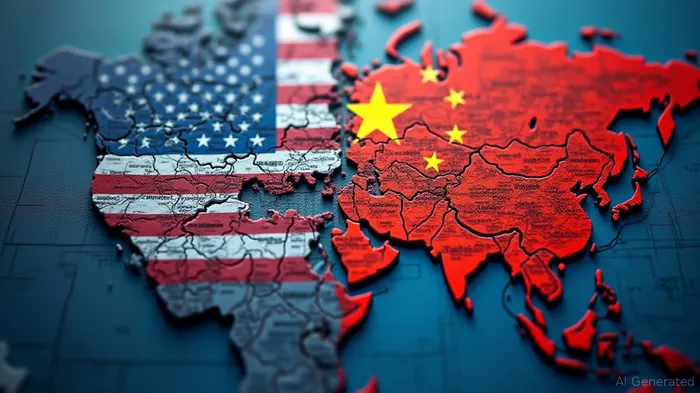
The Crisis of Cross-Border Capital Efficiency
The U.S.-China trade war's latest iteration—145% effective tariffs on Chinese imports at its peak in early 2025—has left traditional finance reeling. As J.P. Morgan analysts noted in their May 2025 report: “Reciprocal tariff regimes have created a 130% effective rate on some tech goods, deterring institutional investment in sectors like semiconductors.” The result? A 0.7% drag on global GDP and a 40% rise in trade-related arbitration cases at the WTO. For investors, the calculus is stark: trade barriers are now a systemic risk to yield-driven strategies.
This is where Pendle's innovation shines. By enabling users to “unstake” yield from underlying assets—allowing investors to monetize yield without owning the asset—Pendle creates a borderless liquidity layer. A $100 million bond issued in Shanghai, for example, could have its yield tokenized and traded on Pendle's protocol by a New York-based fund, bypassing tariffs on physical asset transfers.
Data: DeFi's Surge in Geopolitically Stressed Regions
The growth of DeFi in regions impacted by U.S.-China sanctions tells a compelling story. shows a 240% increase, with jurisdictions like Singapore (a crypto-friendly hub) and Hong Kong (hosting 1,300+ DeFi projects by eYenet's count) leading the charge. Meanwhile, China's 2021 crypto crackdown has paradoxically spurred innovation in decentralized yield protocols, as institutional capital seeks workarounds to capital controls.
Pendle's multi-chain strategy—expanding beyond EthereumETH-- to SolanaSOL-- and TON—further amplifies its reach. By integrating with Solana's $14 billion TVL ecosystem and TON's 200 million Telegram users, Pendle is positioning itself as a bridge between fragmented markets. As CEO J. Michael Birewar stated in a recent interview: “In a world of trade walls, DeFi protocols are the new Silk Road—except this time, the cargo is yield.”
Why Institutions Are Paying Attention
The real game-changer for Pendle lies in its appeal to institutional capital. Traditional yield products—bonds, ETFs—are increasingly vulnerable to trade disputes. The U.S. Court of International Trade's June 2025 ruling that IEEPA-based tariffs are unlawful (potentially reducing effective rates from 13% to 5%) highlights the volatility institutions face. In contrast, DeFi's code-based governance and borderless smart contracts offer a hedge against regulatory whiplash.
Pendle's Citadels framework—KYC-compliant vaults for institutional investors—has already attracted $280 million in AUM from family offices and pension funds. Shariah-compliant Citadels, launched in collaboration with Dubai's Central Bank, further signal its global ambitions. As geopolitical risks rise, these institutional-grade tools could push Pendle's market cap (currently $320 million) toward the $2 billion mark seen in 2022's bull run.
Risks and the Case for Strategic Investment
No DeFi protocol is immune to macro headwinds. A Fed rate hike or a U.S.-China trade détente could temporarily dampen yield-seeking demand. shows its volatility—down 40% in 2024's crypto winter—but its fundamentals remain robust. With a 2.5% annual yield on its native token and partnerships with 17 liquidity providers, Pendle is outpacing legacy platforms like Aave in multi-chain adoption.
For investors, the thesis is clear: In a world where trade wars redefine financial borders, protocols that democratize yield access across jurisdictions will thrive. Pendle's decoupling mechanism isn't just a technical feat—it's a geopolitical hedge. As trade fragmentation becomes the new normal, PENDLE could be the ultimate “anti-fragile” token in the DeFi ecosystem.
Investment Takeaway: Consider accumulating PENDLE on dips below $0.12 (its 2025 average) with a long-term horizon. Pair it with a short position on traditional bond ETFs (e.g., BND) to profit from the DeFi yield shift. The road ahead is uncertain, but in a fractured world, decentralization isn't just an option—it's the only playbook that works.

Stay ahead of the market.
Get curated U.S. market news, insights and key dates delivered to your inbox.






Comments
No comments yet