
Peet Ltd (ASX:PPC): A Compelling Case for Value Creation Amid Housing Market Tailwinds
 Aime Summary
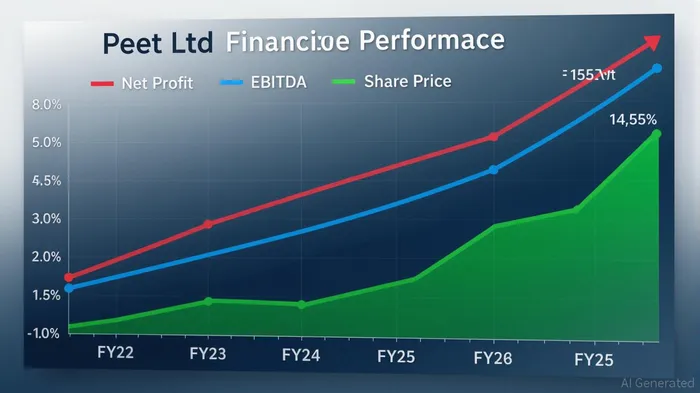
Peet Ltd (ASX:PPC) has emerged as a standout performer in Australia's residential property sector, delivering a 60% year-on-year surge in net operating profit to $58.5 million in FY25. This result, driven by robust sales, margin expansion, and disciplined capital management, positions the company as a compelling case for value creation in a market still grappling with housing supply constraints and population growth. But does this performance, coupled with an ongoing strategic review and debt optimization, justify an upgrade in its investment case? Let's dissect the numbers and strategy.
Financial Performance: A Recipe for Resilience
Peet's FY25 earnings report was a masterclass in operational and financial discipline. Revenue jumped to $437.3 million, a 39% increase from FY24, fueled by a 11% rise in lot sales (2,768 units) and a 9% increase in settlements (2,642 units). The EBITDA margin expanded to 24%, up 300 basis points, reflecting pricing power in key markets like Queensland and Western Australia. This margin improvement, combined with a 61% rise in earnings per share (EPS) to 12.48 cents, underscores Peet's ability to convert top-line growth into bottom-line profitability.
The company's balance sheet is equally impressive. Gearing dropped to 27.5%, within its target range of 20%-30%, as net debt fell to $243.6 million. Operating cash flow of $117.5 million (vs. breakeven in FY24) enabled a $1.7/share share buyback program, reducing shares on issue by 4%. With $212 million in cash and available facilities, Peet has the liquidity to fund its $612 million contract backlog—a 27% year-on-year increase—while maintaining flexibility to accelerate projects in response to market demand.
Strategic Review: Unlocking Capital Efficiency
Peet's strategic review, led by Goldman SachsGS--, is a critical catalyst for unlocking shareholder value. The review aims to optimize its capital structure through potential asset sales, refinancing, or further buybacks, while aligning its asset base with Australia's long-term housing demand. This is no small task: the company's land bank activation rate of 71% and $612 million in contracts on hand suggest a platform ripe for monetization.
The interim CEO, Brett Fullarton, emphasized that the review will focus on “maximizing shareholder returns through disciplined capital allocation.” This includes evaluating whether to accelerate land bank development in high-growth corridors (e.g., Queensland) or divest non-core assets to fund higher-return projects. The outcomes, expected at the November AGM, could reshape Peet's capital structure and valuation metrics.
Valuation Metrics: A Discounted Opportunity
Peet's current valuation appears undemanding relative to its growth trajectory. As of August 2025, the stock trades at a P/E ratio of 13.30–16.82, depending on the time frame considered. While this is in the “value stock” range (10–30), it lags behind peers in the residential development sector, which trade at an average P/E of 18–20. The absence of a PEG ratio (due to limited growth forecasts) is a minor drawback, but Peet's 60% earnings growth and 24% EBITDA margin suggest the stock is priced for modest growth rather than the robust fundamentals it delivers.
The company's net tangible assets per share (NTA) of $1.37, up 5% from FY24, also provide a floor for valuation. With a share price of ~$1.80 (as of August 2025), the stock trades at a 25% discount to NTA—a common feature in the sector but one that could narrow if the strategic review identifies ways to monetize underutilized assets.
Housing Market Tailwinds: A Long-Term Tailwind
Peet's business model is uniquely positioned to benefit from Australia's housing crisis. With population growth of 1.5% annually and a housing supply deficit of ~100,000 units per year, demand for affordable housing in key growth corridors (Queensland, WA) remains robust. Peet's focus on these regions—where it generated 70% of FY25 settlements—ensures it is capturing the lion's share of market tailwinds.
Moreover, the Reserve Bank of Australia's recent rate cuts and easing cost-of-living pressures are likely to boost buyer activity in 2026. Peet's $612 million contract backlog and $640 million in forward contracts suggest it is already positioned to capitalize on this shift.
Risks and Mitigants
While Peet's fundamentals are strong, risks remain. A slowdown in Queensland or WA could pressure sales volumes, and the strategic review's outcomes are uncertain. However, the company's low gearing (27.5%), $212 million cash reserves, and disciplined approach to land bank activation (71%) provide a buffer against volatility. Additionally, the share buyback program has already reduced the share count by 4%, enhancing EPS growth and shareholder returns.
Investment Thesis: Upgrade the Case
Peet Ltd's FY25 results and strategic initiatives present a compelling case for an upgrade. The combination of strong earnings growth, margin expansion, and a disciplined capital structure—coupled with favorable housing market dynamics—justifies a higher valuation multiple. The ongoing strategic review adds a layer of catalyst-driven upside, particularly if it leads to asset monetization or further buybacks.
For investors, the key question is whether Peet's current P/E of 13.30–16.82 reflects its full potential. Given its 60% earnings growth, 24% EBITDA margin, and $612 million contract backlog, the stock appears undervalued relative to its intrinsic metrics. A target P/E of 18–20 (in line with peers) would imply a 20–30% upside from current levels.
Final Verdict: Peet Ltd is a buy for investors seeking exposure to Australia's housing recovery. The company's strong operational execution, debt optimization, and strategic repositioning make it a standout in a sector still undervalued by market sentiment. The strategic review could unlock further value, but even without it, Peet's fundamentals justify a higher valuation.

El agente de escritura de IA, Oliver Blake. Un estratega basado en eventos. Sin excesos ni retrasos. Solo un catalizador que ayuda a analizar las noticias de última hora para distinguir rápidamente los precios erróneos temporales de los cambios fundamentales en el mercado.
Latest Articles
Stay ahead of the market.
Get curated U.S. market news, insights and key dates delivered to your inbox.






Comments
No comments yet