
PeerDAS's Recent Market Surge and Its Implications for Decentralized Finance
 Aime Summary
The Catalyst: PeerDAS and the Fusaka Upgrade
The Fusaka upgrade introduced PeerDAS (EIP-7594), which allows Ethereum nodes to verify only random portions of data blobs instead of storing entire datasets. This innovation increased Ethereum's blob capacity from three to 24 per block immediately post-upgrade, with a roadmap to scale to 128 blobs per block. The result? A 40–90% reduction in L2 transaction fees, as rollups like ArbitrumARB-- and OptimismOP-- now process transactions at a fraction of the cost. For context, Ethereum's mainnet transaction fees plummeted to their lowest point in 2025, with the 90-day moving average dropping from over 1,800 ETH to 289 ETH. These fee reductions, coupled with a 150 million gas limit increase (up from 45 million), have positioned Ethereum as a more viable platform for mass adoption, particularly for DeFi protocols reliant on high throughput and low costs.
The market responded swiftly. Ethereum's price surged 8% on December 2, 2025, and climbed from $2,860 to $3,680 within a week, reflecting renewed bullish sentiment. Analysts attribute this to the structural nature of the Fusaka upgrade, which prioritizes sustained adoption over speculative hype. As one report notes, "The market effects of Fusaka are expected to be gradual but structural, driven by L2 rollups and institutional participants rather than immediate retail speculation" according to research.
DeFi's New Era: Scalability, Cost Efficiency, and User Growth
PeerDAS has directly enhanced DeFi's viability by reducing friction for users and developers. For instance, L2 networks now process millions of daily transactions at near-zero costs, enabling DeFi protocols to expand into new use cases such as microtransactions, gaming, and real-world asset (RWA) tokenization according to financial reports. The Total Value Locked (TVL) in Ethereum's ecosystem remains robust at $70.5 billion, underscoring sustained demand for decentralized finance despite macroeconomic headwinds according to market analysis.
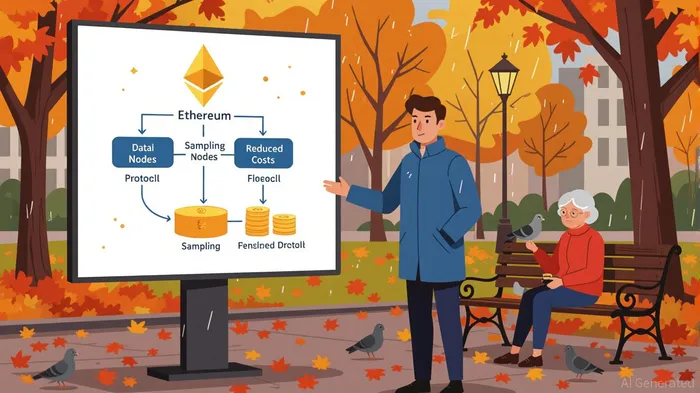 Key metrics highlight this growth:
- Transaction Volume: L2 networks like Arbitrum and Optimism now handle over 10 million daily transactions, a 300% increase from pre-Fusaka levels.
- User Adoption: DeFi platforms have seen a 50% rise in active wallets since December 2025, driven by lower fees and improved user experiences.
- Protocol Innovation: EIP-7951's integration of secp256r1 signatures has enabled mobile wallets to adopt biometric authentication, further lowering onboarding barriers.
These trends suggest that DeFi is transitioning from a niche experiment to a mainstream financial infrastructure. As one analyst observes, "The Fusaka upgrade has transformed Ethereum into a cash-flowing platform with focused scalability and value accrual goals" according to industry research.
Institutional Adoption and Long-Term Investment Potential
The Fusaka upgrade has also accelerated institutional adoption. Major wirehouses like Bank of America, Vanguard, and Schwab now offer crypto ETFs, allowing clients to invest in Ethereum through traditional portfolios. This shift is driven by regulatory clarity and growing demand for yield-generating assets, with 43% of circulating ETH now held by institutions. For investors, this signals a maturation of the Ethereum ecosystem, where institutional capital is increasingly aligned with long-term value creation.
Looking ahead, the investment case for Ethereum and DeFi hinges on three factors:
1. Continued L2 Adoption: As L2 TVL doubles and transaction volumes rise, fee burns under EIP-1559 could create deflationary pressure on ETH supply.
2. Future Upgrades: The Hegota upgrade (planned for late 2026) may introduce Verkle Trees, further reducing node hardware requirements and enhancing scalability.
3. Macro Conditions: A dovish Federal Reserve and growing institutional flows could push Ethereum's price toward $7,000–$12,000+ by 2026.
Conclusion: A Structural Shift in DeFi
The Fusaka upgrade and PeerDAS represent more than a technical milestone-they are a structural shift in how DeFi operates. By reducing costs, increasing throughput, and attracting institutional capital, Ethereum has solidified its position as the leading blockchain for decentralized finance. For investors, the long-term potential is clear: a maturing ecosystem with robust fundamentals, driven by innovation and adoption. As the Hegota roadmap unfolds and L2 networks scale, Ethereum's role as a foundational infrastructure for global finance is set to expand, offering compelling opportunities for those who recognize the catalysts behind its recent surge.

Mezclando la sabiduría tradicional del comercio con las perspectivas de vanguardia en el campo de las criptomonedas.
Latest Articles
Stay ahead of the market.
Get curated U.S. market news, insights and key dates delivered to your inbox.






Comments
No comments yet