
PeerDAS Drives Ethereum's 2026 Scaling Ambitions With Tiered State Design
 Aime Summary
PeerDAS, a data availability solution introduced during Ethereum’s 2025 Fusaka upgrade, is designed to enhance the network’s scalability by separating high-value data from temporary storage.
The technology enables EthereumETH-- to scale by up to 1000x while reducing transaction fees and improving throughput for layer-2 solutions. This has already led to a 75% reduction in average transaction fees and supports more efficient rollup operations.
In 2025, Ethereum doubled its gas limit from 30 million to 60 million, significantly increasing the network’s capacity for transaction processing and data handling. The 2026 roadmap aims to push the gas limit further toward 100 million or more, supporting higher throughput and lower costs.
How PeerDAS and Upgrades Affect Ethereum’s Scalability?
PeerDAS plays a central role in Ethereum’s scalability by improving layer-2 data availability and reducing bottlenecks. It separates high-value state from temporary storage, addressing challenges related to state growth and maintaining security and decentralization. This design allows layer-2 solutions to operate more efficiently on the base layer while 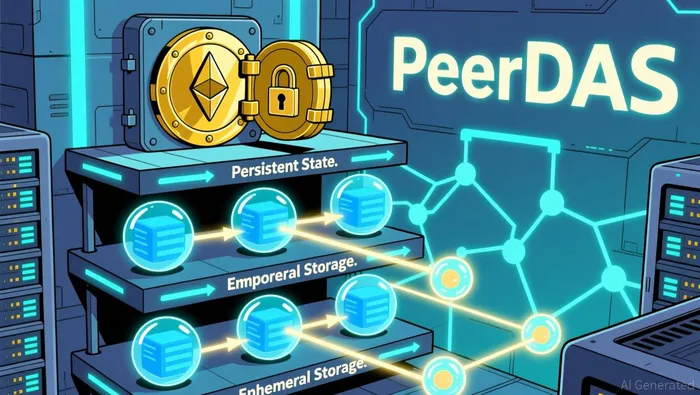 supporting future advancements like the Glamsterdam upgrade.
The increased gas limit and PeerDAS also enable better use of data blobs, enhancing the base layer’s ability to handle more transactions at lower costs. These upgrades are part of a broader strategy to position Ethereum as a cost-effective and scalable platform for decentralized applications and DeFi protocols.
What Is the Investor Relevance of Ethereum’s 2026 Roadmap?
Ethereum’s 2026 roadmap includes scaling, UX improvements, and base-layer hardening. The roadmap aims to increase the gas limit further, implement enshrined Proposer-Builder Separation (ePBS), and introduce quantum-resistant cryptography to future-proof the network. These efforts are expected to enhance Ethereum’s appeal for institutional use cases while improving user experience through native account abstraction.
Despite these technical advancements, Ethereum’s price recovery will depend on economic metrics like fee generation, not just scaling alone. The network must demonstrate that increased usage translates into durable demand and higher fees to regain investor confidence.
What Are the Risks in Ethereum’s Scaling Strategy?
While Ethereum’s 2026 roadmap is ambitious, the market remains skeptical and prioritizes evidence over vision. Challenges include maintaining network stability during large gas limit increases and ensuring client optimizations are stress-tested. Additionally, low fee revenue and weak gas prices currently limit Ethereum’s perceived value capture.
The success of these upgrades will also depend on coordination between developers and the community, as well as the ability to deliver measurable outcomes and gain investor confidence. Any delays or technical setbacks could impact Ethereum’s ability to maintain its position as a leading settlement layer for DeFi and institutional use cases.

Blending traditional trading wisdom with cutting-edge cryptocurrency insights.
Latest Articles
Stay ahead of the market.
Get curated U.S. market news, insights and key dates delivered to your inbox.


AInvest
PRO
AInvest
PRO



Comments
No comments yet