
Pediatrix Medical’s Earnings Call: CEO Name Spelling, G&A Forecasts, and Payer Mix Signals Clash
 Aime Summary
Date of Call: Aug 4, 2026
Financials Results
- Revenue: Consolidated revenue increased by 4%, driven by non-same-unit activity (recent acquisitions) and same-unit growth of 2%.
Guidance:
- Adjusted EBITDA for full year 2026 reaffirmed at $280 to $300 million.
- Adjusted EBITDA for second half of 2026 expected to be fairly ratable in the third and fourth quarters.
Business Commentary:
Financial Performance and EBITDA Outlook:
- Pediatrics and Medical Group, Inc. reported
adjusted EBITDAof$76 millionfor the quarter, with a full-year outlook reaffirmed at$280 to $300 million. - The company repurchased
just under 2 million shares, bringing the total buybacks since August 2025 to7 million shares. - The financial strength, as evidenced by a
cash balance of $289 millionandtotal debt of $584 million, allows consistent support for practices and exploration of growth opportunities.
Revenue and Payer Mix Trends:
- Consolidated
revenue increased by 4%, driven by non-same-unit activity and same-unit growth of2%. - Same-unit pricing was up
4%, supported by strong RCM collections, favorable payer mix, and increased patient acuity. - The payer mix improved by
135 basis pointsyear-over-year and120 basis pointsquarter-over-quarter, attributed to the high value of insurance during pregnancy.
Volume and Acuity Dynamics:
- Same-unit patient service volumes were down
2%, primarily in hospital-based services like neonatology. - The decline in volume is in line with past seasonal patterns and is expected to result in flat to slightly down volumes for the year.
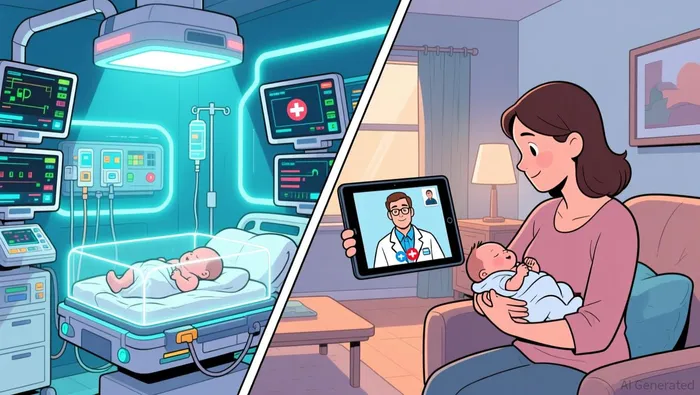
- Increased acuity, especially in neonatology, has been a positive factor, with telemedicine expanding reach to underserved areas.
Operational and Strategic Focus:
- The company is building a significant telemedicine function to augment physical services, leveraging its large footprint in neonatology and maternal fetal medicine.
- Strategic positioning emphasizes combining telemedicine with physical patient visits, with tele-hybrid medicine seen as a significant value addition.
- Active exploration of growth avenues within women's and children's medicine includes potential joint ventures and partnerships with capital investors.
Sentiment Analysis:
Overall Tone: Positive
- "We are pleased to report another solid quarter with adjusted EBITDA of $76 million." "Our overall results for the quarter were in line with our expectations, and we reaffirm our full year 2026 outlook." "We've spoken before about our financial strength, which enables our consistent support for our practices, quality programs, research, and growth."
Q&A:
- Question from Ryan Daniels (William Blair): With the payer mix remaining stable this quarter and increasing for commercial non-government payers year over year and from Q1, based on the prepared remarks, why do you think you have been having a stable payer mix compared to your other peers in health care? And then any pulling on the consumer trend that is driving that payer mix for you, as well as any insights into your expectations of how this payer mix could hold up into the second half?
Response: Management believes the stability is due to logical reasons like higher perceived value of insurance during pregnancy, but acknowledges they are not immune from future changes and sees no negative signs to date.
- Question from Ryan Daniels (William Blair): Given that we've seen a couple of quarters of this volume decrease, do you still believe this is not a trend occurring? And if so what's that reasoning behind the belief that the decrease in the patient volume seen is not a trend occurring?
Response: Volume is on trend with past seasonal patterns, and the company expects full-year volume to be flat to slightly down, though they recognize the possibility of an ongoing trend.
- Question from A.J. Rice (UBS): On the pricing, I know you're attributing part of that to Better Collections, part of it to Pay or Mix, and it sounds like some of it to Acuity. Is there any way to delineate that a little further into what are the drivers, the extent to which any of those were the primary drivers?
Response: The primary drivers in order are RCM collections (biggest), payer mix (second), and acuity (third), which together account for about 95% of pricing. RCM tailwind is expected to dissipate in the second half, but acuity is expected to remain strong.
- Question from A.J. Rice (UBS): On the non-same-store contribution to growth, acquisitions offset maybe by a little bit of dispositions. Can you tell us a little more about what you're doing on the acquisition front, what you're seeing, pricing, and then was there much in the way of dispositions or is most of that behind you at this point?
Response: All dispositions are behind the company. They see opportunities with fair pricing and potential capital partner involvement for larger deals, focusing on women's and children's space that makes operating and financial sense.
- Question from A.J. Rice (UBS): It sounded like there might be some unusual items. I think you mentioned executive transition compensation in the G&A. Is there an unusual item in there that we should back out to come up with a run rate for G&A going forward?
Response: G&A for 2026 is expected in the $230-$240 million range, likely on the higher end due to one-time executive transition costs in Q2, which will step down in the second half.
- Question from Jack Sledden (Jefferies) [on for Brett Grolkowski]: Pricing in the back half of the year, what are the trends you're currently expecting? I know you kind of called out the RCM comps there, but do you see any other incremental opportunities?
Response: Pricing drivers are expected to follow the same four factors (RCM collections, acuity, payer mix, contract revenue), with RCM tailwind lapping but acuity remaining positive.
- Question from Jack Sledden (Jefferies) [on for Brett Grolkowski]: Could you give some extra color on where you're seeing wage inflation tracking? How can we expect this to progress into the rest of the year and then maybe into 2027?
Response: Salary increases have been tightly controlled in a 3-3.5% range recently, a significant improvement from historical mid-single-digit increases, with no anticipated change.
Contradiction Point 1
Spelling of Chief Executive Officer's Name
Inconsistent spelling of the CEO's name in official responses.
Matthew Mardula (William Blair) - Matthew Mardula (William Blair)
2026Q2: We have not seen the same payer mix shifts as other peers... There has been no sign of change at Pediatrics to date. - Mark Wardan(CEO)
Given the stable payer mix compared to peers, what factors are driving this trend and your expectations for the second half? - Matthew Mardula (William Blair)
2026Q2: The company has not seen the same payer mix shifts as other healthcare entities... There has been no sign of change at Pediatrix to date. - Mark Ordan(CEO)
Contradiction Point 2
G&A Expense Run Rate Expectation
Contradiction on the expected run rate for G&A expenses in 2026.
What are your key takeaways from the earnings report, A.J. Rice (UBS)? - A.J. Rice (UBS)
2026Q2: G&A for 2026 is expected in the range of $230 to $240 million, likely on the higher end. - Cassandra Rossi(CFO)
Were there any unusual items, such as executive transition compensation in G&A expenses, that should be backed out to determine the run rate for G&A going forward? - A.J. Rice (UBS)
2026Q2: G&A for 2026 is expected to be in the range of $230 million-$240 million. - Kasandra Rossi(CFO)
Contradiction Point 3
Payer Mix Trends and Outlook
Contradiction on whether payer mix is stable/unchanging or faces potential future shifts.
Matthew Mardula (William Blair) - Matthew Mardula (William Blair)
2026Q2: We have not seen the same payer mix shifts as other peers... There has been no sign of change at Pediatrics to date. We are not immune, but the trend has been strong, and we will monitor the future. - Mark Wardan(CEO)
Given the stable payer mix this quarter and increasing commercial non-government payers YoY and from Q1, what factors are driving this trend compared to peers, and how do you expect the payer mix to hold up in the second half? - Jack Slevin (Jefferies LLC)
2026Q1: No signs of weakness are seen across geographies or service lines. Speculation exists that cost-benefit calculations may keep people in insurance exchanges, but no negative trends are confirmed. - Mark Ordan(CEO)
Contradiction Point 4
Pricing Drivers and Forecast
Contradiction on the primary drivers of pricing and the expectation for RCM collections.
A.J. Rice (UBS) - A.J. Rice (UBS)
2026Q2: The primary drivers are: 1. RCM collections (biggest contributor), 2. Payer mix (close second), 3. Acuity (also contributing). These account for about 95% of pricing. RCM collection tailwinds are expected to dissipate in the second half of 2026... - Cassandra Rossi(CFO)
Can you break down the pricing changes further by Better Collections, Payer Mix, and Acuity, and clarify which is the primary driver? - Matthew Mardula (William Blair & Company L.L.C.)
2026Q1: Pricing strength is driven by four factors: RCM cash collections (strong in H1, will lap in H2), contract administrative fees (currently strong but hospital pressures may affect future), favorable payer mix... Pricing is expected to tick down through the year but no other major headwinds are identified. - Kasandra Rossi(CFO)
Contradiction Point 5
Pricing and Revenue Outlook
Contradiction on pricing trend sustainability and revenue growth drivers.
What were A.J. Rice's (UBS) key questions during the earnings call? - A.J. Rice (UBS)
2026Q2: The primary drivers are: 1. RCM collections (biggest contributor), 2. Payer mix (close second), 3. Acuity (also contributing). These account for about 95% of pricing. RCM collection tailwinds are expected to dissipate in the second half of 2026, but acuity is expected to remain strong. - Cassandra Rossi(CFO)
Can you break down the pricing changes further by Better Collections, Payer Mix, and Acuity, and identify which are the primary drivers? - Ann Hynes (Mizuho Securities USA LLC)
2025Q4: The pricing assumption is **not tied to exchanges**. It is based on expecting 2026 factors (volume, acuity, payer mix) to remain steady as an average of 2025 levels, which did include some favorable payer mix. The strong pricing is driven by solid RCM cash collections, favorable payer mix, increased acuity... and is expected to remain steady in 2026. - Kasandra Rossi(CFO) & Mark Ordan(CEO)

Discover what executives don't want to reveal in conference calls
Latest Articles
Stay ahead of the market.
Get curated U.S. market news, insights and key dates delivered to your inbox.


AInvest
PRO
AInvest
PRO




Comments
No comments yet