
peaq PEAQ Powers Decentralized Machine Economy With High-Throughput Layer-1
 Aime Summary
- peaq is a Layer-1 blockchain and operating system (peaqOS) enabling physical devices to act as autonomous economic agents.
- The network utilizes parallel block production to achieve 10,000 transactions per second with minimal costs.
- The native $PEAQ token facilitates network security, governance, and pays for all machine transactions.
- The ecosystem currently hosts over 30 live DePIN projects.
- The token operates on a disinflationary model with a maximum supply of 4.2 billion tokens.
peaq is a blockchain infrastructure project building a decentralized Machine Economy where physical devices like robots, sensors, and vehicles act as autonomous economic agents . It provides a neutral, omnichain layer allowing machines to own identities, transact, and earn value on-chain . The technology is built as a scalable, EVM-compatible Layer-1 with a dedicated operating system (peaqOS) for easy machine integration .
The architecture consists of peaqOS, an SDK providing modular functions for machine identity, payments, and data access . A decentralized Trust Layer records all ownership and transactions . The network utilizes parallel block production to achieve high throughput, currently supporting up to 10,000 transactions per second . This infrastructure aims to accommodate billions of connected devices with minimal cost .
How Does peaq Enable Machine Autonomy?
peaq addresses the limitation of traditional systems where device-generated value remains siloed within corporate databases . It solves this by providing a neutral, omnichain coordination layer that grants machines verifiable on-chain identities (peaqID) . These identities allow devices to hold embedded wallets and autonomously earn, pay, and build credit histories .
peaqOS is a software development kit offering modular functions for machine identity and payments . This SDK gives builders the tools to integrate machine capabilities directly into the blockchain . The system transforms devices from passive data collectors into independent participants in open markets .
The Trust Layer serves as the decentralized backbone recording all ownership and transactions . It ensures that machine interactions are secure, transparent, and immutableIMX-- . This foundation allows physical assets to transact without relying on centralized intermediaries .
What Is the Role of the $PEAQ Token?
The native $PEAQ token underpins the network's utility and security . It is used to pay gas fees for machine transactions across the ecosystem . The token also secures the network via Delegated Proof of Stake (DPoS) staking . Validators and delegators stake $PEAQ to maintain network integrity .
Token holders participate in governance decisions regarding ecosystem upgrades and machine subsidies . The token may also serve as a reputation proof for machine owners . Its utility is directly tied to machine activity and network growth .
The PEAQ token operates on a disinflationary economic model . Inflation starts at 3.5% for early participants and decreases by 10% annually . This rate stabilizes at 1% to ensure long-term network sustainability .
The maximum total supply is 4.2 billion tokens . Initial distribution supports various stakeholders, with 20% allocated to Community Campaigns . The Core Team holds 15% and EoT Labs holds 13% .
Private and Pre-Launch Private Sales feature a six-month lock-up followed by an 18-month vesting period . Seed and Pre-Seed rounds have a six-month lock-up and 24-month vesting period . Significant unlock events are scheduled for mid-2026 .
How Is peaq Used in Decentralized Physical Infrastructure?
The ecosystem currently hosts over 30 live DePIN projects. These applications span areas like noise pollution monitoring, decentralized energy grids, and tokenized robotics . Each project leverages peaq's high-throughput capabilities for real-world data and asset management .
DePIN projects on peaq enable sensors to transact autonomously for data verification . Robots can earn value by performing tasks and paying for services directly on-chain . This creates a self-sustaining economic loop for physical infrastructure .
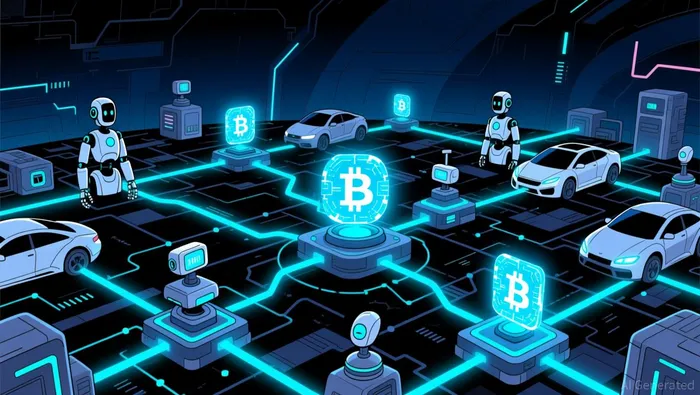
The platform supports applications in decentralized energy grids where devices trade power . Noise pollution monitoring initiatives use sensors to report environmental data for rewards . Tokenized robotics allows physical machines to operate as independent economic entities .
peaq's infrastructure unlocks the economic potential of devices traditionally locked in corporate databases . By enabling on-chain identities and wallets, peaq creates a new market for machine-generated value . This approach supports the growth of a truly decentralized physical economy .

Blending traditional trading wisdom with cutting-edge cryptocurrency insights.
Latest Articles
Stay ahead of the market.
Get curated U.S. market news, insights and key dates delivered to your inbox.


AInvest
PRO
AInvest
PRO




Comments
No comments yet