
PCG Tops Market Volume Despite 22 Percent Drop as Debt Buyback Closes
 Aime Summary
Market Snapshot
Pacific Gas and Electric Company (NYSE: PCG) shares experienced a modest decline on July 31, 2026, closing down 2.25% amidst a notable contraction in trading activity. The stock’s total trading volume for the day reached $0.50 billion, marking a significant 22.3% decrease compared to the previous day’s levels. Despite the drop in turnover, the utility giant maintained its position as the most actively traded stock in the broader market for that session, ranking first in terms of trading volume. This juxtaposition of a price decline with a reduction in overall capital flow suggests a period of consolidation or cautious positioning by investors, particularly as the company concluded major corporate finance activities earlier in the day. The downward pressure on the share price occurred against the backdrop of a market environment where PCGPCG-- had previously demonstrated resilience, having traded up 2.8% in recent sessions and sitting well above its 50-day and 200-day moving averages of $16.91 and $17.00, respectively.
Key Drivers
The primary catalyst for the company’s recent market activity was the conclusion of its previously announced cash tender offers aimed at repurchasing up to $1.2 billion of its outstanding debt securities. On July 31, the expiration date for these offers, Pacific Gas and Electric finalized the pricing and acceptance terms for its bonds. The company successfully accepted all valid tenders for its 3.30% Senior Notes due December 2027, which had an aggregate principal amount tendered of approximately $1.07 billion. For the 2.10% First Mortgage Bonds due August 2027, the company adopted a pro-rata acceptance method, accepting 26.6% of the tendered bonds, which totaled approximately $841 million in principal value. The tender consideration was set at $985.34 per $1,000 principal amount for the senior notes and $977.95 per $1,000 for the first mortgage bonds, excluding accrued interest. This aggressive debt buyback strategy signals the utility’s intent to optimize its capital structure and manage interest rate exposure, a move that generally supports long-term financial health but may have contributed to short-term volatility as the market digested the implications for equity value.
Beyond the immediate debt restructuring, the stock’s performance is deeply rooted in the company’s recent fundamental results and forward-looking guidance. Pacific Gas and Electric reported second-quarter earnings on July 23, delivering a per-share profit of $0.40, which exceeded analyst consensus estimates of $0.36 by $0.04. While the company’s quarterly revenue of $5.90 billion fell slightly short of the $6.20 billion expected by Wall Street, the bottom-line beat highlighted improved cost management and operational efficiency. The firm posted a net margin of 12.25% and a return on equity of 12.48%, underscoring its ability to generate profits despite macroeconomic headwinds. Furthermore, the company reaffirmed its fiscal year 2026 earnings per share guidance at a range of $1.64 to $1.66, providing investors with clearer visibility into its near-term profitability prospects.
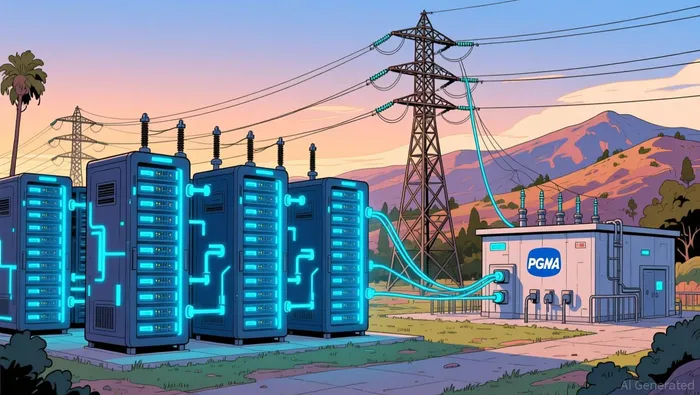
A significant structural shift in the company’s growth narrative is also influencing investor sentiment, particularly regarding its expansion into the power sector driven by artificial intelligence infrastructure. Management highlighted that PG&E’s data center project pipeline more than doubled during the second quarter, reflecting a robust demand for electrical capacity from the technology sector. The company has set an ambitious target of achieving annual earnings per share growth of over 9% through 2030, a goal that relies heavily on this new revenue stream. By reaffirming that there are no immediate needs for new equity issuance, PG&E is signaling confidence in its internal cash generation capabilities to fund these capital-intensive projects, thereby reducing dilution concerns for existing shareholders.
Market analysts remain generally optimistic about the utility’s trajectory, maintaining a consensus "Moderate Buy" rating with an average price target of $22.30. Major financial institutions have recently adjusted their views on the stock, with Morgan Stanley setting a price target of $22.00 and Wells Fargo maintaining an "overweight" rating with a $25.00 target. JPMorgan Chase and Truist Financial have also adjusted their price objectives to $23.00 and $22.00, respectively, while maintaining positive or neutral ratings. This analyst support suggests that despite the recent 2.25% dip, the broader market views PG&E as a stable play with significant upside potential, driven by its dual exposure to traditional utility stability and the burgeoning AI energy demand.
Institutional ownership patterns further reflect this strategic interest in the stock. Recent filings indicate that hedge funds and other institutional investors continue to adjust their positions, with some major players significantly increasing their stakes. For instance, Brown Brothers Harriman & Co. raised its stake by over 900% in the third quarter, while other firms like CoreCap Advisors LLC increased their holdings by 13.1% in the second quarter. With approximately 78.56% of the stock owned by institutional investors, the stock’s price action is heavily influenced by large-scale capital flows and long-term strategic allocations rather than short-term retail speculation. This high level of institutional conviction provides a floor for the stock price, even as daily trading volumes fluctuate in response to specific corporate announcements like the bond tender offer completion.

Stay ahead of the market.
Get curated U.S. market news, insights and key dates delivered to your inbox.


AInvest
PRO
AInvest
PRO




Comments
No comments yet