
PCE Report and Its Implications for Monetary Policy and Equity Valuations


 Aime Summary
The Personal Consumption Expenditures (PCE) price index, the Federal Reserve's preferred inflation gauge, has emerged as a pivotal barometer for monetary policy decisions in 2026. With core PCE inflation
projected to remain above 3% through Q3 2026 and over 2% through 2027, the Fed faces a delicate balancing act: addressing persistent inflation while navigating a weakening labor market. A hotter-than-expected PCE print could delay rate cuts, reshaping equity sector dynamics and investor strategies.
Fed's Cautious Approach to Rate Cuts
The Federal Reserve's December 2025 meeting underscored its data-dependent stance, with policymakers
opting for a 25-basis-point rate cut despite inflation remaining above the 2% target. This cautious approach reflects a broader strategy to avoid overreacting to short-term economic fluctuations.
Goldman Sachs Research forecasts a pause in January 2026, followed by cuts in March and June, bringing the terminal rate to 3–3.25% by midyear. However, Bank of AmericaBAC-- (BofA) warns that
if core PCE inflation stays above 3% through Q3 2026, as projected by the Cleveland Fed's nowcasting model, the Fed may delay cuts further, limiting their stimulative impact on the economy.
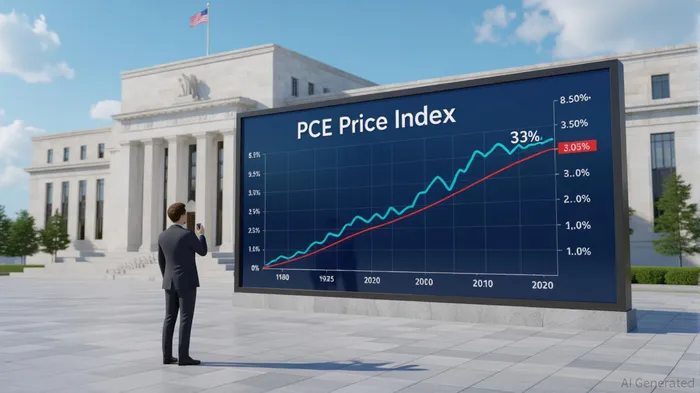
The Fed's median projection, as outlined in the September 2025 dot plot,
anticipates only one rate cut in 2026-a stark contrast to market expectations of multiple reductions. This divergence highlights the central bank's prioritization of inflation control over aggressive easing, even as labor market weakness and slowing growth create pressure for accommodative policy.
Sector Rotation in a Delayed Rate-Cut Scenario
A hotter-than-expected PCE report would likely trigger a shift in equity sector dynamics. Historically, rate cuts have favored long-duration growth stocks, but delayed easing could reverse this trend. For instance, valuation-driven tech and consumer discretionary sectors-sensitive to rising bond yields-may underperform if inflation persists
as reported by Economic Times. Conversely, defensive sectors like utilities and healthcare could gain traction as investors seek stability amid macroeconomic uncertainty
according to Investing.com analysis.
The market is already showing signs of rebalancing. According to a report by Financial Content,
investors are rotating toward traditional financial services and energy sectors, which benefit from interest rate stability and normalized economic conditions. This shift reflects a broader preference for established profitability over speculative growth, particularly in AI-driven segments that have seen rapid expansion.
Real estate and yield-oriented sectors could also benefit if rate cuts eventually materialize, though excess supply in commercial real estate remains a drag
as noted in FXStreet analysis. Meanwhile, a weaker dollar and easing financial conditions may support emerging market assets, provided inflation moderation aligns with Fed expectations
as detailed in FXStreet analysis.
Strategic Implications for Investors
Investors must navigate a landscape of heightened volatility and uneven sector performance. A delayed rate-cut cycle necessitates a focus on diversification and disciplined risk management. As noted by BlackRock,
portfolios should prioritize U.S. large-cap stocks, high-quality bonds, and selective credit opportunities. Additionally, the potential for a weaker dollar underscores the importance of hedging currency exposure in global portfolios.
The coming months will hinge on the Fed's ability to reconcile conflicting signals-softening labor markets versus stubborn inflation. If core PCE inflation cools to 2% by mid-2026
as Goldman Sachs projects, the stage could be set for a more aggressive easing cycle. However, any deviation from this path risks prolonging uncertainty and further reshaping sector rotation patterns.
Conclusion
The PCE report remains a critical determinant of monetary policy and equity valuations in 2026. A hotter-than-expected print could delay rate cuts, forcing the Fed to prioritize inflation control over growth support. For investors, this scenario demands agility, with a strategic tilt toward defensive sectors and a cautious approach to high-growth assets. As the Fed navigates this complex environment, market participants must remain attuned to evolving data and policy signals.

Stay ahead of the market.
Get curated U.S. market news, insights and key dates delivered to your inbox.




Comments
No comments yet