
The PCE Report and Its Implications for the Federal Reserve's Policy Path
 Aime Summary
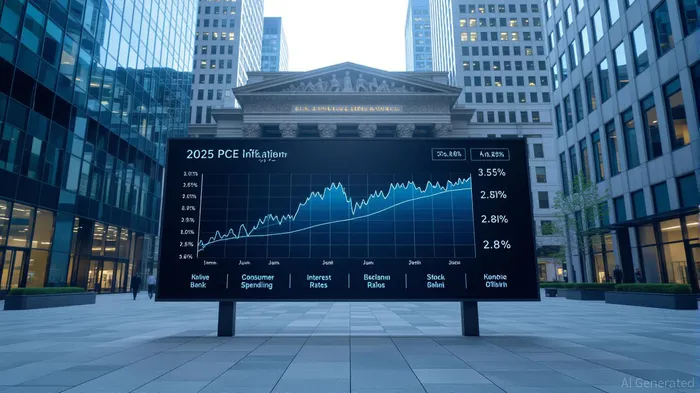
The September 2025 Personal Consumption Expenditures (PCE) report, the Federal Reserve's preferred inflation gauge, has sparked renewed debate about the central bank's policy trajectory. With both headline and core PCE inflation rates holding steady at 2.8% year-over-year, the data underscores a delicate balance between persistent inflation and a softening economy
according to the report. This report, delayed by a 43-day government shutdown, has reshaped market expectations for rate cuts and recalibrated asset allocation strategies across sectors.
Inflation Persistence and the Fed's Dilemma
The core PCE index, which excludes volatile food and energy prices,
rose 0.2% month-over-month in September, marking the lowest annual rate since May 2025. While this signals gradual progress in the Fed's battle against inflation, the 2.8% figure remains above the central bank's 2% target.
According to a Bloomberg report, the Federal Reserve has adopted a cautious stance, emphasizing a "data-dependent" approach as it navigates the tension between curbing inflation and supporting a labor market showing signs of strain.
The September data also reveals a slowdown in consumer spending, which
grew by just 0.3% compared to August's 0.5% increase. This moderation suggests that households are grappling with tighter budgets, with personal savings rates still below pre-pandemic levels.
As noted by the U.S. Bureau of Economic Analysis, the interplay between inflation and consumer behavior will likely remain a critical factor in the Fed's decision-making process.
Rate Cut Expectations and Market Signals
The Federal Reserve's October 2025 meeting delivered a
25-basis-point rate cut, reflecting its acknowledgment of a cooling labor market and the need to support full employment. Market participants, however, are pricing in further easing. The CME FedWatch Tool indicates an 87.2% probability of a 25-basis-point cut at the December meeting,
with additional reductions anticipated by June 2026. This trajectory suggests that the Fed is preparing for a prolonged period of accommodative policy, even as inflation remains stubbornly above target.
The bond market has already responded to these expectations. The 10-year U.S. Treasury yield closed September at 4.16%, down from 4.23% in August,
reflecting diminished concerns about inflation and a stronger appetite for risk assets. This decline has provided a tailwind for bond indices, with the Bloomberg U.S. Aggregate Index
posting a 1.09% return for the month. Such movements highlight the growing alignment between market sentiment and the Fed's potential policy path.
Sector Opportunities in a Shifting Landscape
The evolving inflation and rate-cut environment is prompting investors to reassess sector allocations. In equities, large-cap growth stocks-particularly the Magnificent 7 (Mag-7) companies-
have outperformed, gaining nearly 9.0% in September. This performance underscores the market's confidence in technology-driven growth, even as broader economic conditions remain uncertain. Conversely, discretionary sectors face headwinds as consumers prioritize essential spending over non-essentials
according to Highland Associates.
Fixed-income strategies are also adapting. High-yield municipal bonds and Treasury Inflation-Protected Securities (TIPS) are gaining traction as tools to hedge against inflation and diversify portfolios
according to U.S. Bank. The Bloomberg Municipal Bond Index
returned 2.32% in September, outpacing many other asset classes. Meanwhile, the Russell 2000's all-time high suggests that small-cap stocks are benefiting from a broad-based market rally, albeit with heightened sensitivity to interest rate fluctuations
according to CCMG.
Looking Ahead: Balancing Risks and Opportunities
The Federal Reserve's next moves will hinge on the interplay between inflation persistence and labor market dynamics. While the September PCE report provides some optimism about inflation moderation, the central bank remains vigilant about potential risks,
including the impact of tariffs on corporate margins and the eventual unwinding of inventory adjustments. Investors must remain agile, balancing exposure to growth sectors with defensive strategies that mitigate downside risks.
As the Fed inches closer to a 3% policy rate by mid-2026, the investment landscape will continue to evolve. The key for market participants lies in aligning their strategies with the Fed's dual mandate-price stability and maximum employment-while navigating the uncertainties of a post-pandemic economy.

Stay ahead of the market.
Get curated U.S. market news, insights and key dates delivered to your inbox.






Comments
No comments yet