
The PCE Report and Its Implications for Equity Valuations


 Aime Summary
Disinflationary Trends and the Fed's Balancing Act
The October PCE report highlighted a persistent but moderating inflationary trajectory. Core PCE, the Fed's preferred metric, edged down from 2.9% in August to 2.8% in September, with forecasts pointing to a further decline to 2.7-2.8% in October. While this signals progress toward disinflation, the headline PCE remained near the 2% threshold, reflecting softer goods prices and stable energy costs. The Cleveland Federal Reserve's nowcasting model projects a gradual decline in core PCE through mid-2026, with a 2% target not expected until the latter half of the year.
The Fed's October 2025 FOMC meeting, held on October 28–29, responded to these trends with a 25-basis-point rate cut, lowering the federal funds rate to 3.75%-4.00%. Policymakers acknowledged "moderate" economic growth, a "low" but rising unemployment rate, and inflation that remained "somewhat elevated." This decision reflected a recalibration of risks, particularly downside threats to employment, while maintaining a commitment to achieving the 2% inflation goal. The FOMC also announced the conclusion of its securities holdings reduction by December 1, 2025, signaling a pivot toward accommodative policy.
Market Sentiment and S&P 500 Momentum
The October PCE data and FOMC action ignited optimism about further rate cuts, directly influencing equity valuations. The S&P 500 closed October 2025 up 2.27% at 6,840.20, with analysts like Wells Fargo raising year-end 2025 targets to 7,100, citing improved liquidity and earnings growth. This momentum was fueled by the CME FedWatch Tool, which indicated an 87% probability of a December rate cut following the PCE report.
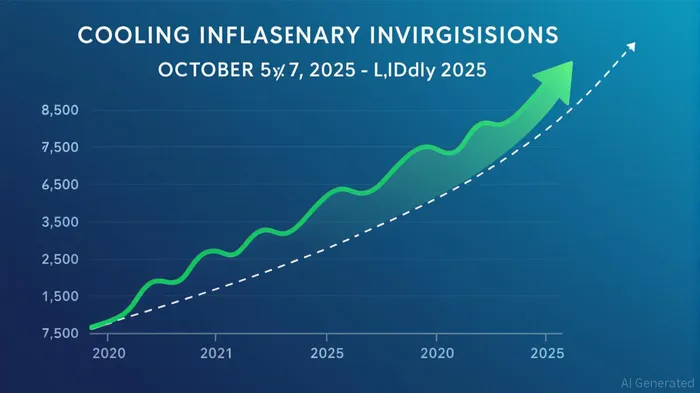
Investor sentiment metrics further underscored this optimism. The VIX Index, a gauge of market volatility, ended October at 17.44-moderate compared to earlier peaks but elevated relative to September's average. Meanwhile, the VIX put/call ratio of 0.70 as of December 4, 2025, highlighted a shift toward bullish positioning, with call options outpacing puts. These metrics contrasted with a temporary spike in bearish sentiment on October 10, when the put/call ratio reached 1.08 amid a selloff, illustrating the market's sensitivity to inflation data and policy signals.
Sectoral Implications and Valuation Concerns
The Fed's dovish pivot and cooling inflation disproportionately benefited sectors reliant on low borrowing costs. Technology and consumer discretionary stocks surged, driven by reduced capital costs and heightened consumer demand. Real estate and home construction companies also gained traction, as cheaper mortgage rates stimulated housing activity. However, the S&P 500's P/E10 ratio of 39.2 as of September 2025-its highest level since October 2000-raises concerns about long-term valuation sustainability. This metric, which averages earnings over a 10-year period, suggests that while short-term optimism persists, investors must remain cautious about overvaluation risks.
Conclusion: Navigating the Fed's Inflation Narrative
The October 2025 PCE report and subsequent Fed action illustrate the delicate interplay between disinflationary trends and market expectations. While the Fed's rate cuts and accommodative stance have bolstered equity valuations and S&P 500 momentum, the path to a "soft landing" remains contingent on sustained inflation moderation and balanced risk management. Investors must weigh the immediate benefits of lower borrowing costs against long-term valuation metrics and sector-specific vulnerabilities. As the Fed continues its inflation narrative, the market's ability to adapt to evolving policy signals will remain critical to sustaining growth in 2026.

Delivering real-time insights and analysis on emerging financial trends and market movements.
Latest Articles
Stay ahead of the market.
Get curated U.S. market news, insights and key dates delivered to your inbox.






Comments
No comments yet