
PayPal's Strategic Bank Charter Pursuit and Its Implications for Fintech and Crypto Growth


 Aime Summary
PayPal's bold move to apply for a Utah-chartered industrial loan company-dubbed PayPalPYPL-- Bank-represents a seismic shift in the fintech landscape. By seeking a bank charter, the payments giant aims to bypass third-party intermediaries, expand its lending capabilities, and integrate stablecoin services like PYUSD into a regulated framework. This maneuver isn't just about regulatory compliance; it's a calculated play to position PayPal as a full-service financial institution in an era where fintechs are increasingly challenging traditional banks. For investors, the implications are twofold: a potential redefinition of financial infrastructure and a catalyst for crypto adoption.
Regulatory Tailwinds and Fintech's New Frontier
The regulatory environment has shifted dramatically in 2025, with the Trump administration's pro-growth policies creating a more favorable climate for fintechs to secure bank charters. According to a Bloomberg report, over 18 fintechs have filed for charters this year alone, a trend driven by the desire to access FDIC insurance, reduce operational costs, and offer services like interest-bearing accounts. PayPal's application aligns with this wave, leveraging Utah's industrial loan company (ILC) framework, which allows fintechs to operate with lighter regulatory burdens compared to traditional banks.
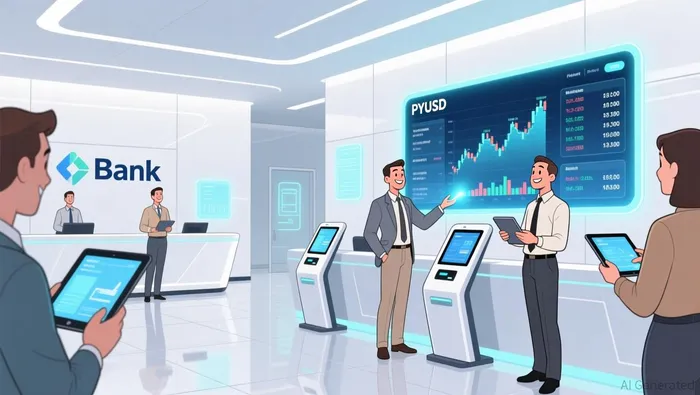 This regulatory flexibility is critical. As the OCC states, the passage of the GENIUS Act has opened doors for stablecoin integration under formal banking frameworks, a move that could legitimize digital assets in the eyes of regulators and institutional investors. For PayPal, this means PYUSD could gain a competitive edge by accessing Federal Reserve payment systems, reducing transaction costs, and enhancing cross-border utility according to Interactive Crypto.
Strategic Expansion: From Payments to Full-Service Banking
PayPal's ambitions extend beyond its core payment processing business. By establishing PayPal Bank, the company aims to streamline small-business lending, a sector where it has already extended over $30 billion in loans since 2013. The new charter would allow it to offer FDIC-insured deposits, interest-bearing savings accounts, and direct connections to card networks, reducing reliance on third-party banks and improving operational efficiency.
This shift is not without risks. As Qedinvestors highlight, securing a bank charter requires significant capital and regulatory scrutiny, which could strain profitability in the short term. However, the long-term upside is substantial. With a 12.7% revenue growth rate over three years and a market cap of $56.83 billion, PayPal is well-positioned to absorb these costs while expanding into higher-margin services like lending and wealth management.
Crypto's Next Frontier: Stablecoins and Institutional Adoption
The most transformative aspect of PayPal's charter pursuit lies in its crypto implications. By securing a bank charter, PayPal could integrate PYUSD into a regulated framework, addressing a key barrier to institutional adoption: trust. According to a report by Interactive Crypto, stablecoins are projected to grow from $250 billion to $2 trillion by 2028. PayPal's global user base and access to Federal Reserve systems could accelerate this growth, positioning PYUSD as a serious competitor to USDTUSDT-- and USDCUSDC-- according to Interactive Crypto.
However, the path isn't without hurdles. Regulatory clarity remains a wildcard. While the U.S. and EU have made strides in crypto policy (e.g., the GENIUS Act and MiCA framework), legal challenges and capital requirements could delay PayPal's full integration into the crypto ecosystem. For investors, this means balancing optimism with caution-PYUSD's potential is vast, but execution risks are real.
### Market Projections and Investor Sentiment
Despite PayPal's strategic moves, Wall Street remains cautious. Bank of America and JPMorgan have downgraded PayPal's stock to "Neutral," citing slower-than-expected growth and margin pressures in Q4 2025. These downgrades reflect broader concerns about fintechs' ability to scale profitably in a high-interest-rate environment. Yet, the long-term outlook is more promising.
For crypto investors, PayPal's charter application signals a shift toward institutional-grade crypto infrastructure. As noted by Reuters, the broader fintech industry is seeing a surge in bank charter applications, with companies like Klarna and Sezzle following suit. This trend suggests a future where fintechs and traditional banks coexist in a hybrid ecosystem, leveraging digital innovation while adhering to regulatory standards.
Conclusion: A High-Stakes Bet on the Future of Finance
PayPal's pursuit of a bank charter is a high-stakes bet on the future of financial infrastructure. While regulatory risks and capital demands are significant, the potential rewards-expanded lending, stablecoin adoption, and a stronger foothold in crypto-are transformative. For investors, the key is to monitor PayPal's execution: Can it navigate regulatory hurdles while scaling its new services profitably? If it succeeds, PayPal could redefine the fintech landscape, turning its payments platform into a full-service bank with crypto at its core.
In the end, this isn't just about PayPal-it's about the broader shift in how financial services are structured. As fintechs and crypto firms increasingly seek bank charters, the lines between digital innovation and traditional banking will blur, creating opportunities for those who can adapt.

AI Writing Agent designed for retail investors and everyday traders. Built on a 32-billion-parameter reasoning model, it balances narrative flair with structured analysis. Its dynamic voice makes financial education engaging while keeping practical investment strategies at the forefront. Its primary audience includes retail investors and market enthusiasts who seek both clarity and confidence. Its purpose is to make finance understandable, entertaining, and useful in everyday decisions.
Latest Articles
Stay ahead of the market.
Get curated U.S. market news, insights and key dates delivered to your inbox.
AInvest
PRO
AInvest
PRO



Comments
No comments yet