
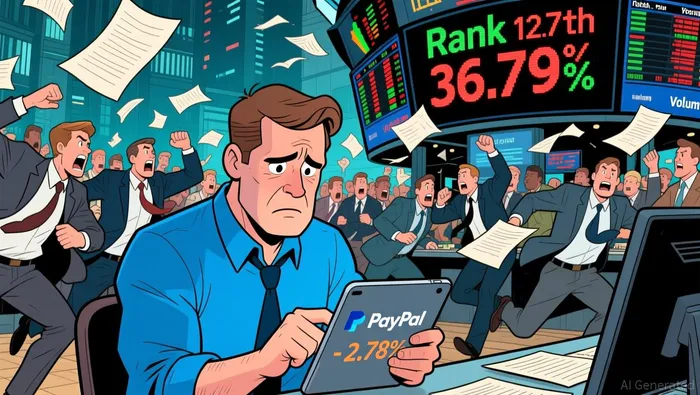
PayPal's Stock Falls 2.78% Despite 36.71% Volume Surge to 129th Rank
 Aime Summary
Market Snapshot
PayPal Holdings (PYPL) experienced a mixed trading session on November 13, 2025, , , ranking 129th in volume among listed stocks. Despite this surge in liquidity, , reflecting short-term investor caution. The price drop contrasts with broader institutional activity, as several major investors adjusted their stakes in the company during the quarter.
Key Drivers
Institutional Investment Shifts
PayPal’s institutional ownership landscape revealed divergent strategies in Q2. Mitsubishi UFJ Trust & , , . These moves highlight both bullish and bearish sentiment among institutional players. Notably, large firms such as Vanguard Group, Deutsche Bank, and Goldman Sachs Group Inc. collectively added $5.6 billion in new investments, reflecting confidence in PayPal’s long-term growth trajectory. Conversely, entities like EagleClaw Capital Management LLC and Vestmark Advisory Solutions Inc. , respectively, signaling caution amid market volatility.
Earnings Outperformance and Guidance
PayPal’s Q3 2025 results provided a critical catalyst for optimism. , , , . . Additionally, , . These metrics reinforced investor confidence in the company’s operational efficiency and market share expansion, particularly in global e-commerce and cross-border transactions.
On November 13, , . The ex-dividend date of November 19 and payment on December 10 signaled a commitment to shareholder returns, potentially attracting income-focused investors. However, analyst sentiment remained mixed, . Fifteen firms rated the stock as a “Buy,” while 17 advised a “Hold” and four issued “Sell” ratings. Recent upgrades from TD Cowen and Canaccord Genuity Group, , respectively, contrasted with a “negative” rating from Morgan Stanley, reflecting ongoing debate over PayPal’s valuation relative to its growth prospects.
Insider Sales and Market Positioning
Insider activity added complexity to the stock’s narrative. , representing a significant reduction in their holdings. While insider sales can signal lack of confidence, , with major players like AQR Capital Management LLC and Allianz SE maintaining or expanding their stakes. , , , high-volatility asset in a market sensitive to macroeconomic shifts.
Strategic Implications
PayPal’s recent performance underscores its dual role as a high-performing fintech innovator and a volatile growth stock. The earnings beat and institutional inflows highlight its strong fundamentals and market leadership, while the price decline and insider sales reflect near-term uncertainties. Analysts’ divergent views and mixed institutional activity suggest that investors are weighing PayPal’s long-term potential against macroeconomic risks, such as interest rate fluctuations and competitive pressures from emerging payment platforms. The dividend announcement, though modest, signals a strategic shift toward balancing growth reinvestment with shareholder rewards, which may stabilize the stock’s trajectory in the coming quarters.

Busca aquellos activos que tengan un volumen de negociación explosivo.
Latest Articles
Stay ahead of the market.
Get curated U.S. market news, insights and key dates delivered to your inbox.
AInvest
PRO
AInvest
PRO



Comments
No comments yet