
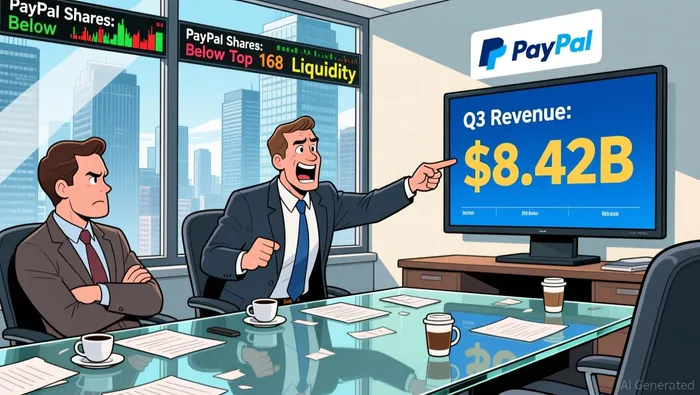
PayPal Q3 Earnings Beat Can't Lift Shares to Top 168 in Liquidity as Skepticism Lingers Despite $8.42 Billion Revenue Surge
 Aime Summary
Market Snapshot
On November 6, 2025, , underperforming the broader market. , ranking 168th in terms of liquidity among U.S. equities. Over the past month, , . The drop came despite the company reporting third-quarter results that exceeded revenue and earnings estimates, , . However, the stock’s negative move suggests investor skepticism about the sustainability of these results or broader market sentiment.
Key Drivers
PayPal’s third-quarter earnings report highlighted robust growth in core financial metrics, yet the stock’s underperformance points to lingering concerns among investors. , , , matching analyst expectations. Transaction take rate, a critical metric for profitability, , . These figures underscore PayPal’s ability to maintain transactional profitability, but the marginal decline in take rate may signal competitive pressures or strategic shifts to prioritize volume over margin.
A key focus for investors is the disparity between TPV and transaction margin growth. , , raising concerns about the quality of volume expansion. Analysts have noted that TPV outpacing TM$ could indicate an increase in lower-margin payment channels, such as credit or debit card transactions, rather than higher-margin linked bank accounts or digital wallet usage. PayPal’s management, under CEO , has emphasized stabilizing transaction profitability, but the slight divergence in metrics may fuel doubts about the company’s ability to sustain margins amid evolving consumer behavior.
Strategic initiatives, particularly in the Branded segment, provided a counterbalance. , driven by U.S. market expansion, Venmo monetization, and (BNPL) offerings. . These growth vectors align with PayPal’s long-term strategy to diversify revenue streams, but their contribution to near-term profitability remains speculative. Investors may be weighing the trade-off between top-line growth and margin preservation, particularly as BNPL faces regulatory scrutiny in some markets.
Despite the earnings beat, , suggesting the market views the results as in line with expectations rather than transformative. The stock’s underperformance relative to the S&P 500 could reflect broader macroeconomic concerns, such as interest rate uncertainty or sector-specific risks in fintech. Additionally, the lack of a significant EPS or revenue surprise—though positive—may have failed to reignite investor enthusiasm. , matching estimates, but the absence of material growth in this metric could dampen optimism about user acquisition and engagement.
In sum, . While the company navigated a challenging environment with stable margins and strategic innovation, the market’s muted reaction highlights the delicate balance between volume-driven growth and margin discipline. Investors will likely monitor the trajectory of TPV-TM$ alignment, Venmo’s monetization potential, and regulatory developments in BNPL to assess whether PayPalPYPL-- can sustain its earnings momentum.

Stay ahead of the market.
Get curated U.S. market news, insights and key dates delivered to your inbox.
AInvest
PRO
AInvest
PRO



Comments
No comments yet