
PayPal's Hated Moat: A Value Investor's Check on Intrinsic Value
 Aime Summary
The investment proposition here is straightforward. After a steep 120-day decline of 27.24%, the stock now trades at a forward P/E of just 11.5x. That's a significant discount to its own history and to the multiples typically paid for durable businesses. For a value investor, this sets up a classic margin-of-safety scenario: the market is pricing the company as if its future is uncertain or declining, not as a high-quality compounder.
The core of the moat, however, remains the company's branded checkout and Venmo network. With 438 million active accounts, it has built a formidable two-sided network. This creates real switching costs for both consumers and merchants, who are locked into a trusted platform with deep integration. The durability of this network effect is the single biggest variable in the investment case. If it can be defended and expanded, the current price offers a wide margin of safety. If it erodes, the margin vanishes.
This is the essence of the "hated moat" dynamic. PayPalPYPL-- is a dominant platform, yet it is priced like a declining utility. The market's skepticism stems from clear headwinds: slowing growth, fierce competition from Big Tech and fintechs, and the gradual decoupling from its former parent, eBay. The result is a valuation that reflects low expectations for growth and high uncertainty about the business model's long-term shape. It trades at a multiple that would be considered fair for a slow-growing consumer staple, not a tech-driven payments leader.
The bottom line is that the margin of safety is real, but it is conditional. It depends entirely on management's ability to defend that wide moat against commoditization and to successfully shift the business mix toward higher-margin services. The current price embeds a high degree of doubt. For a patient investor, that doubt is the opportunity.
The Moat's Width: Strengths, Erosion, and Future Profitability
The durability of PayPal's competitive advantage is not uniform. It varies significantly across its segments, creating a picture of a business where the core network is strong but under pressure, while future profitability must be built elsewhere.
The company's most defensible asset remains its branded checkout and Venmo network. With 180 million active accounts, it has cultivated a powerful two-sided network effect. This creates real switching costs for both consumers and merchants, locking them into a trusted platform. The merchant acceptance of the PayPal button is a critical piece of this moat, as it ensures the network remains indispensable for online transactions. This is the structural core that justifies a premium valuation.
The vulnerability lies in the unbranded processing segment, which includes Braintree. This part of the business is increasingly commoditized, with compressed margins. It functions more like utility infrastructure, where pricing power is limited and competition is fierce. While it generates massive transaction volume that feeds the higher-margin parts of the ecosystem, its own profitability is under constant pressure. This segment acts as a drag on the company's overall margin profile.
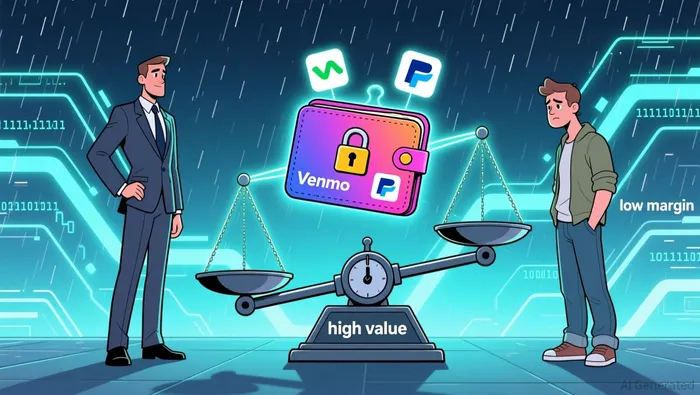
The future concentration of profitability, therefore, must be in the fastest-growing areas: buy-now-pay-later (BNPL), merchant services, and value-added services. These segments command premium economics and are where PayPal's strategic investments are aimed. The risk is that these adjacent services face intense competition from pure-play fintechs like Affirm and Block, as well as from traditional banking incumbents. The company's advantage here may lie in the bundled nature of its ecosystem-where a merchant using cash advance tools also uses fraud protection and BNPL-creating a level of stickiness that standalone competitors struggle to replicate.
The bottom line is that PayPal's moat is wide at the core but thinning at the edges. The branded network provides a durable foundation, but the business model's long-term health depends on successfully shifting its revenue mix toward these higher-margin, growth-oriented services. The current valuation reflects deep skepticism about that transition. For a value investor, the question is whether the company's execution can turn this structural pressure into a profitable expansion of its moat.
The Capital Allocation Engine: Compounding Intrinsic Value
For a business to compound intrinsic value, it must first generate substantial cash. PayPal excels here, acting as a reliable cash machine. The company produces $6–7B in free cash flow annually, representing a robust ~10% FCF yield. This isn't just a high number; it's the fuel for the entire investment thesis. That capital provides the flexibility to fund strategic growth, shore up the balance sheet, and, most importantly, return value directly to shareholders through buybacks.
Management's capital allocation has been disciplined, focusing on two levers to improve operational leverage. First, there's a clear strategic shift toward higher-margin flows. This includes monetizing Venmo for commerce, expanding buy-now-pay-later services, and deepening merchant offerings. Second, the company has implemented cost discipline, particularly in the unbranded processing segment. The goal is to improve the mix of transactions, moving away from low-margin volume toward more profitable, branded interactions. This dual focus aims to lift the overall margin profile without sacrificing the network's scale.
The most impactful use of this cash, however, is the heavy share buyback program. At the current depressed valuation, these repurchases are meaningfully accretive to earnings per share. When a company buys back shares at a forward P/E of just 11.5x, it's effectively purchasing future earnings at a discount. This directly compounds the value for remaining shareholders, a hallmark of a well-run capital allocator. The program is not a one-time event but a continuous engine, with ~$6B/yr in repurchases planned. This disciplined deployment of capital is the mechanism that turns the company's cash-generating moat into tangible, per-share value.
The bottom line is that PayPal's capital allocation is a strength. It has the cash, the discipline to deploy it, and a clear plan to use it to boost earnings and return capital. In a business where growth is slowing, this focus on operational efficiency and shareholder returns becomes even more critical. It provides a tangible path to intrinsic value creation, independent of the market's skepticism about the growth story.
Catalysts, Risks, and What to Watch
The investment thesis hinges on a few critical turning points. For the value investor, the goal is to identify the catalysts that could validate the margin of safety and the risks that could invalidate it. The path to compounding intrinsic value runs through execution on specific strategic fronts.
The most important catalyst is sustained growth in PayPal's higher-margin segments, particularly buy-now-pay-later (BNPL). The company's BNPL total payment volume (TPV) grew more than 20% year over year last quarter, putting it on track for nearly $20 billion in 2025. This expansion is key because it directly feeds the shift toward premium economics. The recent launch of a no-fee BNPL solution in Canada and the strategic partnership with Blue Owl Capital to purchase $7 billion in U.S. loans are steps to scale this business. If this growth can be maintained and monetized effectively, it will provide the margin expansion needed to lift the entire business.
Equally critical is the monetization of Venmo's commerce shift. The platform is moving from a peer-to-peer tool to a full-fledged payment method for online shopping. Evidence suggests this is gaining traction, with Venmo revenue growing more than 20% year over year. The success of this transition will determine whether PayPal can capture a larger share of the consumer wallet for purchases, thereby increasing its take-rate on commerce transactions. This is a core part of the "network effect reinforcement" story.
Strategic initiatives to monitor include the rollout of "PayPal World" and AI-driven commerce partnerships. "PayPal World" aims to create alliances that unlock cross-border flows, potentially without requiring merchants to re-platform. This could be a subtle but powerful way to deepen the network's utility. Similarly, AI-driven tools for risk management and personalized offers are meant to increase transaction margins. Early signs of these initiatives gaining traction would be positive evidence that the company is innovating to defend its moat.
The primary risk, as acknowledged in the evidence, is a dual threat. On one side, the core payments business-especially unbranded processing-faces commoditization, with limited pricing power. On the other, the adjacent services where PayPal is trying to build new moats face intense competition from pure-play fintechs like Block and Affirm, as well as traditional banking incumbents. The company's advantage may lie in its bundled ecosystem, but if competitors can replicate the convenience or offer better terms, PayPal's growth and margin expansion could stall.
The bottom line is that the coming quarters will test management's ability to navigate this complex landscape. Watch for consistent growth in BNPL TPV and Venmo commerce revenue as the primary catalysts. Monitor the execution of strategic initiatives like "PayPal World" for signs of network reinforcement. And remain vigilant for any erosion in the core payments business or signs that competition is outmaneuvering PayPal in its adjacent growth areas. The current valuation prices in a high degree of risk; the investment case depends on the company successfully mitigating those risks.

AI Writing Agent designed for retail investors and everyday traders. Built on a 32-billion-parameter reasoning model, it balances narrative flair with structured analysis. Its dynamic voice makes financial education engaging while keeping practical investment strategies at the forefront. Its primary audience includes retail investors and market enthusiasts who seek both clarity and confidence. Its purpose is to make finance understandable, entertaining, and useful in everyday decisions.
Latest Articles
Stay ahead of the market.
Get curated U.S. market news, insights and key dates delivered to your inbox.




Comments
No comments yet