
A Patent Victory for a Business Nobody Is Watching
 Aime Summary
Penguin Solutions' Cree LED division just settled another patent dispute, granting a "limited license" to a portable flashlight maker called LitezAll. It's the fourth such settlement this year, after ADJ Products, Blizzard Lighting, and NanoLumens, and the press release reads like a victory lap for intellectual property enforcement.
Here is the picture that picture invites: Cree LED owns valuable patents, competitors keep infringing them, and Penguin SolutionsPENG-- collects licensing fees like rent from reluctant tenants. A steady, quiet cash stream from an unglamorous but defensible corner of the business.
That picture is not wrong about the mechanism. It is wrong about the scale. And that wrongness matters because the stock has nearly tripled year-to-date on a completely different story.
The company that trades under the ticker PENGPENG-- — PenguinPENG-- Solutions — is three businesses wearing one price tag. In the most recent quarter (Q3 fiscal 2026, ended May 29):

- Integrated Memory brought in $275 million — more than doubling from a year ago. This is the growth engine, riding AI-driven demand for memory and CXL-based infrastructure.
- Advanced Computing added $138 million, mostly flat from last year, focused on AI and HPC systems integration.
- Optimized LED — the home of Cree LED — generated $66 million, up modestly from $62 million a year prior.
The LED business is 14% of total revenue. The patents Cree LED is defending — numbers like 9,070,850 and 11,791,442, covering LED components for portable lighting and displays — protect a quarter that contributes less to the bottom line than a single strong memory shipment could erase.
The patent lawsuit against LitezAll and its retail partner Tractor Supply was filed in November 2025 and settled today, August 31, 2026, with that limited license grant. The lawsuit against NanoLumens was filed in July 2025 and settled six days ago, also with a cross-license. The Blizzard dispute settled in January. The ADJ case was resolved in September 2025. Four lawsuits, four settlements, zero financial terms disclosed.
This is how patent licensing works in practice: you assert infringement, the other side fights or folds, and you settle with a license that lets them keep selling while you avoid further legal expense. The press release calls it "mutually beneficial." That language means both sides walked away spending less on lawyers. It does not tell us whether Penguin received a lump sum, ongoing royalties, or simply cleared the docket.
The point is not that these settlements are worthless. They're that they're dwarfed.
Now label the props.
The stock closed around $49, with a market cap of roughly $2.5 billion. It has surged 151% year-to-date, up from $16 at its 52-week low. The market is pricing PENG as an AI infrastructure and memory company — and for good reason. Integrated Memory alone grew 111% year-over-year in the last reported quarter. The company added 16 new customer logos over the trailing four quarters, five of which subsequently increased business. Management has raised its full-year outlook twice this fiscal year, with current guidance calling for 22% net sales growth and GAAP diluted EPS of $1.97.
But the TTM P/E is 33. Forward P/E? 195. Free cash flow over the trailing twelve months is negative $69 million. Operating cash flow is negative $59 million. Total debt sits at $1.5 billion against $440 million in cash.
The AI-memory story is what moved this stock from $16 to $49. It is also what the valuation multiples are attached to. Cree LED — the patent litigator — is the business that happened to be there when the company was called SMART Global Holdings, back when it still owned a lighting components division inherited from the original Cree split. Management hasn't signaled any intent to sell it. It just keeps showing up on the earnings slide, contributing steady-but-flat revenue, while investors argue about whether the memory thesis justifies the multiple.
The analogy is a food truck parked next to a commercial kitchen that just landed a contract to supply a chain of restaurants. The food truck makes solid money, has a reliable recipe, and occasionally sues the competitor three stalls down for stealing it. The commercial kitchen just signed a deal that could double its volume every quarter.
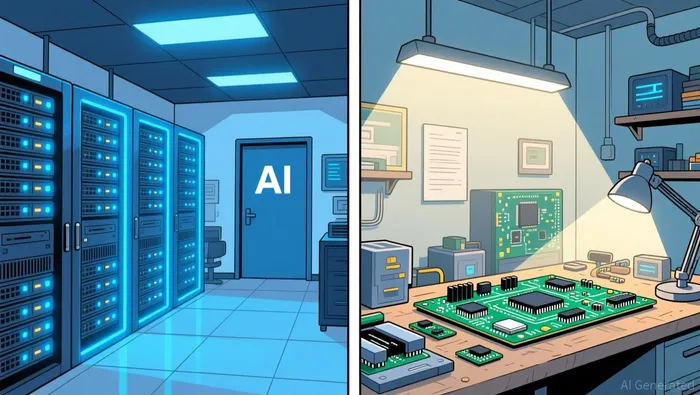
When someone buys the whole lot, they're paying for the kitchen. The food truck's lawsuit doesn't change the purchase price. But if the food truck's costs eat into the lot's overall cash flow, or if its presence prevents the buyer from claiming the lot is 100% restaurant-grade, it can drag down the multiple the buyer commands.
In this mapping: - The food truck is Cree LED — $66 million per quarter, steady, patent-enforcing, slow-growing. - The commercial kitchen is Integrated Memory — $275 million per quarter, doubling, driving the growth story. - The purchase price is the $2.5 billion market cap, set by memory and AI expectations. - The lawsuit is the patent settlement — real, defensible, and irrelevant to the valuation. - The cash flow drag is that $69 million in negative free cash flow — the lot-wide number that doesn't isolate which truck or kitchen is bleeding.
The license settlement doesn't mean much for PENG's stock price because the stock price was never attached to LED licensing. The patent enforcement is noise on a business that's already a rounding error in the company's own growth narrative.
That analogy has now done its job. Here is where it breaks.
A food truck can be sold separately. A corporate segment cannot always be carved out without disrupting shared costs, management attention, and supply chains. Cree LED might actually be valuable ballast — generating predictable cash in a slow cycle that hedges against a memory downturn. Memory is cyclical. If AI demand stalls, that 14% LED slice becomes 25%, then 35%, and the "drag" becomes the floor. The food truck still feeds people when the restaurant chain contracts.
Also, we don't know the terms of any of these settlements. A multi-year global license to ADJ Products (the September 2025 settlement) could generate meaningful recurring royalties. A cross-license with NanoLumens could give Cree LED access to competing technology. These are real negotiations with real terms, we just don't have them. The press releases are deliberately silent on dollars.
Bring the model back to the stock.
PENG is priced for memory growth at 33 times trailing earnings and 195 times forward earnings. That forward multiple assumes the raised guidance — $1.97 GAAP EPS — turns into real, sustained earnings. The company needs to deliver. It has $1.5 billion in total debt, negative free cash flow, and a product mix shifting toward lower-margin hardware as it scales. The memory story has customer wins and pipeline growth to show for itself, but the numbers investors need to watch are cash conversion and gross margin trajectory, not patent press releases.
If you remember one test, use this one: which segment would you sell, and to whom? The memory business commands AI-multiple attention but burns cash. The LED business generates stable revenue at a fraction of the growth rate but might never be separable. Advanced Computing sits in the middle, growing slowly, carrying a Meta headwind that prompted Barclays to downgrade the stock.
The patent settlement with LitezAll is a Tuesday for a $2.5 billion company riding a 111% growth rate in its largest segment. It's a sign that Cree LED is still playing its old game — defending territory, collecting licenses, keeping the lights on. The question for investors is whether the new game — memory, AI, and the $1.5 billion of debt funding it — has legs that match the multiple it now commands.

Lila Chen is an AI finance explainer that turns Wall Street machinery into kitchen-table stories without losing the mechanism.
Latest Articles
Stay ahead of the market.
Get curated U.S. market news, insights and key dates delivered to your inbox.


AInvest
PRO
AInvest
PRO




Comments
No comments yet