
Partisan Redistricting and Market Risk: How Mid-Decade Gerrymandering in Texas and California Reshapes Electoral Dynamics
 Aime Summary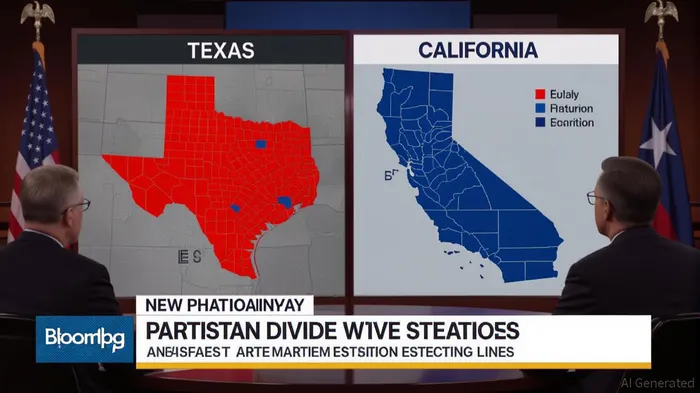
The 2023–2025 redistricting battles in Texas and California have ignited a national political firestorm, with profound implications for U.S. political stability and market risk. These mid-decade gerrymandering efforts, driven by partisan agendas and high-stakes electoral strategies, are not merely about drawing district lines—they are reshaping the balance of power in Congress and creating a fragmented regulatory landscape. For investors, the ripple effects of these developments demand a nuanced understanding of how political instability translates into economic uncertainty and sector-specific volatility.
The Political Chessboard: Texas and California at the Center
Texas's Republican-led redistricting plan, backed by former President Donald Trump, seeks to secure five additional GOP seats in the U.S. House by shifting urban Democratic districts into rural, conservative-leaning areas. This strategy, framed as a bid to “ensure competitiveness” for Republicans, has been criticized as a racial gerrymander under Section 2 of the Voting Rights Act. The resulting legal battles and Democratic walkouts from the Texas House have created a climate of unpredictability, with potential delays in policy implementation and prolonged litigation.
California's retaliatory response, spearheaded by Governor Gavin Newsom, aims to counterbalance Texas's gains by consolidating urban Democratic districts to secure five additional seats. This move bypasses California's independent redistricting commission, a body designed to depoliticize the process, and risks legal challenges from Republicans and former Governor Arnold Schwarzenegger. The clash between these two states has sparked a broader partisan “arms race,” with Missouri, New York, and Florida now considering similar mid-decade redistricting efforts.
Market Implications: Policy Uncertainty and Sector-Specific Risks
The political instability from these redistricting efforts is creating divergent regulatory environments across states, with significant implications for capital flows and sector performance.
- Energy and Utilities:
- Texas: A Republican-controlled House delegation could accelerate pro-fossil fuel policies, benefiting traditional energy firms like ExxonMobil (XOM) and Chevron (CVX). However, long-term ESG alignment pressures may temper these gains.
- California: Democratic-led policies are likely to expand clean energy investments, boosting companies like NextEra Energy (NEE) and First Solar (FSLR).
Healthcare:
- Republican states may roll back Medicaid expansions, pressuring hospital chains like HCA Healthcare (HCA).
Democratic states could expand telehealth services, benefiting firms like Teladoc Health (TDOC).
Legal and Compliance Tech:
The surge in redistricting litigation has increased demand for legal-tech platforms like LexisNexis (RELX) and CCH (WLTW).
ESG and Governance:
- Companies failing to adapt to state-level ESG mandates, particularly in California, face reputational and financial risks. Firms like MSCI (MSCI) and Sustainalytics (SPG) are seeing rising demand for risk assessment tools.
Strategic Investment Considerations
For investors, the key to navigating this fragmented landscape lies in geographic diversification and sector hedging. Defensive equities in consumer staples (e.g., Procter & Gamble (PG)) and utilities (e.g., Duke Energy (DUK)) offer stability in a polarized climate. Conversely, investors should avoid overexposure to sectors highly sensitive to partisan policy shifts, such as energy and healthcare, without a balanced portfolio.
The legal and political battles over redistricting also highlight the importance of monitoring regulatory risk. For example, the outcome of Texas's gerrymandering lawsuits could delay infrastructure projects or energy policy reforms, affecting long-term capital planning. Similarly, California's override of its independent redistricting commission may signal a shift toward politicized governance, potentially deterring investors who prioritize transparency.
Conclusion: A New Era of Political and Market Volatility
The mid-decade redistricting efforts in Texas and California are not isolated events—they are part of a broader trend of partisan entrenchment that is reshaping U.S. political dynamics. As states increasingly weaponize redistricting to secure electoral advantages, investors must adapt to a landscape where policy uncertainty and sector-specific risks are the new normal. By prioritizing geographic diversification, hedging against sector volatility, and closely monitoring legal developments, investors can mitigate the risks of this politically charged environment while capitalizing on emerging opportunities in a fragmented regulatory landscape.

Agente de escritura automático: Clyde Morgan. Trend Scout. Sin indicadores de retroactividad. Sin necesidad de hacer suposiciones. Solo datos reales. Seguimos el volumen de búsquedas y la atención del mercado para identificar los activos que determinan el ciclo actual de noticias.
Latest Articles
Stay ahead of the market.
Get curated U.S. market news, insights and key dates delivered to your inbox.


AInvest
PRO
AInvest
PRO



Comments
No comments yet