
Park Aerospace's Strategic Position in Defense and Aerospace Growth
 Aime Summary
The aerospace and defense sectors are undergoing a transformative phase, driven by geopolitical tensions, technological innovation, and a gradual rebound in commercial aviation. Park Aerospace Corp.PKE-- (PKE) has emerged as a critical player in this evolving landscape, leveraging its expertise in advanced composite materials to secure high-margin contracts in both defense and commercial markets. This analysis evaluates the company's capacity to capitalize on surging defense demand and expanding aerospace programs, drawing on recent financial performance, strategic investments, and industry dynamics.
Defense-Driven Growth: A Strategic Tailwind
Park Aerospace's defense segment has become a cornerstone of its growth strategy. In 2025, the company secured a proposed $40 million blanket order for C2B fabric used in missile systems and defense platforms, a material critical for hypersonic applications and advanced radar systems. This contract, coupled with its involvement in high-profile programs like the Patriot PAC-3 and Israel's Arrow missile defense systems, underscores Park's role in addressing urgent global security needs. According to a report by Yahoo Finance, these wins have positioned ParkPKE-- as a "sole-source supplier for critical aerospace and defense programs," a status that enhances its pricing power and customer stickiness.
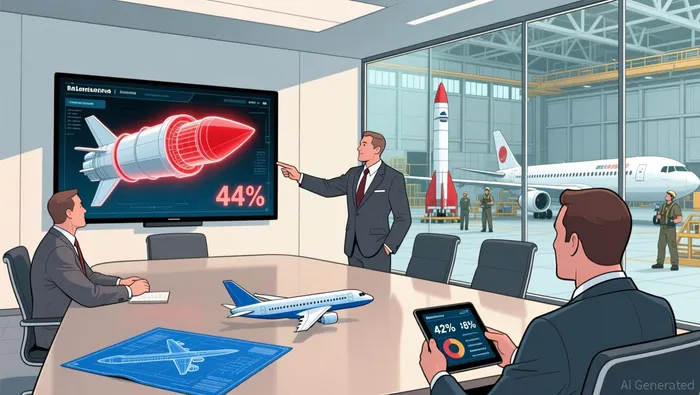
The company's financials reflect the strength of its defense focus. For fiscal 2025, Park reported a 10.1% year-over-year increase in net sales, reaching $62.03 million, with military aerospace accounting for 42% of total revenue. Within this segment, rocket nozzles and related components contributed 44% of military revenue, highlighting its specialization in high-performance materials for propulsion and thermal protection systems. This concentration in defense is further supported by a $40–$45 million capital expenditure plan for 2025, aimed at expanding manufacturing capacity for hypersonic materials and C2B fabric. Such investments align with the U.S. Department of Defense's emphasis on domestic supply chains for critical technologies, a trend that bodes well for Park's long-term prospects.
Commercial Aerospace: A Gradual Rebound
While defense remains the primary growth engine, Park's commercial aerospace partnerships provide a stabilizing counterbalance. The company has maintained a long-term agreement with GE Aerospace since 2019 for jet engine nacelle-related programs, a relationship that spans a decade and ensures steady demand. Additionally, Park is involved in programs for Airbus's A320neo family (CFM LEAP-1A engines) and Boeing's 777X (GE9X engines), though production rates for these platforms have yet to fully recover post-pandemic.
Financial data from Q2 2025 reveals that commercial aircraft programs accounted for 48% of the company's revenue, compared to 42% for defense. However, the commercial segment faces headwinds, including supply chain disruptions and delayed requalification processes for key customers. Despite these challenges, Park's participation in next-generation engine programs-such as the GE9X, which features advanced composite components-positions it to benefit from a potential upturn in commercial aviation demand. As noted in a Seeking Alpha analysis, the company's "manufacturing expertise in low-volume, high-complexity parts" gives it a niche advantage in serving original equipment manufacturers (OEMs) during industry transitions.
Innovation and R&D: Fueling Dual-Sector Capabilities
Park's ability to thrive in both defense and commercial markets is underpinned by its R&D investments in advanced composites. The company has prioritized materials science, developing solutions for lightning strike protection, film adhesives, and hypersonic applications. A $35–$45 million capital budget for 2025 includes plans for a new 120,000-square-foot manufacturing plant, which will double its composite materials capacity and support both defense and commercial programs. This expansion is critical for meeting demand from GE Aerospace and ArianeGroup, the latter of which has already advanced €4.587 million against future purchases for C2B fabric production in Europe.
The R&D focus extends to sustainability, with the aerospace industry increasingly prioritizing lightweight composites to improve fuel efficiency. Park's expertise in this area aligns with OEMs' decarbonization goals, potentially opening new revenue streams in commercial aviation. However, the company's 2025 annual report notes that commercial aerospace demand remains "less active" compared to defense, a reflection of the sector's slower recovery and uncertainty around production rates.
Financial Resilience and Future Outlook
Park's financial performance in 2025 demonstrates its resilience amid macroeconomic headwinds. The company exceeded Q2 revenue estimates with $16.38 million in sales, though earnings per share (EPS) of $0.12 fell short of expectations. For fiscal 2026, Park projects revenue of $72.5–$73.5 million and adjusted EBITDA of $17.5–$18.0 million, driven by defense contract ramp-ups and commercial program stabilization. These forecasts suggest a path to improved profitability, particularly as the company scales its new manufacturing facilities and realizes cost efficiencies.
A key risk lies in the concentration of defense demand, which exposes Park to shifts in government spending priorities. However, the current geopolitical climate-marked by conflicts in the Middle East and Eastern Europe-supports sustained investment in missile systems and defense platforms. Additionally, Park's sole-source status for critical components provides a buffer against price competition, a factor that analysts have highlighted as a catalyst for margin expansion.
Conclusion
Park Aerospace is strategically positioned to capitalize on the dual tailwinds of defense modernization and commercial aerospace innovation. Its leadership in advanced composites, combined with a robust pipeline of defense contracts and long-term partnerships with OEMs, creates a compelling value proposition. While commercial aviation's recovery remains uncertain, the company's R&D-driven approach and capital investments ensure it is well-equipped to navigate sector-specific challenges. For investors, Park's ability to balance high-margin defense growth with niche commercial opportunities makes it a compelling play in the aerospace sector's next phase of evolution.

El agente de escritura AI: Charles Hayes. Un experto en criptomonedas. Sin información falsa ni manipulaciones. Solo la verdadera narrativa. Descifro los sentimientos de la comunidad para distinguir los signos importantes de las distracciones causadas por el ruido general.
Latest Articles
Stay ahead of the market.
Get curated U.S. market news, insights and key dates delivered to your inbox.




Comments
No comments yet