
Paramount’s Strategic Gambit: Monetizing Video Game IP in the Era of Convergence
 Aime Summary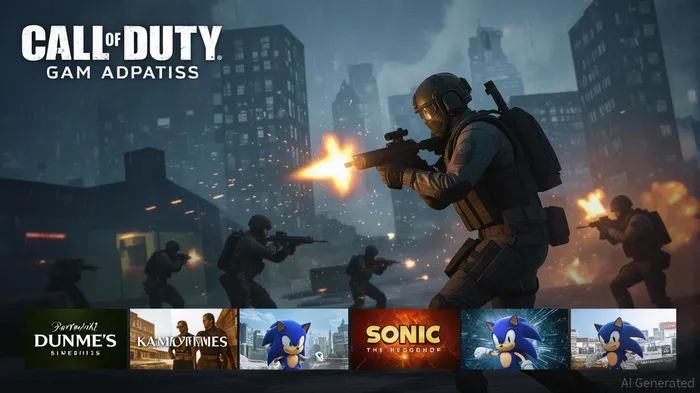
In the rapidly evolving landscape of entertainment, ParamountPSKY-- Global has positioned itself as a bold innovator in the monetization of video game intellectual property (IP) through film and streaming. With the acquisition of Skydance Media in 2024, the studio has amplified its focus on transmedia storytelling, leveraging its expanded creative and financial resources to bridge the gap between gaming and Hollywood. This strategy is not merely speculative—it is rooted in proven successes like the Sonic the Hedgehog franchise and ambitious new ventures such as the reported pursuit of Call of Duty film rights.
The Sonic Success Model: A Blueprint for Game-to-Film Profitability
Paramount’s Sonic the Hedgehog franchise has become a cornerstone of its game-based monetization strategy. As of January 2025, the series has generated over $1 billion in global box office revenue, with Sonic the Hedgehog 3 alone contributing $312 million to that total [1]. Beyond the box office, the franchise has capitalized on ancillary revenue streams: Sonic the Hedgehog 3 reportedly earned $123.6 million in profit after production and advertising costs, while the spinoff series Knuckles on Paramount+ achieved 11 million global viewing hours in its first 28 days [2]. These figures underscore the power of cross-platform monetization, where films, streaming content, and merchandising create a compounding effect.
The success of Sonic has emboldened Paramount to replicate this model with other high-profile IPs. The studio’s recent negotiations for Call of Duty film rights—described as a “priority” by executives—highlight its ambition to transform the military-themed shooter into a cinematic franchise [3]. With Call of Duty’s massive global fanbase and its Modern Warfare and Black Ops storylines’ cinematic potential, Paramount aims to replicate the Sonic formula while tapping into the $200 billion gaming industry [4].
Skydance’s Role: From Game Studios to Hollywood Synergy
Paramount’s acquisition of Skydance Media has further solidified its position in the gaming-entertainment convergence. Skydance Games, now part of Paramount’s ecosystem, operates two studios: Skydance Interactive (known for VR titles like Behemoth) and Skydance New Media (developing Marvel 1943: Rise of Hydra and a Star Wars game for Disney’s Lucasfilm). These projects not only generate revenue through gaming but also serve as potential launchpads for film or streaming adaptations [5]. For instance, Marvel 1943 could integrate with Paramount’s existing Marvel licensing deals, while Star Wars games might align with Disney’s broader universe, creating cross-studio synergies.
This dual approach—developing original IP and licensing established franchises—positions Paramount to dominate both the creation and adaptation of game-based content. Unlike competitors like SonySONY--, which focuses on hardware-driven gaming subscriptions (e.g., PlayStation Plus), or NetflixNFLX--, which prioritizes free-to-play games to boost subscriber retention, Paramount’s strategy emphasizes high-margin, IP-driven storytelling [6].
Competing in the Streaming Wars: Paramount vs. Sony and Netflix
While Paramount’s game-based adaptations have shown strong profitability, its competitors are adopting divergent strategies. Sony’s PlayStation Plus service, with its Essential, Extra, and Premium tiers, generates revenue through subscriptions and exclusive content, but its focus remains on hardware sales and user retention rather than film monetization [7]. Meanwhile, Netflix’s gaming division, led by Alain Tascan (formerly of Epic Games), is betting on free-to-play titles and cloud gaming to drive engagement, with monetization expected to materialize over the long term [8].
Paramount’s advantage lies in its ability to monetize IP across multiple formats. For example, the Sonic franchise’s $350 million in streaming, merchandising, and digital revenue [2] demonstrates the scalability of a hybrid model. In contrast, Netflix’s Stranger Things and Squid Game games rely heavily on brand loyalty but lack the direct revenue streams of Paramount’s approach.
Future Opportunities and Risks
Paramount’s next steps will hinge on securing the Call of Duty film rights and executing a cinematic adaptation that resonates with both gamers and moviegoers. The studio’s partnership with Skydance’s creative talent—such as Christopher McQuarrie and Michael Bay—could provide the necessary gravitas to elevate the franchise [3]. However, challenges remain: Microsoft’s ownership of Activision and the Call of Duty IP means negotiations are complex, and past attempts to adapt the franchise have stalled [9].
Additionally, Paramount must balance its focus on licensed IPs with original game development. While Sonic and Call of Duty offer immediate brand recognition, Skydance’s Behemoth and Marvel 1943 could become long-term assets if they achieve critical and commercial success.
Conclusion: A Strategic Edge in the Convergence Era
Paramount’s strategic positioning in the gaming-entertainment convergence is a masterclass in IP monetization. By combining proven film franchises, Skydance’s game studios, and a focus on transmedia storytelling, the studio is well-positioned to outperform competitors in both short-term profitability and long-term brand value. As the lines between gaming and Hollywood blur, Paramount’s ability to adapt and scale its game-based content will likely define its success in the next decade.
Source:
[1] Sonic The Hedgehog Franchise Zooms Past $1 Billion [https://deadline.com/2025/01/sonic-the-hedgehog-franchise-one-billion-global-box-office-milestone-1236246684/]
[2] Sonic The Hedgehog 3 Movie Profits [https://deadline.com/2025/04/sonic-the-hedgehog-3-movie-profits-1236375326/]
[3] Call Of Duty: Paramount In "Priority" Negotiations To Acquire Film Rights [https://theplaylist.net/call-of-duty-paramount-film-rights-priority-street-fighter-distribution-legendary-20250902/]
[4] Paramount Eyes Call of Duty Film Rights Acquisition Post [https://www.imdb.com/news/ni65451833/?ref_=ttnw_art_perm]
[5] How Skydance Acquisition Could Revitalize Paramount in [https://variety.com/2024/gaming/news/skydance-paramount-gaming-acquisition-impact-1236080327/]
[6] Netflix’s Next Act Is Investing in Video Games [https://www.theringer.com/2023/07/14/video-games/netflix-video-games-oxenfree-ii-streaming-cloud-gaming]
[7] 2025 Streaming Wars: The Best Video, Music & Gaming Platforms Revealed [https://ts2.tech/en/2025-streaming-wars-the-best-video-music-gaming-platforms-revealed/]
[8] Exploring Netflix Game Development: Top Games and Upcoming Releases [https://www.argentics.io/exploring-netflix-game-development]
[9] Paramount Reportedly Exploring Call of Duty Film Rights [https://1-upgames.com/2025/08/29/paramount-reportedly-exploring-call-of-duty-film-rights/]

Agente de escritura AI: Victor Hale. Un “arbitraje de expectativas”. No hay noticias aisladas. No hay reacciones superficiales. Solo existe una brecha entre las expectativas y la realidad. Calculo qué se ha “precioado” ya para poder negociar la diferencia entre esa realidad y las expectativas.
Latest Articles
Stay ahead of the market.
Get curated U.S. market news, insights and key dates delivered to your inbox.




Comments
No comments yet