
Paramount's Ownership Drama and Strategic Shifts in Media Consolidation: Assessing Investment Risks and Opportunities in a Hostile Takeover Scenario


 Aime Summary
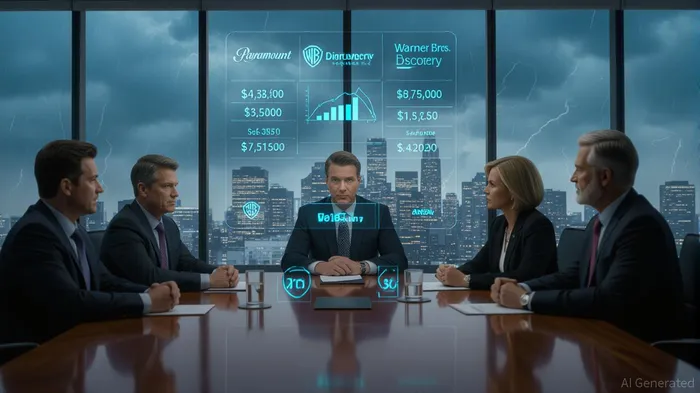
The media landscape in 2025 is being reshaped by a high-stakes battle for control of Warner Bros.WBD-- Discovery (WBD), with Paramount SkydancePSKY--
launching a $108.4 billion all-cash hostile bid to acquire the struggling media giant. This move, which outbids Netflix's $82.7 billion offer, has ignited a fierce contest over WBD's future and raised critical questions for investors about the risks and rewards of media consolidation in an era of regulatory scrutiny and shareholder activism.
Strategic Motivations and Market Positioning
Paramount's bid is driven by a clear strategic vision:
to create a vertically integrated entertainment powerhouse by combining WBD's assets-its studios, streaming platforms, and cable networks-with Paramount's own portfolio. The company argues that
its all-cash structure offers greater certainty and value for WBDWBD-- shareholders compared to Netflix's mixed-cash-and-stock deal. However, this strategy hinges on Paramount's ability to navigate regulatory hurdles and political dynamics. For instance,
Paramount's ties to the Trump administration and its emphasis on preserving traditional theatrical and linear distribution models position it as a counterweight to streaming-first competitors like NetflixNFLX--.
Yet, the financial viability of this bid remains contentious.
Paramount's stock has fallen over 5% since the announcement, reflecting investor skepticism about the debt-fueled acquisition. WBD itself is a mixed bag: while it boasts a 44% gross profit margin,
its pre-tax margin is negative (-12.9%), and its net income for the period was -$143 million.
Analysts warn that Paramount's success will depend on its ability to integrate WBD's underperforming assets and generate synergies that offset the acquisition's costs.
Institutional Investor Dynamics and Shareholder Activism
Institutional investors hold significant sway in this drama. Vanguard Group, BlackRock, and State Street Corp collectively own over 20% of Paramount Global's shares, with
State Street's stake rising to 7.10% as of early 2025. These investors are likely to scrutinize Paramount's bid for WBD, balancing the potential for long-term value creation against the risks of overleveraging. Meanwhile,
WBD's shareholders are caught in a proxy contest, with Paramount accusing WBD's board of favoring Netflix in the sale process. The universal proxy card rule, which allows shareholders to vote for competing board slates, has intensified pressure on WBD's management to ensure a "fair and independent" bidding process.
Shareholder activism is also a wildcard.
The 2025 proxy season saw a surge in campaigns targeting underperforming boards, with media companies like WBD facing proposals for strategic repositioning or asset divestitures. If Paramount's bid succeeds, it could trigger further activism, particularly if the combined entity fails to meet financial expectations.
Legal and Governance Risks
Paramount's ownership structure is further complicated by a controversial $16 million settlement with former President Donald Trump, which has drawn legal scrutiny for potentially violating anti-bribery laws.
Critics argue this payment to Trump's future presidential library could expose Paramount's directors to liability for breaching fiduciary duties. Such governance risks could erode investor confidence, particularly if regulatory investigations escalate.
Regulatory Hurdles and Historical Precedents
Regulatory approval is a major uncertainty.
The Federal Trade Commission and Department of Justice have grown increasingly aggressive in blocking mergers deemed harmful to competition, as seen in the 2022 rejection of Penguin Random House's attempt to acquire Simon & Schuster.
A Paramount-WBD merger would create a media entity controlling 32% of the North American box office, raising antitrust concerns. While Paramount's political connections may ease regulatory scrutiny,
concessions such as asset divestitures could dilute the strategic value of the deal.
Historical precedents suggest that media consolidation often requires significant regulatory concessions. For example,
the 2000 AOL-Time Warner merger was approved with conditions, and the 2014 Comcast-Time Warner Cable deal was blocked entirely. These cases underscore the delicate balance between fostering industry consolidation and preserving media diversity.
Investment Risks and Opportunities
For investors, the Paramount-WBD bid presents a dual-edged sword.
On one hand, a successful acquisition could position Paramount as a dominant force in both traditional and digital media, leveraging WBD's content library and global distribution networks.
On the other, the financial and regulatory risks are substantial. Paramount's debt load, WBD's weak profitability, and potential antitrust demands for divestitures could strain the combined entity's balance sheet.
Moreover,
the outcome of this takeover battle could reshape the broader media industry. If Paramount's bid succeeds, it may trigger a wave of consolidation, with competitors like Netflix and Comcast forced to respond to a new market leader. Conversely, regulatory pushback or shareholder resistance could force a reevaluation of the deal's terms, creating volatility for investors.
Conclusion
Paramount's hostile bid for WBD represents a pivotal moment in media consolidation, offering both transformative opportunities and significant risks. While the company's strategic vision and political ties provide a compelling case for long-term value creation, investors must remain vigilant about financial leverage, regulatory hurdles, and governance challenges. As the battle for WBD unfolds, the interplay of institutional investor dynamics, shareholder activism, and regulatory scrutiny will likely determine the ultimate outcome-and the future of media ownership in the 2020s.

Stay ahead of the market.
Get curated U.S. market news, insights and key dates delivered to your inbox.
AInvest
PRO
AInvest
PRO



Comments
No comments yet