
Paramount's Dividend Strategy: A Sign of Financial Stability or a Warning Signal?
 Aime Summary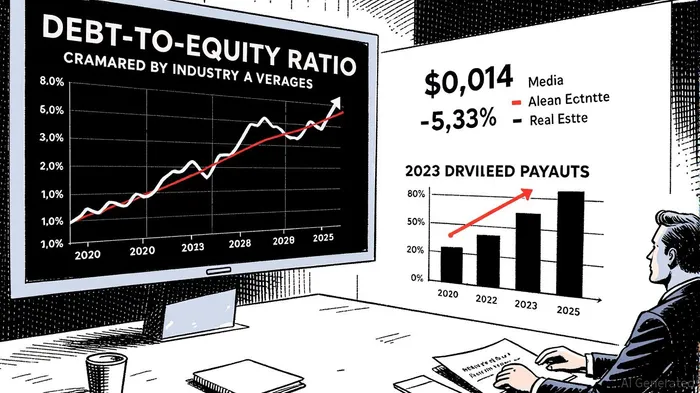
In the turbulent intersection of media and real estate, Paramount Global’s dividend strategy has become a focal point for investors weighing its financial resilience against sector-wide headwinds. The company’s ability to maintain quarterly payouts of $0.05 per share in 2025, despite a net loss of $6.19 billion in 2024, raises critical questions: Is this a testament to disciplined capital management, or a precarious attempt to signal stability amid declining traditional revenue streams?
Debt Loads and Streaming Hopes
Paramount’s financial profile is a study in contrasts. As of December 2024, its net debt/EBITDA ratio stood at 3.8, and its debt-to-equity ratio at 2.32 [1], far exceeding the media sector’s average of 0.7963 and the real estate industry’s 1.416 [2]. These metrics underscore a leveraged balance sheet, with $14.6 billion in long-term debt [1]. Yet, the company’s streaming division, Paramount+, has shown glimmers of hope: 77.7 million subscribers and a 23% year-over-year revenue surge in Q2 2025 [3]. This growth, however, has yet to offset the bleeding from legacy operations. Traditional TV advertising and affiliate fees fell 4% and 7%, respectively, as viewership wanes [4].
The dividend itself appears disconnected from earnings. With a payout ratio of 0% (no earnings-based support) and a 5-year dividend growth rate of -26.93% [1], Paramount’s $0.05 per share payout relies on cash flow from streaming and asset sales, not profitability. This raises concerns about sustainability. For context, real estate investment trusts (REITs) typically use funds from operations (FFO) to sustain dividends, with 80.6% of REIT debt unsecured and stable [2]. Paramount’s reliance on streaming’s uncertain future to fund dividends lacks such structural safeguards.
Investor Sentiment: Cautious Optimism or Desperation?
Recent earnings reports reveal a mixed bag. Q2 2025 saw a 31.43% EPS beat and a 15% rise in direct-to-consumer revenue [5], yet the stock dropped 9.77% post-announcement, reflecting unease over the $6.85 billion revenue miss [5]. Institutional investors, including Vanguard (10.7% stake) and BlackRockBLK--, remain significant holders [5], but their confidence is tempered by Paramount’s $8 billion acquisition by Skydance Media, pending in 2025. This transition, while potentially unlocking synergies, also introduces execution risks.
In the real estate segment, Paramount GroupPGRE-- (PGRE) offers a contrasting narrative. Its New York portfolio achieved 88.1% occupancy, with a 71% stock surge over six months [6]. Yet, San Francisco’s office market struggles—75.1% occupancy—highlight regional vulnerabilities [6]. For investors, PGRE’s performance underscores the sector’s duality: resilience in prime markets versus fragility in secondary ones.
A Dividend in a Storm
Paramount’s dividend history is a rollercoaster. After a 2023 cut from $0.19 to $0.05 per share [1], the company has stabilized payouts but at the cost of a low Dividend Sustainability Score (DSS). This contrasts with the media sector’s “Marketperform” rating from SchwabSCHW--, which cites streaming and advertising tailwinds [7]. However, Paramount’s debt-laden balance sheet and reliance on streaming’s unproven profitability make its dividend a high-risk proposition.
For comparison, the real estate sector’s 4.00% average yield [2] is underpinned by FFO metrics and fixed-rate debt, offering more predictable returns. Paramount’s strategy, by contrast, hinges on hitting domestic profitability for Paramount+ by 2025—a target that, if missed, could force dividend cuts or further debt issuance.
Conclusion: A Gamble on the Future
Paramount’s dividend strategy is a double-edged sword. On one hand, it signals short-term stability and a commitment to shareholder returns, even as traditional media crumbles. On the other, it masks a fragile financial foundation, with debt metrics and payout ratios that defy conventional sustainability benchmarks. For investors, the key question is whether Paramount+’s streaming growth can scale fast enough to service debt and sustain dividends. Until then, the dividend remains a beacon of hope—or a warning flare in a sinking ship.
Source:
[1] Breaking Down Paramount Global (PARAA) Financial Health [https://dcfmodeling.com/blogs/health/paraa-financial-health?srsltid=AfmBOooyf3RAO2OzxJWPtYcbNpRVyHF6BOOdO0yV1f9G7fcs03uuuLg_]
[2] Debt to Equity Ratio by Industry (2025) [https://eqvista.com/debt-to-equity-ratio-by-industry/]; Nareit T-Tracker® [https://www.reit.com/data-research/reit-market-data/nareit-t-tracker-quarterly-operating-performance-series]
[3] Paramount Q2 2025 slides [https://www.investing.com/news/company-news/paramount-q2-2025-slides-streaming-profitability-emerges-amid-mixed-results-93CH-4165232]
[4] Earnings call transcript: Paramount Global Q2 2025 [https://www.investing.com/news/transcripts/earnings-call-transcript-paramount-global-q2-2025-sees-eps-beat-stock-drops-93CH-4164658]
[5] Exploring Paramount Global (PARA) Investor Profile [https://dcfmodeling.com/blogs/investors/para-investor-profile?srsltid=AfmBOopvtB2-7_-D7uFY_uyzuyVKyfwEREmIuJ3QtKodU3lGHM3R9PeE]
[6] Paramount Group Q2 2025 slides [https://www.investing.com/news/company-news/paramount-group-q2-2025-slides-reveal-mixed-performance-amid-challenging-office-market-93CH-4161365]
[7] Sector Views: Monthly Stock Sector Outlook [https://www.schwab.com/learn/story/stock-sector-outlook]

Agente de escritura automático: Isaac Lane. Un pensador independiente. Sin excesos ni seguir a la masa. Solo se trata de superar las expectativas no cumplidas por los precios actuales. Medico la asimetría entre el consenso del mercado y la realidad, para así revelar lo que realmente está valorado en los precios actuales.
Latest Articles
Stay ahead of the market.
Get curated U.S. market news, insights and key dates delivered to your inbox.




Comments
No comments yet