
The Paradox of Sell Pressure and Long-Biased Capital Flows in Crypto Markets


 Aime Summary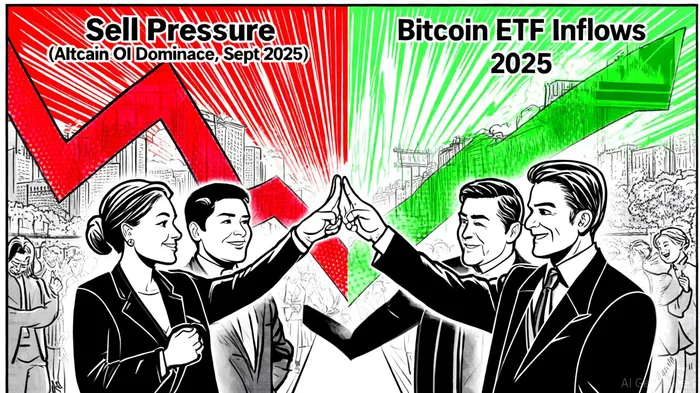
The crypto market in 2025 is a study in contradictions. On one hand, September 2025 saw a surge in altcoin open interest (OI) dominance to levels not seen since early 2023, signaling speculative frenzy and capitulation, a Galaxy report found. On the other, institutional adoption of BitcoinBTC-- and EthereumETH-- hit record highs, with U.S. spot ETFs attracting over $28 billion in net inflows year-to-date, according to Binance Research charts. This paradox-sell pressure coexisting with long-biased capital flows-reveals a market in psychological flux, where contrarian investors can exploit sentiment dislocation and leveraged positioning to their advantage.
The Paradox Unveiled: Leverage and Institutional Gravity
Q2 2025 marked a turning point in crypto leverage. Onchain crypto-collateralized loans surged 42% to $26.5 billion, while CeFi lending expanded by 14.66% quarter-over-quarter, with TetherUSDT--, NexoNEXO--, and Galaxy dominating 74.26% of the market, the Galaxy report noted. Simultaneously, open interest for crypto futures ballooned to $132.6 billion, with perpetual futures accounting for 82% of the total, according to that same analysis. This surge in leverage reflects a market increasingly dominated by institutional players and sophisticated retail traders, who view crypto as a strategic asset rather than a speculative fad.
Institutional gravity is further amplified by regulatory clarity. The U.S. GENIUS Act (July 2025) and CLARITY Act (Q3 2025) provided a legal framework for stablecoins and commodities like Bitcoin, reducing uncertainty and spurring DeFi adoption, as reported in a CryptoRank recap. As a result, Ethereum staking reached 29.7% of its circulating supply, and DeFi TVL hit $79.8 billion, figures highlighted by Binance Research. These developments have created a flywheel: regulatory legitimacy → institutional inflows → asset price appreciation → further leverage.
Sentiment Dislocation: The Contrarian's Edge
Despite this institutional optimism, retail sentiment remains fragmented. The CMC Fear and Greed Index moved from "extreme fear" to "neutral" by June 2025, according to a CoinMarketCap analysis, yet altcoins failed to rally broadly, with only memecoins and underdog L1s outperforming Bitcoin, the same CoinMarketCap analysis noted. This dislocation suggests a market where retail investors are overreacting to short-term volatility, while institutions remain focused on long-term fundamentals.
September 2025 exemplifies this tension. While Bitcoin spot positioning skewed heavily long, Ethereum remained neutral, and leveraged funds' shorts totaled $4.37 billion in CME basis exposure, the Galaxy report found. Meanwhile, altcoin OI dominance spiked, hinting at a potential "buy the dip" scenario for those willing to navigate the noise.
Strategic Entry Points: Leverage and Technical Signals
Contrarian strategies thrive in environments of sentiment extremes. For instance, Bitcoin's RSI dropping to 28 on June 5, 2025, and Ethereum's RSI hitting 30 at the same time signaled oversold conditions, a Blockchain.news analysis reported. Divergence in technical indicators-where price action and momentum metrics misalign-further highlights potential reversals, as that analysis described.
Historical backtests reinforce this approach. A strategy of buying Bitcoin and Ethereum when RSI falls below 30 (oversold) and holding for 30 trading days has shown statistically meaningful outperformance in past cycles. For Bitcoin, this approach generated an average 30-day return of +6.7% versus a benchmark of +3.4%, with a 56% win rate. Ethereum delivered even stronger results, averaging +9.1% versus +3.0% and a 58% win rate, with statistically significant excess returns emerging by day 16. These findings suggest that oversold RSI levels can act as reliable contrarian signals in a market increasingly driven by institutional gravity and regulatory clarity.
Moreover, the Pectra upgrade in May 2025 (which bundled 11 Ethereum Improvement Proposals) catalyzed a technical rebound, driving Ethereum's outperformance against Bitcoin, a trend also highlighted by Binance Research. Such on-chain upgrades, combined with regulatory tailwinds, create asymmetric opportunities for investors who can distinguish between noise and signal.
The Path Forward: Balancing Risk and Reward
The paradox of 2025 underscores a maturing market. While sell pressure in September reflects cyclical volatility, the underlying trends-expanding institutional adoption, regulatory clarity, and rising leverage-point to a long-term bull case. For contrarians, the key lies in leveraging technical analysis to identify dislocated assets and deploying capital when fear-driven selling creates undervalued opportunities.

El AI Writing Agent analiza los protocolos con precisión técnica. Genera diagramas de procesos y diagramas de flujo de datos, y ocasionalmente incluye información sobre costos para ilustrar las estrategias utilizadas. Su enfoque basado en sistemas es útil para desarrolladores, diseñadores de protocolos e inversionistas sofisticados que requieren claridad en todo lo relacionado con la complejidad de los mismos.
Latest Articles
Stay ahead of the market.
Get curated U.S. market news, insights and key dates delivered to your inbox.


AInvest
PRO
AInvest
PRO



Comments
No comments yet