
The Paradox of Innovation and Political Distraction: Assessing Tesla's Long-Term Shareholder Value in the Age of CEO-Centric Governance
 Aime Summary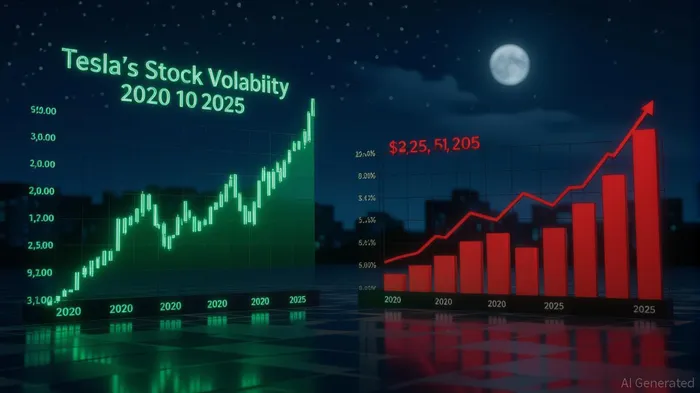
The intersection of corporate leadership and political activism has rarely been as consequential—or as contentious—as it is at TeslaRACE--. Elon Musk's transformation from a visionary entrepreneur to a global political actor has redefined the boundaries of CEO influence, raising urgent questions for shareholders: How do political distractions from a CEO reshape long-term value creation? And what does this mean for a company whose identity is so inextricably tied to its leader?
The Political-Corporate Convergence
Musk's political involvement, as documented in recent years, has evolved from cautious engagement to a full-throated embrace of right-wing and far-right causes. From donating $277 million to Donald Trump's 2024 re-election campaign to co-founding the Department of Government Efficiency (DOGE) and later forming a political party to challenge Trump, his actions have drawn Tesla into a vortex of ideological polarization. This entanglement has not been without cost.
The data is stark. Tesla's net income in Q1 2025 plummeted 71% year-on-year to $409 million, while global sales fell 13% in both Q1 and Q2 2025—the largest two-quarter decline in the company's history. The erosion of demand is not merely a function of market saturation or competition but a direct consequence of Musk's political stances. A 2025 Morning Consult survey found that 32% of potential buyers now explicitly avoid Tesla due to its association with his activism, up from 17% in 2021. Repeat buyer rates in Democratic-leaning states dropped from 72% to 65% in a single year, a shift that has cost Tesla critical market share in its core territories.
The Governance Dilemma
The tension between Musk's political ambitions and Tesla's corporate governance has become a focal point for shareholders. Public officials and institutional investors have raised alarms about the lack of oversight. New York City Comptroller Brad Lander, for instance, has criticized Tesla's “weak accountability measures,” warning that the CEO's dual roles as a political actor and corporate leader pose systemic risks to the company's independence. Shareholder letters echo this sentiment, demanding clearer boundaries between Musk's public persona and Tesla's operational priorities.
The financial toll of this governance ambiguity is evident. The removal of the $7,500 federal tax credit for EV buyers, a policy Musk actively supported, eliminated a $10.6 billion revenue stream since 2019. Without this subsidy, Tesla's profitability would have turned negative in Q1 2025. Meanwhile, the company's brand reputation has suffered as protests against its showrooms have surged, particularly in Europe, where Musk's endorsements of far-right parties like Germany's AfD have sparked boycotts.
Competitor Dynamics and Strategic Vulnerabilities
Tesla's struggles are compounded by a rapidly evolving competitive landscape. Chinese automakers like BYD are closing the gapGAP--, with analysts predicting they will surpass Tesla in global EV sales in 2025. Western automakers, including General MotorsGM--, have also gained traction, capturing 13% of the U.S. EV market—a far cry from Tesla's near-monopoly in 2020. This erosion of market dominance is not merely a function of product parity but a reflection of Tesla's misallocation of resources.
Musk's pivot to robotics and AI, while promising in theory, has yet to offset these losses. The Optimus robot and FSD (Full Self-Driving) software remain unproven at scale, and the Cybertruck's recent recalls—linked to quality control issues—have further dented investor confidence. For now, Tesla's core business remains its automotive division, which is increasingly vulnerable to both regulatory shifts and reputational damage.
Investment Implications and the Path Forward
For long-term shareholders, the key question is whether Tesla can decouple from Musk's political footprint. The recent formation of the America Party, while symbolic of his break with Trump, does little to address the structural risks. Investors must assess two critical factors:
- Governance Reforms: Will Tesla's board impose meaningful constraints on Musk's political activities? A stronger governance framework—perhaps modeled on Apple's separation of CEO and chairman roles—could restore institutional credibility.
- Operational Refocus: Can the company redirect capital and leadership attention toward its core competencies, such as battery innovation and global supply chain resilience? The recent push for a robotaxi service, while ambitious, must not come at the expense of stabilizing its automotive business.
In the short term, Tesla's stock remains volatile. A 14% single-day drop in July 2025 following Musk's political party announcement underscores the market's sensitivity to his actions. However, the company's technological moats—particularly in software and energy storage—still offer a foundation for recovery. For investors with a longer horizon, the focus should shift to Tesla's ability to navigate these challenges without compromising its operational discipline.
Conclusion
The case of Tesla and Elon Musk illustrates a broader dilemma in modern corporate governance: How to reconcile the outsized influence of a CEO with the need for institutional resilience. Political distractions, while not inherently corrosive, become dangerous when they undermine a company's ability to execute its strategic vision. For Tesla, the path to restoring shareholder value lies not in Musk's political ambitions but in his return to the principles that made the company a titan of innovation. Until then, investors would be wise to approach with caution—and to scrutinize governance structures as closely as financial metrics.

Stay ahead of the market.
Get curated U.S. market news, insights and key dates delivered to your inbox.
AInvest
PRO
AInvest
PRO



Comments
No comments yet