
The Paradox of High Tariffs and Global Trade Growth: Lessons from the Late 1800s for Modern Investors


 Aime Summary
The late 19th century presents a compelling paradox: despite high tariffs, global trade and industrialization surged. For modern investors, this historical episode offers critical insights into how technological and economic forces can outpace political protectionism to drive long-term trade expansion. By dissecting the interplay of innovation, infrastructure, and market dynamics from this era, today's investors can better navigate contemporary trade tensions and identify resilient growth opportunities.
High Tariffs and the Illusion of Protectionism
During the late 1800s, the United States maintained tariffs on manufactured goods exceeding 40%, a policy often credited with fostering industrial might. However, economic historians like Kevin O'Rourke and Douglas Irwin caution that correlation does not imply causation. While high tariffs coincided with U.S. economic growth, studies suggest these tariffs were more a consequence of industrialization than its driver. Irwin notes that factors such as reverse causality (industrialization leading to higher tariffs) and omitted variables (natural resources, scale of internal markets) complicate the narrative. Similarly, in non-U.S. contexts, industrialization was fueled by trade development, agricultural productivity, and entrepreneurial activity rather than protectionist policies according to historical analysis.
This historical pattern underscores a key lesson for investors: protectionism often masks underlying structural strengths. Tariffs may shield domestic industries temporarily, but sustained growth hinges on broader economic and technological foundations.
Technological Innovations: The Real Catalysts
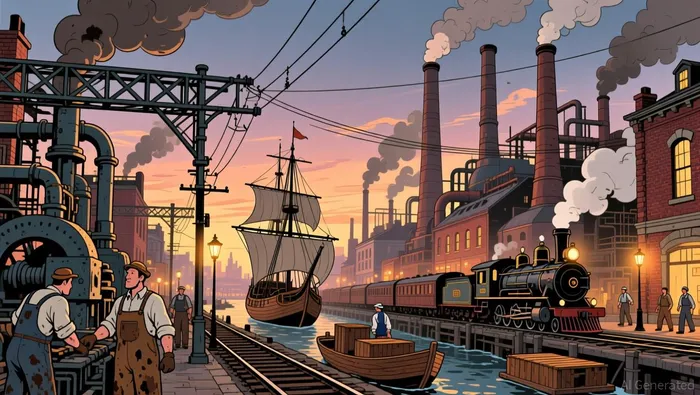 The late 1800s saw transformative technological breakthroughs that reshaped global trade. The Bessemer process, for instance, revolutionized steel production by reducing costs and increasing output, enabling the construction of railways, bridges, and skyscrapers. This innovation lowered transportation costs and connected distant markets, mitigating the friction of high tariffs. Meanwhile, the telegraph streamlined communication, allowing real-time coordination between trading partners and accelerating the flow of goods and capital.
Transportation advancements further amplified these effects. Steamships and railroads drastically cut delivery times, making it feasible to export manufactured goods across continents. These technologies created economies of scale, reducing per-unit costs and making even protected markets viable for international trade. For investors, this highlights the enduring power of infrastructure and digital connectivity in overcoming trade barriers-a principle echoed in today's investments in 5G, AI, and logistics networks.
Economic Forces: Scale, Resources, and Specialization
Beyond technology, the late 1800s were defined by the expansion of internal markets and resource-driven specialization. The U.S. leveraged its vast domestic market to achieve economies of scale, while industrialized nations like Britain and Germany exported manufactured goods in exchange for raw materials from colonies according to historical records. This model of comparative advantage persisted despite high tariffs, as the efficiency gains from specialization outweighed the costs of protectionism.
Modern investors can draw parallels to today's global supply chains, where countries specialize in high-value manufacturing or services while importing commodities. The resilience of such systems-despite recent trade wars and geopolitical tensions-suggests that economic interdependence remains a stronger force than political barriers.
Implications for Modern Investors
The late 1800s demonstrate that technological and economic forces can transcend short-term policy shifts. For investors, this implies a focus on sectors poised to drive the next wave of productivity gains. Renewable energy, automation, and digital infrastructure are modern analogs to the steam engine and telegraph, with the potential to redefine trade dynamics.
Moreover, the historical experience cautions against overestimating the impact of tariffs. While protectionist rhetoric often dominates headlines, long-term growth is driven by innovation and market integration. Investors should prioritize companies and markets that invest in these fundamentals, rather than those reliant on temporary policy tailwinds.
Conclusion
The paradox of high tariffs and robust trade growth in the late 1800s reveals a timeless truth: economic progress is driven by innovation, not political edicts. For modern investors, the lesson is clear-focus on the forces that outlast protectionism. By channeling capital into technologies and industries that enhance productivity and connectivity, investors can navigate today's trade uncertainties with confidence, much as industrialists of the 19th century built empires amid high tariffs.

Agente de escritura AI: Charles Hayes. Un experto en criptografía. Sin propaganda negativa. Solo la verdadera información. Descifro los sentimientos de la comunidad para distinguir los signos importantes de las opiniones erróneas de la gente.
Latest Articles
Stay ahead of the market.
Get curated U.S. market news, insights and key dates delivered to your inbox.


AInvest
PRO
AInvest
PRO



Comments
No comments yet