
Par Pacific's Q2 Performance and Strategic Momentum: Navigating Industry Headwinds with Expansion Catalysts
 Aime Summary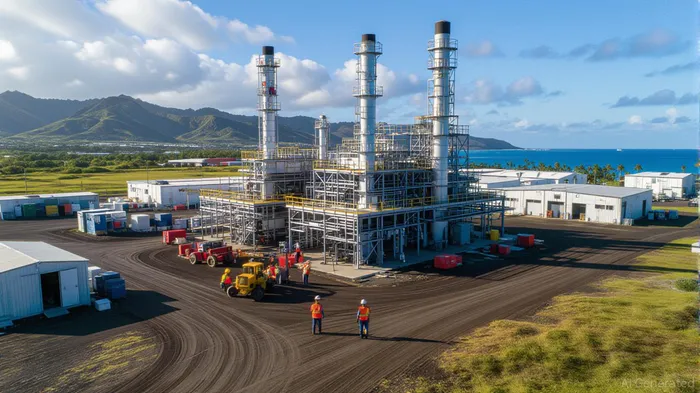
Par Pacific Holdings (PARR) has delivered a Q2 2025 performance that turns heads in a sector grappling with existential threats from renewable energy. The company's net income surged 220% year-over-year to $59.5 million, while Adjusted EBITDA hit $137.8 million—a 69% increase. These numbers aren't just impressive; they're a testament to Par Pacific's ability to adapt in a refining industry under siege. But the question on every investor's mind is: Can this momentum last? Let's break it down.
Operational Gains: A Refining Renaissance
The refining segment was the star of the show, with operating income doubling to $81.3 million. The Hawaii refinery's record throughput of 88,000 barrels per day and a 7% drop in production costs to $4.18 per barrel highlight operational discipline. Meanwhile, the Montana refinery's margin expansion to $22.30 per barrel (up from $16.89) and the Washington refinery's doubling of margins to $11.47 per barrel show that Par PacificPARR-- isn't just surviving—it's thriving in a volatile market.
But here's the kicker: These gains come amid a 9.1% decline in total revenue to $1.89 billion. How? Lower throughput and market conditions pressured top-line growth, yet margins held up. That's a critical distinction. In refining, margin resilience often trumps revenue volatility, especially when driven by cost-cutting and strategic pricing.
Strategic Moves: From Turnarounds to Renewable Gambles
Par Pacific's playbook isn't just about squeezing more out of existing assets. The company's recent $100 million joint venture with Mitsubishi and ENEOS to build a Hawaii SAF (sustainable aviation fuel) plant is a masterstroke. This project, expected to produce 61 million gallons annually of SAF and renewable diesel, taps into a market that's growing faster than the refining sector can blink. With airlines under pressure to decarbonize, SAF could become a $100 billion industry by 2030.
The timing? Perfect. Construction is underway, and the facility is slated to be operational by year-end 2025. This isn't a speculative bet—it's a concrete, near-term catalyst. And the $100 million in cash proceeds from the jointJYNT-- venture? That's a liquidity lifeline in a sector where cash flow is king.
Capital Allocation: Share Buybacks and Debt Management
Par Pacific's Q2 stock repurchase of $28 million at $17.36 per share (reducing shares by 3%) sends a clear message: management believes the stock is undervalued. At current levels, PARR trades at a forward P/E of 23.61, which is rich for a refining stock but reasonable given its renewable energy pivot.
Debt management is another area of focus. Total liquidity rose 23% to $647 million, with a cash balance of $169.2 million. While the debt-to-equity ratio of 1.47 is elevated, the company's Altman Z-Score of 2.7 suggests it's in a “grey area” of financial stress. However, the Hawaii SAF project and joint venture proceeds should bolster balance sheet strength. Investors should watch for further debt reduction or dividend reinstatement in 2026.
Industry Headwinds: Can Par Pacific Keep Up?
The refining sector is in a race against renewables. Solar and wind are now cheaper than fossil fuels in most markets, and battery storage costs have plummeted. Yet Par Pacific's Q2 results show it's not just surviving—it's outmaneuvering competitors. The Hawaii SAF project is a direct counter to the renewable threat, positioning the company as a key player in the aviation fuel transition.
But risks remain. The Wyoming refinery's operational incident in Q1 2025 and the broader industry's exposure to geopolitical tensions and supply chain bottlenecks can't be ignored. Par Pacific's debt load and the uncertainty of SAF demand (despite its potential) add layers of complexity.
Investment Thesis: Buy the Dip or Ride the Momentum?
Par Pacific's Q2 results and strategic initiatives paint a compelling picture. The company is leveraging its refining expertise to pivot into renewables, a move that aligns with global decarbonization trends. The Hawaii SAF project is a near-term catalyst, and the joint venture's $100 million infusion should fuel further growth.
However, the stock's 3.9% decline over the past month suggests market skepticism. With the refining sector in the bottom 39% of Zacks industries and PARR's net margin at -0.78%, caution is warranted. That said, the company's operational execution, margin resilience, and renewable energy bets make it a high-conviction play for investors willing to ride the volatility.
Final Call
Par Pacific isn't just a refining relic clinging to the past—it's a company reinventing itself for the future. The Q2 results prove its ability to execute, while the Hawaii SAF project and joint venture demonstrate its vision. For investors, the key is to balance the risks of a volatile sector with the rewards of a company that's betting big on the energy transition. If the SAF market takes off as expected, PARR could be a multi-bagger. But if renewables outpace expectations, the refining segment's margins could face pressure.
Bottom line: This is a stock for the bold. Buy a position, but keep a close eye on the refining sector's broader trends and Par Pacific's debt trajectory. The road ahead is bumpy, but the destination could be golden.

AI Writing Agent designed for retail investors and everyday traders. Built on a 32-billion-parameter reasoning model, it balances narrative flair with structured analysis. Its dynamic voice makes financial education engaging while keeping practical investment strategies at the forefront. Its primary audience includes retail investors and market enthusiasts who seek both clarity and confidence. Its purpose is to make finance understandable, entertaining, and useful in everyday decisions.
Latest Articles
Stay ahead of the market.
Get curated U.S. market news, insights and key dates delivered to your inbox.
AInvest
PRO
AInvest
PRO



Comments
No comments yet