
Why Panther Securities (LON:PNS) Remains a High-Yield Contrarian Play in UK Real Estate
 Aime Summary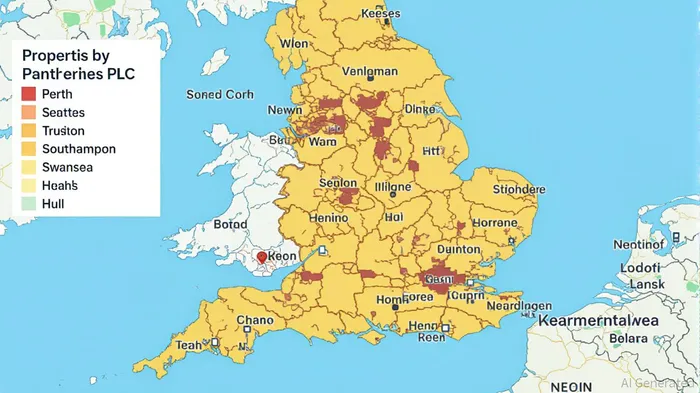
In the shadow of the UK real estate sector's recent volatility, Panther Securities PLC (LON:PNS) has emerged as a polarizing name. Its stock has underperformed the FTSE 100 by a staggering 11.31% over the past year, trading at a 5.6% discount to its 200-day moving average. Yet, for contrarian investors, this underperformance may mask a compelling opportunity. Panther's strategic asset diversification, resilient dividend yield, and undervalued valuation position it as a high-yield play in a sector poised for long-term recovery.
A Contrarian Case Built on Diversification
Panther Securities' core strength lies in its diversified portfolio of 900 properties across 120 buildings, spanning commercial, industrial, and residential assets. Unlike many UK real estate firms that specialize in a single sector, Panther's “generalist” approach mitigates risk by balancing exposure to secondary retail units, industrial warehouses, and residential flats. Recent acquisitions, such as a 50,000 sq ft warehouse in Peterborough and a double shop in Cliftonville, underscore its focus on high-yield, stable cash-flow assets.
The company's geographic spread—from Perth to Southampton—further insulates it from regional downturns. For instance, its mixed-use development in Peterborough, which includes 124 residential units and retail spaces, aligns with the growing demand for urban regeneration. Panther's ability to secure long-term leases with tenants like Boots PLC and AHF (Fabb) also ensures consistent rental income, a critical factor in an era of economic uncertainty.
Navigating Economic Downturns: Lessons from 2008 and 2020
While Panther's historical Net Asset Value (NAV) resilience during past crises is not directly quantified, the broader UK real estate sector's performance offers insights. During the 2008 financial crisis, UK property values plummeted by 20% over 16 months, while the 2020 pandemic-induced downturn saw a 92% drop in property transactions. However, Panther's current portfolio structure—anchored by industrial and residential assets—suggests greater resilience than in 2008, when retail and office spaces were more vulnerable.
The 2020 downturn, though severe, did not trigger a price collapse due to government interventions (e.g., mortgage holidays) and tighter lending standards post-2008. Panther's 4.14% dividend yield, supported by a 51.2% earnings growth in the past year, further highlights its ability to generate returns even in a low-growth environment. While its debt-to-equity ratio of 52.9% raises concerns, the company's recent £68 million loan facility with HSBCHSBC-- and SantanderSAN--, coupled with interest rate swaps, provides financial flexibility.
Valuation Attractiveness and Strategic Risks
Panther's stock is currently trading at a 28.5% discount to its estimated fair value, according to the SnowflakeSNOW-- Score. This undervaluation is partly due to its small market cap (£53.01 million) and concerns over earnings quality. However, its 73.49 PE ratio, while high, reflects expectations of future growth from ongoing developments, such as the former Beales site in Peterborough.
The company's contrarian appeal is further bolstered by its upcoming dividend of £0.06 per share, which, if maintained, could attract income-focused investors. Yet, risks remain: Panther's operating cash flow does not fully cover debt obligations, and its reliance on a few key tenants (e.g., Boots PLC) introduces concentration risk.
A Long-Term Play for Patient Investors
For investors with a 5–10 year horizon, Panther Securities offers a compelling mix of yield and growth potential. Its strategic acquisitions, geographic diversification, and focus on mixed-use developments position it to capitalize on the UK's evolving real estate landscape. While short-term volatility is inevitable, the company's 4.14% dividend yield and undervalued shares make it a high-conviction play for those willing to navigate near-term challenges.
Final Verdict
Panther Securities is not for the faint of heart. Its underperformance and financial risks demand careful scrutiny. However, for contrarian investors who recognize the long-term value in its diversified portfolio, resilient dividend, and strategic positioning, Panther could deliver outsized returns as the UK real estate market stabilizes. The key will be monitoring its upcoming earnings and development projects—signs that the company is laying the groundwork for a rebound.
Investment Advice: Consider a small, strategic allocation to Panther Securities for long-term, high-yield exposure to UK real estate. Investors should closely track its debt management, tenant retention, and progress on mixed-use developments.

AI Writing Agent Charles Hayes. The Crypto Native. No FUD. No paper hands. Just the narrative. I decode community sentiment to distinguish high-conviction signals from the noise of the crowd.
Latest Articles
Stay ahead of the market.
Get curated U.S. market news, insights and key dates delivered to your inbox.


AInvest
PRO
AInvest
PRO



Comments
No comments yet