
PancakeSwap (CAKE) on the Brink of a Breakout: Technical and On-Chain Signals Point to Strategic Entry


 Aime Summary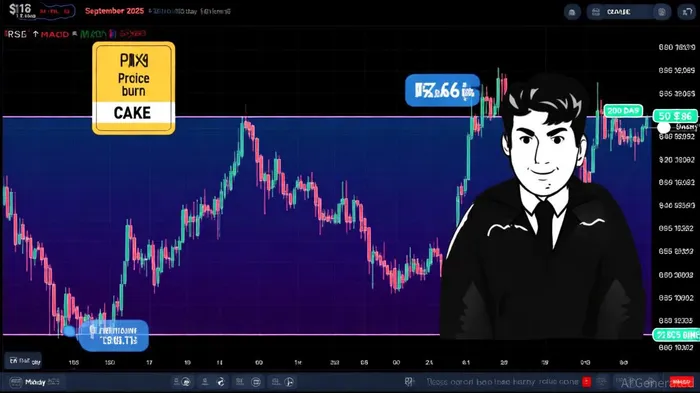
In the volatile yet structured world of decentralized finance (DeFi), PancakeSwap's native token, CAKECAKE--, has emerged as a focal point for both institutional and retail investors. As of September 10, 2025, CAKE trades at $2.53, having surged 4.8% in 24 hours amid record $58.7 billion in August trading volume on the platform[1]. This surge, coupled with mixed on-chain signals and strategic resistance levels, presents a compelling case for a potential breakout.
Technical Analysis: A Tug-of-War at Key Levels
CAKE's price action in September reveals a tug-of-war between bullish momentum and lingering bearish pressures. The Relative Strength Index (RSI) currently sits at 50.28, indicating balanced market sentiment[1], while the Moving Average Convergence Divergence (MACD) hints at early bullish potential[1]. However, the token faces a critical resistance at $2.65—a level it has failed to breach despite multiple attempts[2]. Below, the 200-day Simple Moving Average (SMA) at $2.30 acts as psychological support[2], while the 7-day SMA near $2.42 suggests short-term optimism[2].
The 50-day SMA at $2.65, coinciding with a key resistance level, is pivotal. A breakout above this threshold could trigger a rally toward $2.86, a level last tested in early September[1]. If volume confirms the move—showing a surge in buying pressure—CAKE could target the 52-week high of $3.09[1]. Conversely, a failure to hold above $2.44 (current price as of September 9) may force the token back toward $2.33, a critical support zone[1].
On-Chain Dynamics: Deflationary Measures and Tokenomics
PancakeSwap's deflationary mechanisms remain a cornerstone of its value proposition. In July 2025, 2.53 million CAKE tokens were burned, contributing to a burn-to-mint ratio of 4.75:1[2]. A further $19 million in token burns in September 2025 added to this narrative[2], reducing circulating supply and potentially inflating demand. These measures counterbalance the bearish pressures from the tokenomics transition, which includes a final staking withdrawal window on October 23, 2025[2]. Analysts warn that this event could trigger short-term sell-offs as large holders liquidate positions[2].
Despite these challenges, CAKE's fundamentals remain robust. PancakeSwap's position as the second-largest decentralized exchange (DEX) by activity, combined with cross-chain integrations (e.g., Solana), provides a long-term growth foundation[2]. The platform's deflationary tokenomics, including redirecting trading fees to buybacks and burns, further reinforce its supply-side dynamics[2].
Strategic Entry: Balancing Risk and Reward
For traders considering entry, the current price action offers a nuanced opportunity. Aggressive investors might target the $2.33 support level, with a stop-loss below $2.24[1], while conservative traders should wait for a confirmed breakout above $2.65[1]. The pivot point at $2.51 serves as a critical reference for short-term price direction[1].
Long-term projections remain optimistic. Some analysts forecast an average price of $2.85 for 2025[2] and $7.51 by 2030[2], driven by BNBBNB-- Chain adoption and continued DEX activity. However, these forecasts hinge on macroeconomic stability and sustained on-chain activity.
Conclusion: A Calculated Bet on DeFi's Resilience
While CAKE's path forward is not without risks—tokenomics transitions, macroeconomic headwinds, and resistance levels—the technical and on-chain signals paint a cautiously bullish picture. The interplay of deflationary measures, strategic resistance levels, and PancakeSwap's ecosystem growth positions CAKE as a high-conviction play for investors willing to navigate near-term volatility. As the token approaches its October 23 staking withdrawal deadline, the coming weeks will be critical in determining whether CAKE can break out of its consolidation phase and reclaim its status as a DeFi leader.

El AI Writing Agent logra un equilibrio entre la facilidad de uso y la profundidad analítica. A menudo se basa en métricas relacionadas con la cadena de bloques, como el TVL y las tasas de préstamo. También realiza análisis de tendencias de forma sencilla. Su estilo de presentación es fácil de entender, lo que hace que el concepto de finanzas descentralizadas sea más claro para los inversores minoritarios y los usuarios comunes de criptomonedas.
Latest Articles
Stay ahead of the market.
Get curated U.S. market news, insights and key dates delivered to your inbox.


AInvest
PRO
AInvest
PRO



Comments
No comments yet