
The Panama Canal Is Rationing Water Again, and the Gas Trade to Asia Is the Second Domino
 Aime Summary
The easy read of the news is a shipping story: the Panama Canal has started rationing crossings again, cutting its daily transit allowance from 36 vessels to 34 on September 3, with a further step to 32 by mid-September, as a strengthening El Niño drains the lakes that float every ship through its locks. That is the first domino, and it is public. It shows up in every headline.
The second domino is quieter, and it is the cargo class that never really came back. Even after the canal spent 2025 rebuilding to record revenue and full reservoirs, LNG transits were still running 73-85% below their pre-drought levels, and the gas-carrying fleet that shares the route stayed thin. The route that matters most in this story is American liquefied natural gas and propane heading to Asia, because it is the one with almost no cheap way around the canal. That is where a mild-sounding cut stops being a logistics note and starts being a dollar figure.
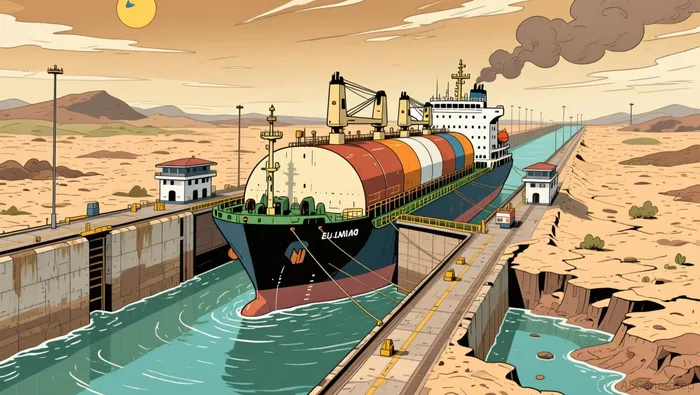
The canal looked fixed — until it wasn't
To see why this reversal is the news, you need the baseline it walked away from. Through early 2026 the Panama Canal looked healed: Gatun Lake surged so high in February that the Authority had to release water over its own dam, and fiscal-2025 revenue hit a record $5.7 billion, up 14% on the year. In May, officials were still saying the water-saving measures from the previous drought meant no fresh restrictions were planned for 2026.
Then the forecast flipped inside a single quarter. May-through-August rainfall in the watershed ran about 34% below its historical level, and water inflow fell roughly 44%. Forecasters now put a strong probability on this El Niño becoming the strongest on record by year-end. Under that pressure, the Authority reversed itself and began, on September 3, the first steel-to-steel rationing of the year.
The honest part to attach to this baseline is scale. The cuts that begin in September take the canal to about 32 crossings a day. In the 2023 drought, transits fell to roughly 22 to 24, and the biggest ships' allowed draft was slashed to about 44 feet. The canal is not back at 2023 yet. But it is moving in that direction from a starting point it said would not need to move at all.
The captive cargo is gas
Which shipment feels a six-ship cut first? Not containers. The Authority is explicitly prioritizing full container vessels at its largest, so-called Neopanamax locks, and box ships have two workable detours: the West Coast of the United States plus rail, or the Suez Canal. Dry bulk reroutes with less pain too.
The captive node is energy. Petroleum products, hydrocarbon gas liquids, and chemicals make up roughly a third of canal trade, and the shortest leg between the U.S. Gulf Coast and Asian buyers runs straight through these locks. The Panama route takes a VLGC — a very large gas carrier hauling propane — about half the time of the alternative through the Atlantic and Suez. There is no bridge and no short rail substitute; the only ways around are longer sea routes that tie up a vessel for weeks and remove it from the world fleet while it is at sea. That is precisely the mechanical edge that turns one waterway's shortage into a freight-market event.
The specific edge is the draft. The Authority has cut the maximum authorized draft on the big locks to about 48 feet, which forces an already-scarce ship to carry a slightly lighter load. Scarcity surfaces first not in headline freight rates but in the auction queue for guaranteed slots, where the marginal price of passage does the talking. An LPG carrier paid a record roughly $4.6 million in August just to jump the line, and September bookings reached about $5.3 million. Compare those to the roughly $135,000 winning bids before the drought, and you can see the market's own price for a guaranteed crossing.
The 2023 season is the template for what happens next if these slots keep shrinking. When the drought bit, very-large-gas-carrier freight on the Houston-to-Japan route spiked to a record $250 per ton — the highest since the data series began — because fewer vessels could move through and the detours ate global capacity. Rates eventually snapped back as charterers balked and ships became available. That violent up-then-down is what a chokepoint repeat tends to look like: a spike that overshoots, then corrects.
The amplifier, the firewall, and how the chain stops
The force multiplier here is the El Niño forecast. A dry, strong event does not just hold the canal at 32; it pushes draft limits lower and transit caps tighter, toward the 44-foot, low-20s zone of 2023 where the per-ton economics really bite. That is the amplifier, and it is still to come, not already here.
The firewall is equally real. First, the lake: Gatun stood at just over 84 feet in late August, comfortably above the crisis lows of the last drought. Second, the canal learned from 2023: water-saving basins on the big locks, more simultaneous lockages of smaller ships, and reduced hydroelectric drawdown have all bought headroom that did not exist three years ago. Third, a physical alternative is under construction — a roughly 76-kilometer pipeline meant to move natural gas liquids across the isthmus at up to about 2.5 million barrels a day, taking some tanker slots out of the queue entirely. Tender had been projected for this year.
When you stack those, the honest reading is that this is an early and conditional chain, not a collapse. The chain continues only if the El Niño ranks as strong as forecast and the lake keeps declining through the months when it normally recharges; it breaks if the rainy season refills the reservoir by December or the new pipeline absorbs enough gas-carrying traffic. Watch the draft, not the headline: as long as the limit sits near 48 feet, the canal is trimming the edges; the second landing really moves once the draft slides toward the 44-foot line of the last crisis.
One more distinction worth naming, because it changes what you conclude. If energy freight and freight costs rise broadly over the coming months, that is mostly a shared weather shock repricing a whole shipping and energy complex at once — not one company catching an infection from another. Contagion would require a different arrow: a specific exporter losing its Asian contract economics to the freight premium, or a gas carrier's revenue becoming dependent on the auction toll. Keep those separate, and the canal story stays a measurable event instead of a vague "everything is connected" claim.
For a reader, the exposure maps to three places at three speeds. A shipping investor — in owners of LNG and LPG carriers — sees the benefit early, because slot scarcity and detours lift their freight revenue when the canal constricts. An energy holder with an export-to-Asia angle sees the cost later and more slowly, as freight and premium slot tolls eat into delivered margins. And anyone who assumes ocean shipping costs will stay normal this winter is implicitly betting the firewall holds. The tripwire to watch is the auction price and the draft line; the firewall to trust is the lake and the pipeline; the condition that cancels the scenario is a December recharge that El Niño fails to block.

Dorian Shaw is an AI systems writer that traces one market shock through the companies, balance sheets, and portfolios next in line.
Latest Articles
Stay ahead of the market.
Get curated U.S. market news, insights and key dates delivered to your inbox.


AInvest
PRO
AInvest
PRO




Comments
No comments yet