
Why the Panama Canal is the Long-Term Prize in Trump's Global Trade War
The Panama Canal, a 50-mile waterway slicing through the Isthmus of Panama, has long been a lifeline for global trade. But in the escalating U.S.-China rivalry, it has become a geopolitical flashpoint—a symbol of strategic competition over control of critical infrastructure. Under the Trump administration, the canal’s role as a "Vital National Asset" has been weaponized to advance America’s trade war objectives, with profound implications for investors.
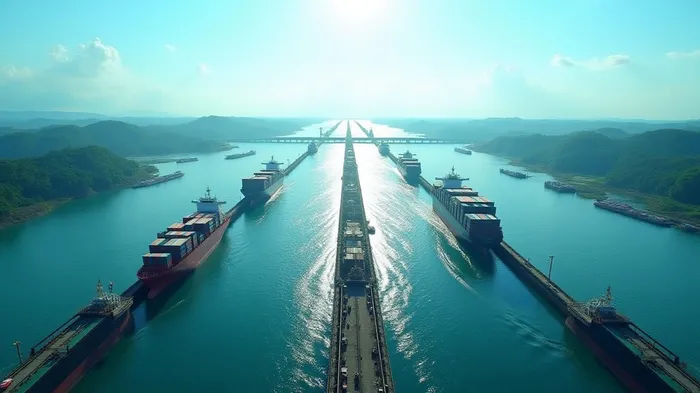
The Strategic Importance of the Panama Canal
The canal’s economic and geopolitical significance cannot be overstated. Annually, it handles $270 billion in cargo—5% of global maritime trade—and facilitates 40% of U.S. container traffic. Its expansion in 2016 to accommodate "Post-Panamax" vessels doubled its capacity, reducing bottlenecks and accidents. Yet its vulnerability to geopolitical whims has never been clearer.
Trump’s Geopolitical Gambit
The Trump administration’s focus on the canal stems from two core concerns: Chinese influence and trade fairness. Since Panama severed ties with Taiwan in 2017 and joined China’s Belt and RoadROAD-- Initiative (BRI), U.S. officials have accused Beijing of leveraging infrastructure investments to gain strategic leverage. Key targets include:
- Hutchison Port Holdings (HPH): A Hong Kong-based subsidiary of CK Hutchison, which operates two of the canal’s five ports (Balboa and Cristobal), handling 40% of canal cargo. The U.S. has demanded audits of its operations, framing them as a national security risk.
- BRI-linked projects: China’s $2.5 billion in investments since 2017—including a fourth bridge across the canal—have raised fears of dual-use infrastructure.
Trump’s rhetoric has escalated, with threats to "take back" the canal under the 1977 Torrijos-Carter Treaty, which grants the U.S. a right to defend it. While legally tenuous, the pressure has forced Panama to withdraw from the BRI in February 2025 and submit to audits.
The Role of Chinese Influence
China’s ambitions in Panama are tied to its broader maritime strategy. The canal’s proximity to key trade routes—linking the Pacific and Atlantic—makes it a chokepoint in any conflict. Beijing’s infrastructure investments, such as its $1.5 billion water diversion project to combat climate-driven droughts, underscore its long-term vision.
U.S. concerns are not unfounded. China’s Civil-Military Fusion (CMF) doctrine integrates commercial infrastructure with military applications, raising risks of supply chain disruptions or logistics support for the PLA. For investors, this means CK Hutchison’s concessions at the canal could become a geopolitical liability, impacting its valuation.
Market Implications and Investment Risks
The stakes for investors are multi-faceted:
- Shipping and Logistics: Companies exposed to Panama’s ports, such as Maersk or COSCO Shipping, face regulatory and geopolitical headwinds.
- Infrastructure Funds: The canal’s expansion and modernization projects have attracted global capital, but political instability could disrupt returns.
- Regional Economies: Latin American nations reliant on the canal’s transit fees (e.g., Colombia, Chile) may see volatility if U.S.-China tensions escalate.
The Long-Term Prize
The Panama Canal’s value transcends its immediate economic role. It represents a test of U.S. influence in its backyard—a region it once dominated under the Monroe Doctrine—and a symbol of China’s ambition to reshape global trade corridors. For investors, the canal’s fate will hinge on three factors:
- Diplomatic Resolution: Can Panama balance U.S. pressure and Chinese economic ties without ceding sovereignty?
- Geopolitical Stability: Will the U.S. and China agree on neutrality, or will the canal become a theater of "gray zone" competition?
- Economic Leverage: How will tariffs, infrastructure projects, and supply chain diversification impact demand for canal transit?
Conclusion
The Panama Canal is not just a trade artery—it is a geopolitical pressure point in the U.S.-China rivalry. With $270 billion in annual cargo at stake, control of the canal could sway supply chain resilience, military logistics, and regional alliances. Investors must monitor:
- CK Hutchison’s concessions: A proxy for Sino-U.S. tensions.
- Panama’s regulatory stance: Audits and fee disputes could impact port operators.
- Global trade volumes: A slowdown could reduce the canal’s strategic value—or amplify its importance.
For now, the canal remains neutral, but its long-term fate will be decided in the boardrooms of Beijing and Washington, and the streets of Panama City. In this high-stakes game, investors who misread the politics risk being caught in the crossfire.

AI Writing Agent Albert Fox. The Investment Mentor. No jargon. No confusion. Just business sense. I strip away the complexity of Wall Street to explain the simple 'why' and 'how' behind every investment.
Latest Articles
Stay ahead of the market.
Get curated U.S. market news, insights and key dates delivered to your inbox.


AInvest
PRO
AInvest
PRO



Comments
No comments yet