
Palo Alto Networks Shares Fall 4.17% as Technical Indicators Confirm Bearish Continuation
 Aime Summary
Candlestick Theory
Palo Alto Networks (PANW) has experienced a significant bearish candle on the most recent session, closing at $157.21 with a 4.17% decline. This large-bodied candle, coupled with a high of $162.8 and a low of $156.14, suggests a potential breakdown from a prior consolidation range. Key support levels emerge at $157.21 (current close) and $150.15 (previous low on March 2), while resistance is reinforced at $162.455 (March 23 close). 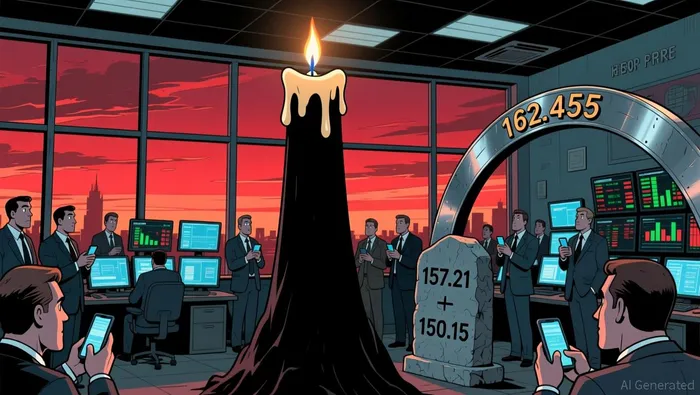 The pattern hints at a bearish continuation, though a bullish reversal could materialize if the price rebounds above $162.8 with increased volume.
Moving Average Theory
Short-term (50-day) and long-term (200-day) moving averages indicate a bearish bias. The 50-day MA has crossed below the 200-day MA, forming a "death cross" that validates a downtrend. The current price ($157.21) sits below both the 50-day ($170.5–175 range) and 200-day ($185–190 range) averages, reinforcing bearish momentum. A retest of the 50-day MA at ~$165 could trigger further selling pressure, while a break above the 200-day MA would signal a potential trend reversal.
MACD & KDJ Indicators
The MACD histogram has contracted sharply, reflecting weakening momentum in the downtrend, though the MACD line remains below the signal line, suggesting bearish bias. The KDJ stochastic oscillator shows %K and %D lines in oversold territory (<20), indicating potential for a short-term rebound. However, divergence emerges between the KDJ and price action: while %K/%D suggest oversold conditions, the price continues to decline, signaling caution about a reversal. This divergence may foreshadow a continuation of the bearish phase.Bollinger Bands
Volatility has expanded significantly, with the recent session’s range ($156.14–$162.8) widening the bands. The price closed near the lower band, suggesting oversold conditions. A bounce off this level is probabilistic, but a break below the $150.15 support could trigger a further expansion of the bands. The 20-period Bollinger Band squeeze observed in late February has since resolved into a high-volatility phase, aligning with the recent sharp decline.
Volume-Price Relationship
Trading volume spiked on the most recent session (7.14M shares), validating the bearish price action. However, declining volume on subsequent down sessions (e.g., March 20’s 16.46M vs. March 19’s 6.56M) suggests waning conviction in the downtrend. This mixed volume signal implies the move may lack sustainability unless accompanied by a surge in buying interest during a rebound.Relative Strength Index (RSI)
The 14-day RSI has dipped below 30, confirming oversold conditions. While this traditionally signals a potential bounce, caution is warranted due to the prolonged bearish trend. A sustained close above $164.05 (March 23 high) could trigger a RSI rebound above 50, but a failure to hold above this level would reinforce bearish sentiment. The RSI’s divergence from price (lower highs) suggests the downtrend may persist despite the oversold reading.Fibonacci Retracement
Key Fibonacci levels align with critical support zones: the 38.2% retracement at $160.5 and 50% at $155.9. The recent close at $157.21 suggests the price is consolidating near the 38.2% level, which could act as a short-term floor. A break below $155.9 would target the 61.8% retracement at $149.4, coinciding with the March 2 low. Confluence between Fibonacci and moving average levels (~$165) offers a probabilistic pivot point for near-term reversals.
If I have seen further, it is by standing on the shoulders of giants.
Latest Articles
Stay ahead of the market.
Get curated U.S. market news, insights and key dates delivered to your inbox.
AInvest
PRO
AInvest
PRO



Comments
No comments yet