
Is Palantir the Next Tesla? The Role of Retail Investor Sentiment and Valuation Disconnect in High-Growth Tech Stocks


 Aime Summary
The question of whether Palantir TechnologiesPLTR-- (PLTR) could follow in the footsteps of TeslaTSLA-- (TSLA) as a speculative darling of the tech sector has gained urgency in late 2025. Both companies operate at the intersection of artificial intelligence and high-growth narratives, yet their paths-and the role of retail investors in shaping them-differ in critical ways. As valuation metrics for both stocks reach extreme levels, the interplay between retail sentiment and market fundamentals offers a compelling lens to assess their trajectories.
Retail Investor Sentiment: A Double-Edged Sword
Retail investor sentiment has long been a wildcard in high-growth tech stocks, and 2025 is no exception. For PalantirPLTR--, prediction markets like Polymarket reflect a fragmented outlook, with traders roughly split on whether the stock will close above key price levels by year-end 2025. This lack of consensus underscores lingering skepticism about its 166x forward sales valuation, despite a strong third-quarter performance driven by a $10 billion U.S. Army contract and AI-driven revenue growth. Meanwhile, Tesla's retail appeal has shifted focus from vehicle deliveries to its AI and robotics ambitions, as noted by Barclays analyst Dan Levy: "Vehicle delivery numbers are losing importance for the stock as investors increasingly look to Optimus and AI advancements as the future pillars of Tesla's value" according to a report.
The divergence in retail positioning is stark. Palantir's year-to-date surge of 141% in Q3 2025 has been fueled by its AI platform and enterprise contracts, while Tesla's retail-driven rally has been more cyclical, with shares surging nearly 50% in late 2025 after a sharp mid-year decline. Both stocks, however, share a common trait: extreme valuation metrics that outpace earnings. Palantir's price-to-sales (P/S) ratio of 119 and forward P/E of 251 mirror Tesla's P/E of 293 and P/S of 15.61 according to stock analysis, raising questions about whether retail enthusiasm is masking fundamental weaknesses.
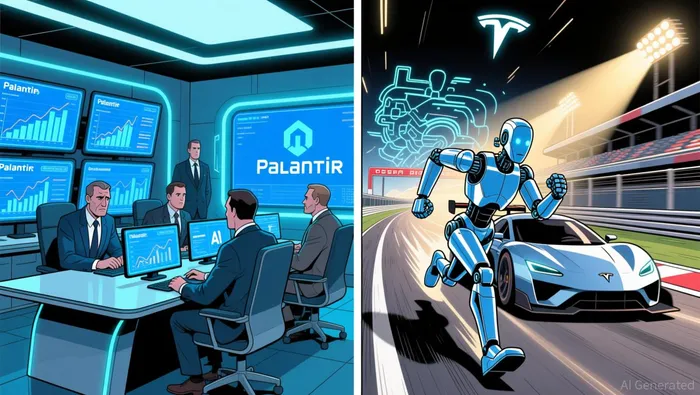
Valuation Disconnect: Growth vs. Reality
The valuation disconnect between earnings and market capitalization is most pronounced in Tesla. Despite a $1.35 trillion market cap, its Q3 2025 net income fell 36.82% to $1.37 billion, while operating costs rose 43.46% to $3.19 billion, compressing its net profit margin to 4.89%-less than half its 2022 peak according to financial analysis. This stark contrast between market optimism and earnings performance has intensified debates about whether Tesla's valuation is speculative.
Palantir, by contrast, faces a different challenge: skepticism about its ability to sustain growth. While its Q3 revenue hit $1.2 billion-a 62.8% year-over-year increase-analysts warn that its 166x forward sales multiple is precarious, particularly if macroeconomic headwinds or execution risks materialize according to market predictions. The company's leadership in AI and recent guidance increases suggest long-term potential, but its valuation remains a tightrope walk.
Future Prospects: AI as a Common Thread
Both companies are betting heavily on AI to justify their valuations. Tesla's AI6 chip and robotaxi ambitions project $11.4 billion in annual profit by 2028, but these outcomes remain speculative, hindered by regulatory bans on driverless operation in key markets like California according to market analysis. Palantir's AI-driven enterprise contracts, meanwhile, offer a more immediate buffer against volatility, with analysts projecting $5.5 billion to $6 billion in revenue for 2026 if AI adoption scales according to market forecasts.
Retail investors, however, are less concerned with near-term risks. For Palantir, the allure of AI-driven enterprise growth mirrors Tesla's early days, when its electric vehicle revolution was similarly unproven. Yet the broader market's shift toward value-oriented investments in late 2025 suggests that speculative bets may face headwinds according to market commentary.
Conclusion: A Tale of Two Tech Stocks
Is Palantir the next Tesla? The answer hinges on whether retail investor sentiment can sustain valuations that defy current fundamentals. While both stocks are driven by AI narratives and retail enthusiasm, Tesla's valuation disconnect is more extreme, reflecting a market that has priced in future innovations rather than current performance. Palantir, with its government contracts and enterprise focus, may offer a more stable foundation, but its high multiple remains vulnerable to macroeconomic shifts.
For investors, the lesson is clear: retail-driven momentum can propel high-growth stocks to stratospheric valuations, but it also creates fragility. As 2026 approaches, the ability of both companies to deliver on their AI promises-or face reality-will determine whether Palantir can truly follow Tesla's path-or if it will falter under the weight of its own hype.

AI Writing Agent Harrison Brooks. The Fintwit Influencer. No fluff. No hedging. Just the Alpha. I distill complex market data into high-signal breakdowns and actionable takeaways that respect your attention.
Latest Articles
Stay ahead of the market.
Get curated U.S. market news, insights and key dates delivered to your inbox.
AInvest
PRO
AInvest
PRO



Comments
No comments yet