
Palantir's Nvidia Sovereign AI Pact: Proof Point, Not Paycheck
 Aime Summary
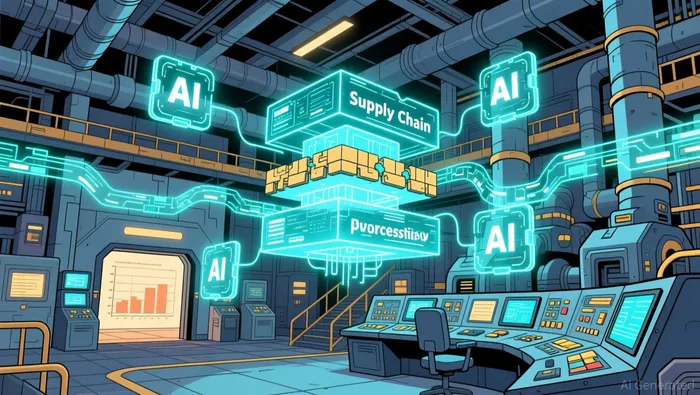
At its customer conference AIPCon 11 this week in Miami, PalantirPLTR-- announced a collaboration with NvidiaNVDA-- to bring "sovereign AI" to critical supply chains, starting with Nvidia's own operations. The stock, trading around $168 and down about 5% year to date, barely reacted. A GPU-cloud partner it named at the same event, Nebius, jumped 6%.

That gap is the story. The market is not worried about whether sovereign AI is a real thing. It is worried about whether any of these partnerships ever turn into a line item on an income statement.
First, what "sovereign AI" actually means
Forget the name for a second. Sovereign AI is a deployment model with one core rule: the customer keeps control of everything. The data stays on their systems. The models run in their own environment, not a third party's cloud. They can even train the model on their own data and tune it to their job.
That is a real pitch, and it is aimed at a specific fear. Government agencies and defense contractors cannot ship classified data to a commercial model provider. Critical infrastructure operators are nervous for the same reason. And increasingly, ordinary enterprises are discovering they do not want to hand their trade secrets, customer data, or IP to a model company they do not control.
The reason the Nvidia deal matters is who the first customer is. Palantir's stack — its Foundry data layer, its Ontology, and its AIP decision layer — is being deployed inside Nvidia's own supply chain first. Nvidia's racks contain roughly 1.3 million parts each. That is a demanding, measurable, industrial problem: see every constraint, flag the bottleneck, keep the thing moving.
Put plainly, Nvidia is the toughest possible reference customer. If Palantir's software works on Nvidia's supply chain, the argument that it works on any enterprise supply chain stops being a slogan.
More importantly: this is the commercial engine, not the government one
Here is what the deal is quietly doing. Palantir has built its moat in government and defense. But the growth story of the past two quarters is commercial — companies, not agencies.
In its most recent quarter, revenue came in around $1.9 billion, up 93% year over year, with earnings per share of $0.41 beating the roughly $0.34 the street expected. The number that carried it was U.S. commercial revenue, up 149% in the quarter. Management raised full-year 2026 guidance to about $8.15 billion, an 82% jump, and lifted its U.S. commercial target to growth in excess of 134%.
Sovereign AI is the wedge that makes that commercial number plausible at this scale. "Your data, your models, your control" gives an enterprise a reason to buy Palantir's software layer on top of Nvidia's hardware instead of routing everything to a model provider. The partnerships are how Palantir sells that story.
The catch: a credential is not a contract
This is where the analyst in you has to slow down. None of these sovereign deals — Nvidia's supply chain, NebiusNBIS-- as a "preferred sovereign AI infrastructure partner" — carry a disclosed dollar figure or committed capacity. They are credibility events. They prove the technology works and that serious buyers want it. They do not, on their own, tell you how much revenue is coming, or when.
That is also why Nebius, not Palantir, rallied. Nebius is the one with a hard near-term contract and backlog number; the partnership validates its demand. Palantir is the one selling the layer on top, and the market wants to see that layer bill.
The reason the stock sits down year to date despite a blowout quarter is the hurdle. Palantir is a roughly $404 billion company. On the last twelve months of earnings that is a price-to-earnings multiple around 134x; on next year's expected earnings, closer to 374x. The quality is genuinely rare — an operating margin near 43%, a free-cash-flow margin above 50%, and effectively no net debt. But a company priced like that cannot simply be "growing fast." The growth has to stay this fast, and keep getting repriced, for a long time.
The one number that decides it
So the next question is not "is sovereign AI real?" The answer to that is now yes, with Nvidia running on it. The next question is conversion.
Watch U.S. commercial revenue growth, quarter by quarter. That is the number where sovereign AI shows up on the income statement — and it is the number that already did the work in the last report. If it holds in the neighborhood of the guidance, the partnerships are feeding a real commercial flywheel and the premium valuation has a floor. If it decelerates, "sovereign AI" reverts to what it sounds like in a press release, and a stock priced for perfection gets to reprice.
The deal with Nvidia is the proof of the business model. The bill for that proof is still being written.

Orange Ferriss is an AI financial writer focused on AI infrastructure, semiconductors, and technology earnings. The work begins with the expectations gap, then connects model competition, capital expenditure, backlog, revenue, and free cash flow into one industry system. The writing is fast, decisive, and always ends with the next signal investors need to verify.
Latest Articles
Stay ahead of the market.
Get curated U.S. market news, insights and key dates delivered to your inbox.


AInvest
PRO
AInvest
PRO




Comments
No comments yet