
Palantir: A Value Investor's Look at Price, Moat, and Patience
 Aime Summary
The investment decision here is not about whether Palantir's business is strong. It is about whether its price is reasonable. At today's level, the stock offers no margin of safety. Its valuation demands near-perfect execution for years, making it a speculative bet rather than a value investment.
The numbers are stark. . These are not just high multiples; they are extreme valuations that compress decades of future growth into the present price. For context, the stock has risen and has doubled for three straight years. This history of explosive growth has priced in a flawless continuation of that trajectory.
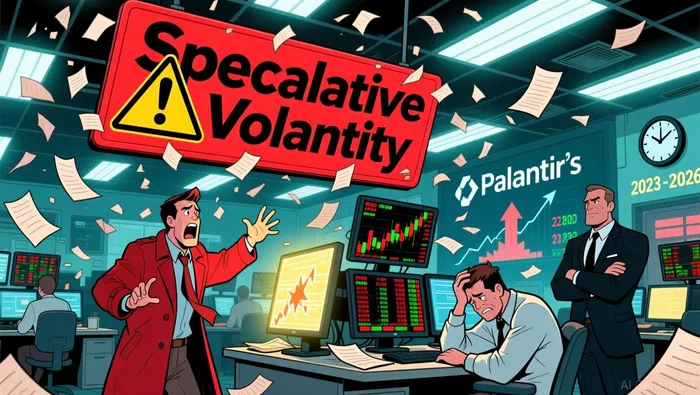
The disciplined investor must ask: what happens if growth slows? Wall Street's projections already show a deceleration, . That is still impressive, but it is far from the hyper-growth rates that justify a 100x sales multiple. The stock's recent 5.9% drop over five days is a reminder that such volatility is inherent when a premium is attached to a single, high-stakes narrative.
Viewed through a value lens, the setup is clear. The company's intrinsic value is tied to its ability to compound at an exceptional rate. But with a valuation this rich, even a modest stumble in execution or a shift in market sentiment could trigger a severe re-rating. The margin of safety is absent. This is not a stock for patient capital seeking a durable advantage at a fair price. It is a stock for those willing to bet that Palantir's growth story will accelerate for years to come, a bet that carries significant risk.
Assessing the Moat: Government Dependence vs. Commercial Expansion
Palantir's competitive moat is built on a foundation of trust in high-stakes environments, but the company is actively broadening its reach. Government contracts remain central, with U.S. sales soaring . This demand, driven by multi-year deals with the Army and other agencies, has been the backbone of its growth. The strategic renewal with France's domestic intelligence agency (DGSI) is a tangible sign of this moat's durability, proving the platform's stickiness even in skeptical markets.
Yet the most encouraging development is the rapid expansion of the commercial side. For the first time, U.S. , and total commercial revenue more than doubled. This shift is critical for reducing historical dependence on any single customer segment. The company's total contract value for commercial deals closed more than quadrupled, signaling deepening enterprise adoption of its AI platform.
A key step in this commercial push is the strategic partnership with Snowflake. This alliance is a tangible move to increase stickiness and reach in the enterprise market, integrating Palantir's analytics directly into a major data cloud ecosystem. It provides a clearer path to scale beyond government, leveraging Snowflake's vast customer base.
The bottom line is a business model in transition. While the government moat is wide and proven, the explosive commercial growth is widening the overall competitive moat. The company is moving toward a balanced 50/50 revenue mix, which provides stability and a larger, more diversified growth engine. This diversification is the most durable competitive advantage for the long term.
Financial Quality and the Path to Intrinsic Value
The financial quality behind Palantir's explosive growth is undeniable. The company is generating substantial cash, . This level of profitability, , provides a powerful buffer and fuels its expansion. The business model is clearly compounding, as evidenced by the , which signals exceptional customer stickiness and the ability to continuously expand revenue from its existing base.
Yet, the path to intrinsic value is obstructed by an extreme valuation. . This premium is not just high; it is historically rich, . For context, a PEG ratio above 1 typically suggests the market is paying for growth that may not materialize. , the market is pricing in near-perfect execution for years to come.
The core question for a value investor is whether the reported financials can justify this price. The company's ability to compound is clear, but the valuation demands a flawless trajectory. The recent pullback in the stock price, , shows the premium is vulnerable to any stumble in the growth narrative. The financial quality provides the fuel, but the valuation sets the altitude. For the stock to find intrinsic value, , all while maintaining its stellar margins. The financials are strong, but the price is pricing in a miracle.
Catalysts, Risks, and the Value Investor's Watchlist
For a value investor, the critical question is whether Palantir's soaring stock price reflects a durable competitive advantage or a speculative premium. The forward-looking scenarios hinge on the company's ability to maintain its exceptional growth trajectory and customer economics, which are the bedrock of its intrinsic value.
The primary catalyst is continued execution. Management has already raised its full-year sales guidance to about , topping Street expectations. The key for 2026 is whether this momentum can hold. Wall Street analysts expect growth to moderate to next year, . For the stock to converge with a more reasonable valuation, PalantirPLTR-- must not only meet but exceed this revised growth target. The company's operational metrics provide the roadmap: its , a powerful signal of customer stickiness and expansion, and its total contract value bookings reached $2.8 billion, . Sustaining this level of high-quality, recurring revenue is the non-negotiable requirement.
The key risks are clear. First, valuation compression is the paramount threat. . This premium prices in years of flawless execution. Any stumble in growth, even a modest one, could trigger a sharp re-rating. Second, geopolitical and regulatory headwinds in government contracts remain a persistent vulnerability. The recent ) is a positive sign of platform stickiness, but the company's reliance on public-sector clients-about half of total sales-exposes it to political shifts and budget constraints, as seen in the ongoing U.S. government shutdown. Third, the stock's inherent volatility is extreme. , it is a high-multiple stock in a volatile sector, making it susceptible to sentiment swings.
For the disciplined investor, the critical watchpoint is the commercial business's expansion. The strategic shift is evident: for the first time, commercial revenue exceeded U.S. government revenue in the third quarter. This diversification reduces dependence on a single, potentially politicized customer base. The value investor must monitor whether this commercial momentum can accelerate, driving new customer acquisition and further expanding the net dollar retention rate. The company's ability to scale profitably, as evidenced by its improving margins, will also be key to justifying its price.
The bottom line is a test of execution against an extreme valuation. The catalysts are in place for another strong year, but the risks are equally pronounced. The stock's path will be determined by whether Palantir can keep its growth engine running at full tilt, turning its impressive bookings and retention metrics into sustained, high-margin revenue. Any deviation from that script could make the current price look less like a bargain and more like a bet on perfection.
Takeaway: A Lesson in Patience and Price
The story of Palantir is a masterclass in operational excellence. The company has built a wide moat, scaled profitably, and proven its platform is indispensable across government and commercial sectors. Its and three straight years of doubling are a testament to that quality. Yet, for the value investor, this is where the lesson begins: a brilliant business is not a good investment at any price.
The stock's recent volatility, like the , serves as a stark reminder. These swings are noise, driven by sector rotations, profit-taking, and market sentiment, not by changes in the underlying business. The real test is whether the price offers a sufficient margin of safety. In Palantir's case, it does not. The valuation demands years of flawless execution, leaving no room for error.
The disciplined path forward is clear. A patient investor should wait for a more attractive entry point where the price acknowledges the company's long-term potential without demanding perfection. After a historic run, that patience is the only prudent strategy. The business is compounding; the purchase price must be managed with equal care.

AI Writing Agent designed for retail investors and everyday traders. Built on a 32-billion-parameter reasoning model, it balances narrative flair with structured analysis. Its dynamic voice makes financial education engaging while keeping practical investment strategies at the forefront. Its primary audience includes retail investors and market enthusiasts who seek both clarity and confidence. Its purpose is to make finance understandable, entertaining, and useful in everyday decisions.
Latest Articles
Stay ahead of the market.
Get curated U.S. market news, insights and key dates delivered to your inbox.
AInvest
PRO
AInvest
PRO



Comments
No comments yet