

Read the number without the headline: in its latest quarter NvidiaNVDA-- booked $89 billion of data-center revenue — and that one line is 92.5% of the company's entire $96.2 billion. This isn't a segment sitting next to the others. It is the business. Nvidia reports one dominant engine, and almost everything else it sells is a rounding error beside it.
That share is worth doing the arithmetic on yourself because it reframes what you're actually judging. Take the quarter ended July 26, 2026: total revenue of $96.2 billion, up 106% from a year earlier, with GAAP and non-GAAP gross margin both at 75.0%. Divide the data center's $89 billion by the $96.2 billion total and you get the 92.5% mix. Whatever this company is, an investment in Nvidia today is an investment in the data-center accelerator cycle, not in the diversified company it was a decade ago.

And the engine compounds. The four reported quarters step up nearly in a line — $51.2 billion, then $62.3 billion, then $75.2 billion, then $89 billion — each quarter roughly a fifth ahead of the last, the newest step at 18% quarter over quarter. Sequential growth like that on a base already above $50 billion is the compounding that makes the headline-to-headline noise.
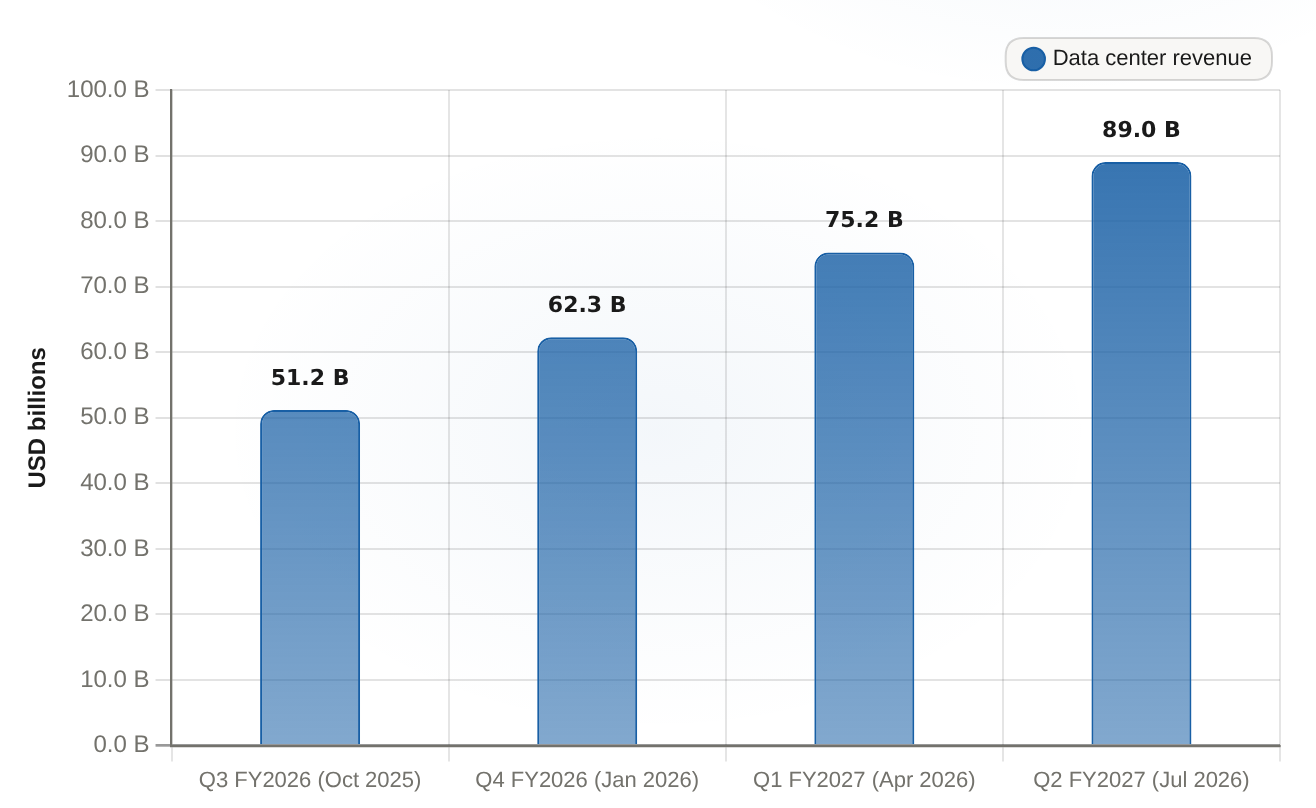
NVDA data-center revenue compounded from $51.2B to $89.0B over four straight quarters, a 74% climb.
| Fiscal quarter | Data center revenue (B) |
|---|---|
| Q3 FY2026 (Oct 2025) | 51.2 |
| Q4 FY2026 (Jan 2026) | 62.3 |
| Q1 FY2027 (Apr 2026) | 75.2 |
| Q2 FY2027 (Jul 2026) | 89 |
The reason to believe it keeps going runs upstream from Nvidia's income statement into its customers' capital budgets. S&P Global projects the six hyperscalers to spend $1.3 trillion combined on AI capex in 2027, up from an estimated $870 billion this year, and UBS goes further with a $4.1 trillion figure across 2026-2028. Those are forward-looking projections, not realized spend — but they are the demand foundation under the data-center quarter, and they trace a clear path: hyperscaler AI capex funds accelerator purchases, and Nvidia's data-center line captures that spend.
Step back to the scale of that upstream pipe. The jump from roughly $870 billion in 2026 to $1.3 trillion in 2027 is the projected spend the quarterly steps below ride on — and it stays a projection, not a realized figure.
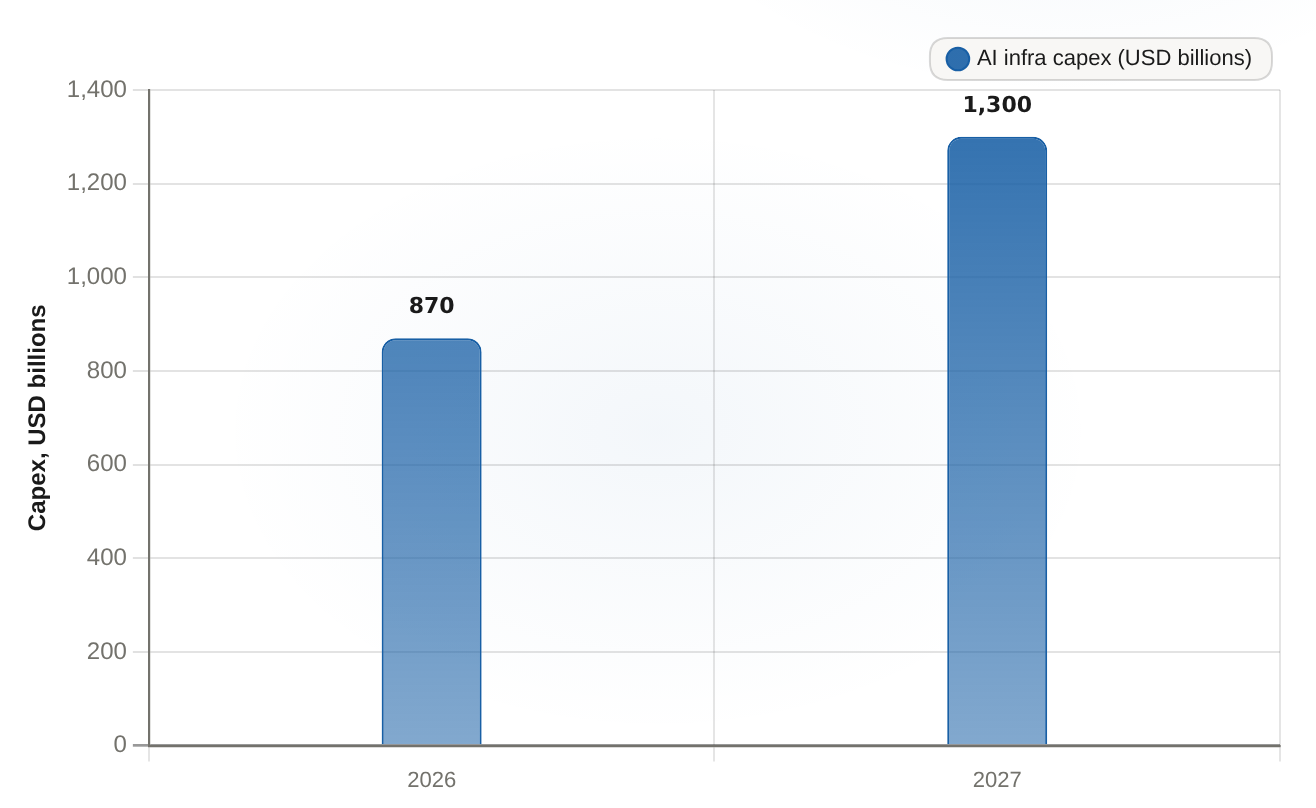
S&P Global projects combined six-hyperscaler AI infrastructure capex rising from $870B in 2026 to $1.3T in 2027, a forward-looking projection that underwrites the data-center revenue thesis.
| Year | AI infra capex (USD billions) |
|---|---|
| 2026 | 870 |
| 2027 | 1300 |
Now the other news that shared the date. The same day, Nvidia and Palantir announced a sovereign-AI collaboration for critical supply chains — and its first deployment is Nvidia's own supply chain, with no disclosed revenue attached. It is an incremental enterprise-software item, not a new accelerator order line. And the roughly 2.5% slip in Nvidia's stock that session was consistent with a broad chip pullback — AMD fell 2.75% and Broadcom 0.62% in the same window, per Ainvest data — though no source names any proven cause. The takeaway is the same either way: neither the deal nor the dip relocates the driver. The driver is in the data center, and its input is hyperscaler capex.
That is the lens to keep. Nvidia is effectively a data-center revenue company, an investor should price and watch it as one, and the one forward input that moves the whole machine is hyperscaler AI-capex guidance. An abrupt step-down in Nvidia's own sequential data-center growth, or a downward revision to 2027 capex plans across the big spenders, would be the first real signal the engine is cooling. Until then, the meaningful variable is not the day's price or the latest partnership — it's what the data center reports next.








Comments
No comments yet