
Palantir's Earnings Triumph and 7th-Spot Trading Volume Clash with Valuation Doubts
 Aime Summary
Market Snapshot
On November 14, 2025, PalantirPLTR-- (PLTR) traded with a volume of $10.75 billion, ranking seventh in daily trading activity. The stock closed the day with a 1.09% increase, reflecting modest gains despite broader market pressures. This performance followed a sharp selloff in the preceding week, during which the stock dropped 14% after the release of its third-quarter earnings report. The recent volatility highlights the tension between the company’s strong financial results and investor concerns about its valuation and long-term sustainability.
Key Drivers
Strong Earnings Amid Valuation Concerns
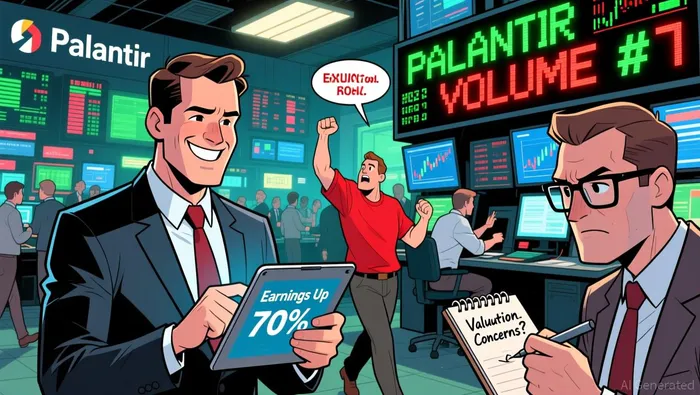
Palantir reported third-quarter revenue of $1.18 billion, a 63% year-over-year increase, with net income rising 40% to $475.6 million. U.S. commercial revenue surged 121% to $397 million, while government revenue grew 52% to $486 million. The company closed 204 deals exceeding $1 million, including 53 deals over $10 million, and signed $2.76 billion in total contracts. Despite these record results, the stock fell 14% post-earnings, driven by concerns over its valuation multiples. Analysts cited a price-to-sales ratio of 137, significantly higher than the industry average of 8.8 for application software companies, and a price-to-earnings ratio of 623. These metrics raised questions about whether the stock was priced for perfection, with investors fearing a potential correction if growth slows.
Growth Sustainability and Analyst Caution
Analysts highlighted risks to Palantir’s long-term growth trajectory. Freedom Capital Markets analyst Almas Almaganbetov raised his price target to $170 from $125 but maintained a “Sell” rating, warning that U.S. commercial growth could normalize after an exceptional year. Government and defense budgets, which drive a significant portion of Palantir’s revenue, may tighten, and ongoing hiring for AI talent could pressure profit margins. The stock’s forward price-to-sales ratio of 103, based on 2025 revenue guidance, further underscored the premium investors were paying for future performance. Almaganbetov argued that the current valuation left little room for disappointment, creating downside risk if growth decelerates.
CEO Defiance and Market Sentiment
CEO Alex Karp defended the company’s valuation in his shareholder letter, dismissing critics as “left in a kind of deranged and self-destructive befuddlement.” He emphasized Palantir’s role in national security and enterprise AI adoption, arguing the company is still early in a massive growth cycle. Karp’s bold stance galvanized retail investors but drew skepticism from institutions. Meanwhile, investor Michael Burry’s $9.2 million put position against Palantir intensified bearish sentiment, contributing to recent volatility. Despite the pullback, Palantir remains a top-performing stock year-to-date, up 127%, fueled by rising defense spending and AI software demand.
Institutional and Retail Investor Dynamics
Institutional ownership of Palantir remains around 45–46%, with notable additions from hedge fund managers like Israel Englander (Millennium Management) and Cliff Asness (AQR Capital). However, some funds trimmed large positions to book profits, reflecting mixed institutional sentiment. Retail investors, meanwhile, continue to support the stock, driven by Karp’s aggressive messaging and the company’s high-profile AI platform. The stock’s adjusted operating margin of 51% and record deal activity suggest strong operational execution, but analysts caution that macroeconomic factors, including rising bond yields and reduced expectations for Fed rate cuts, could weigh on high-valuation tech stocks.
Broader Market Pressures
Palantir’s selloff occurred amid broader tech sector weakness, as investors rotated out of high-multiple stocks. The company’s artificial intelligence platform, launched in mid-2023, has driven much of its recent success but also exposed it to AI bubble fears. Analysts noted that while Palantir’s fundamentals remain robust, the market’s focus has shifted to valuation and macroeconomic risks. The absence of a U.S. stock split for Nasdaq-listed shares further contributed to uncertainty, as Canadian depositary receipts (CDRs) underwent a 4-for-1 split. With Wall Street analysts divided—11 “Hold” ratings, three “Buys,” and two “Sells”—the stock remains a polarizing investment, balancing high growth potential against significant downside risks.

Stay ahead of the market.
Get curated U.S. market news, insights and key dates delivered to your inbox.
AInvest
PRO
AInvest
PRO



Comments
No comments yet